

converted into acetal groups to protect them before performing other
reactions on different groups in the
molecule. See also ketals.
A
• Information about IUPAC nomenclature
acetamide See ethanamide.
acetanilide A white crystalline primary amide of ethanoic acid,
CH 3 CONHC 6 H 5 ; r.d. 1.2; m.p. 114.3°C;
b.p. 304°C. It is made by reacting
phenylamine (aniline) with excess
ethanoic acid or ethanoic anhydride
and is used in the manufacture of
dyestuffs and rubber. The full systematic name is N-phenylethanamide.
acetate See ethanoate.
acetate process See rayon.
acetic acid See ethanoic acid.
acetic anhydride See ethanoic
anhydride.
acetoacetic acid See 3-oxobutanoic acid.
acetoacetic ester See ethyl 3oxobutanoate.
acetone See propanone.
acetone–chlor–haemin test
(Wagenaar test) A *presumptive test
for blood in which a small amount of
acetone (propenal) is added to the
bloodstain, followed by a drop of hydrochloric acid. Haemoglobin produces derivatives such as haematin
and haemin, forming small characteristic crystals that can be identiÜed
under a microscope.
acetonitrile See ethanenitrile.
acetophenone See phenyl methyl
ketone.
acetylacetonato The ion
(CH 3 COCHCOCH 3 )
– , functioning as a
bidentate ligand coordinating
through the two oxygen atoms. In
formulae, the symbol acac is used.
acetylating agent See ethanoylating agent.
acetylation See acylation.
acetyl chloride See ethanoyl
chloride.
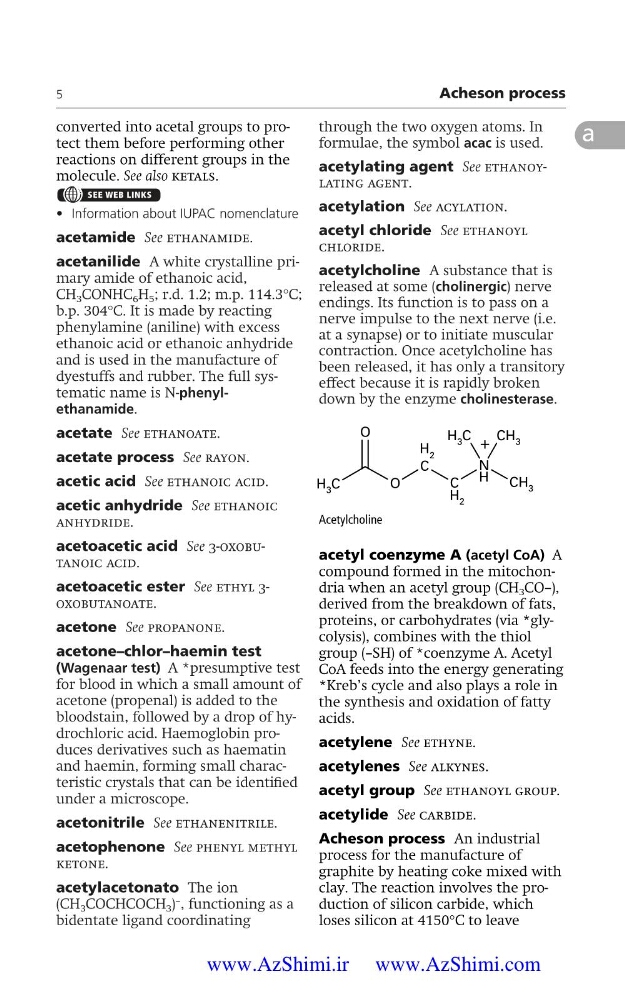
acetylcholine A substance that is
released at some (cholinergic) nerve
endings. Its function is to pass on a
nerve impulse to the next nerve (i.e.
at a synapse) or to initiate muscular
contraction. Once acetylcholine has
been released, it has only a transitory
effect because it is rapidly broken
down by the enzyme cholinesterase.
5
Acheson process
a
C
H 3
O
C
H 2
C
H 2
N
H CH 3
O
C
H 3
CH 3
+
Acetylcholine
acetyl coenzyme A (acetyl CoA) A
compound formed in the mitochondria when an acetyl group (CH 3 CO–),
derived from the breakdown of fats,
proteins, or carbohydrates (via *glycolysis), combines with the thiol
group (–SH) of *coenzyme A. Acetyl
CoA feeds into the energy generating
*Kreb’s cycle and also plays a role in
the synthesis and oxidation of fatty
acids.
acetylene See ethyne.
acetylenes See alkynes.
acetyl group See ethanoyl group.
acetylide See carbide.
Acheson process An industrial
process for the manufacture of
graphite by heating coke mixed with
clay. The reaction involves the production of silicon carbide, which
loses silicon at 4150°C to leave
www.AzShimi.ir www.AzShimi.com
reactions on different groups in the
molecule. See also ketals.
A
• Information about IUPAC nomenclature
acetamide See ethanamide.
acetanilide A white crystalline primary amide of ethanoic acid,
CH 3 CONHC 6 H 5 ; r.d. 1.2; m.p. 114.3°C;
b.p. 304°C. It is made by reacting
phenylamine (aniline) with excess
ethanoic acid or ethanoic anhydride
and is used in the manufacture of
dyestuffs and rubber. The full systematic name is N-phenylethanamide.
acetate See ethanoate.
acetate process See rayon.
acetic acid See ethanoic acid.
acetic anhydride See ethanoic
anhydride.
acetoacetic acid See 3-oxobutanoic acid.
acetoacetic ester See ethyl 3oxobutanoate.
acetone See propanone.
acetone–chlor–haemin test
(Wagenaar test) A *presumptive test
for blood in which a small amount of
acetone (propenal) is added to the
bloodstain, followed by a drop of hydrochloric acid. Haemoglobin produces derivatives such as haematin
and haemin, forming small characteristic crystals that can be identiÜed
under a microscope.
acetonitrile See ethanenitrile.
acetophenone See phenyl methyl
ketone.
acetylacetonato The ion
(CH 3 COCHCOCH 3 )
– , functioning as a
bidentate ligand coordinating
through the two oxygen atoms. In
formulae, the symbol acac is used.
acetylating agent See ethanoylating agent.
acetylation See acylation.
acetyl chloride See ethanoyl
chloride.
acetylcholine A substance that is
released at some (cholinergic) nerve
endings. Its function is to pass on a
nerve impulse to the next nerve (i.e.
at a synapse) or to initiate muscular
contraction. Once acetylcholine has
been released, it has only a transitory
effect because it is rapidly broken
down by the enzyme cholinesterase.
5
Acheson process
a
C
H 3
O
C
H 2
C
H 2
N
H CH 3
O
C
H 3
CH 3
+
Acetylcholine
acetyl coenzyme A (acetyl CoA) A
compound formed in the mitochondria when an acetyl group (CH 3 CO–),
derived from the breakdown of fats,
proteins, or carbohydrates (via *glycolysis), combines with the thiol
group (–SH) of *coenzyme A. Acetyl
CoA feeds into the energy generating
*Kreb’s cycle and also plays a role in
the synthesis and oxidation of fatty
acids.
acetylene See ethyne.
acetylenes See alkynes.
acetyl group See ethanoyl group.
acetylide See carbide.
Acheson process An industrial
process for the manufacture of
graphite by heating coke mixed with
clay. The reaction involves the production of silicon carbide, which
loses silicon at 4150°C to leave
www.AzShimi.ir www.AzShimi.com