

chains of atoms in chemical compounds. 2. The formation of a *catenane compound by mechanical
bonding.
cathetometer A telescope or
microscope Ütted with crosswires in
the eyepiece and mounted so that it
can slide along a graduated scale.
Cathetometers are used for accurate
measurement of lengths without mechanical contact. The microscope
type is often called a travelling microscope.
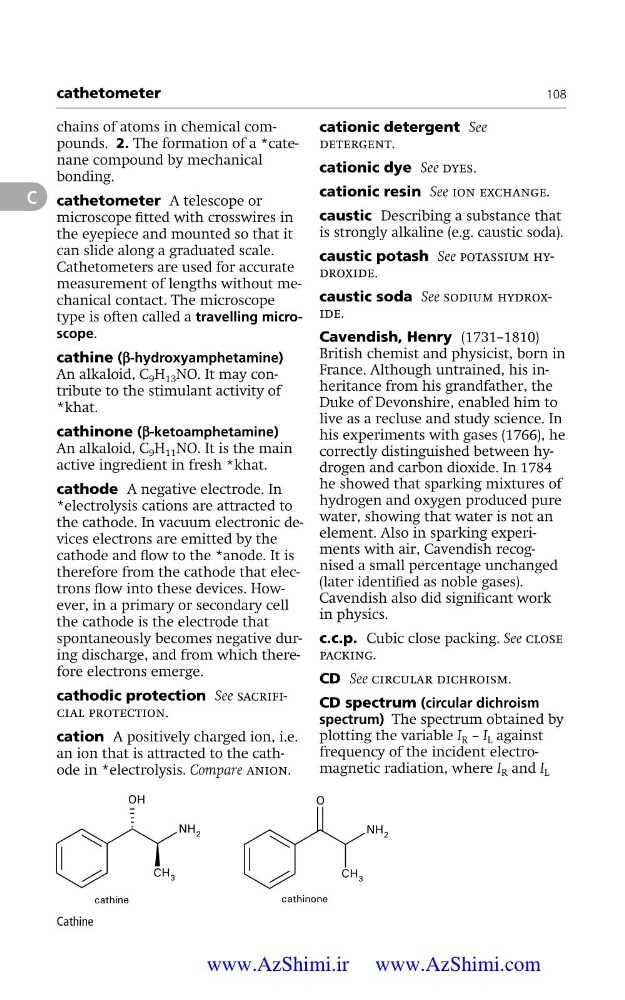
cathine (β-hydroxyamphetamine)
An alkaloid, C 9 H 13 NO. It may contribute to the stimulant activity of
*khat.
cathinone (β-ketoamphetamine)
An alkaloid, C 9 H 11 NO. It is the main
active ingredient in fresh *khat.
cathode A negative electrode. In
*electrolysis cations are attracted to
the cathode. In vacuum electronic devices electrons are emitted by the
cathode and Ûow to the *anode. It is
therefore from the cathode that electrons Ûow into these devices. However, in a primary or secondary cell
the cathode is the electrode that
spontaneously becomes negative during discharge, and from which therefore electrons emerge.
cathodic protection See sacrificial protection.
cation A positively charged ion, i.e.
an ion that is attracted to the cathode in *electrolysis. Compare anion.
cationic detergent See
detergent.
cationic dye See dyes.
cationic resin See ion exchange.
caustic Describing a substance that
is strongly alkaline (e.g. caustic soda).
caustic potash See potassium hydroxide.
caustic soda See sodium hydroxide.
Cavendish, Henry (1731–1810)
British chemist and physicist, born in
France. Although untrained, his inheritance from his grandfather, the
Duke of Devonshire, enabled him to
live as a recluse and study science. In
his experiments with gases (1766), he
correctly distinguished between hydrogen and carbon dioxide. In 1784
he showed that sparking mixtures of
hydrogen and oxygen produced pure
water, showing that water is not an
element. Also in sparking experiments with air, Cavendish recognised a small percentage unchanged
(later identiÜed as noble gases).
Cavendish also did signiÜcant work
in physics.
c.c.p. Cubic close packing. See close
packing.
CD See circular dichroism.
CD spectrum (circular dichroism
spectrum) The spectrum obtained by
plotting the variable I R – I L against
frequency of the incident electromagnetic radiation, where I R and I L
cathetometer
108
c
0*
1*
%*
0*
1
%*
ECVJKPG
ECVJKPQPG
Cathine
www.AzShimi.ir www.AzShimi.com
bonding.
cathetometer A telescope or
microscope Ütted with crosswires in
the eyepiece and mounted so that it
can slide along a graduated scale.
Cathetometers are used for accurate
measurement of lengths without mechanical contact. The microscope
type is often called a travelling microscope.
cathine (β-hydroxyamphetamine)
An alkaloid, C 9 H 13 NO. It may contribute to the stimulant activity of
*khat.
cathinone (β-ketoamphetamine)
An alkaloid, C 9 H 11 NO. It is the main
active ingredient in fresh *khat.
cathode A negative electrode. In
*electrolysis cations are attracted to
the cathode. In vacuum electronic devices electrons are emitted by the
cathode and Ûow to the *anode. It is
therefore from the cathode that electrons Ûow into these devices. However, in a primary or secondary cell
the cathode is the electrode that
spontaneously becomes negative during discharge, and from which therefore electrons emerge.
cathodic protection See sacrificial protection.
cation A positively charged ion, i.e.
an ion that is attracted to the cathode in *electrolysis. Compare anion.
cationic detergent See
detergent.
cationic dye See dyes.
cationic resin See ion exchange.
caustic Describing a substance that
is strongly alkaline (e.g. caustic soda).
caustic potash See potassium hydroxide.
caustic soda See sodium hydroxide.
Cavendish, Henry (1731–1810)
British chemist and physicist, born in
France. Although untrained, his inheritance from his grandfather, the
Duke of Devonshire, enabled him to
live as a recluse and study science. In
his experiments with gases (1766), he
correctly distinguished between hydrogen and carbon dioxide. In 1784
he showed that sparking mixtures of
hydrogen and oxygen produced pure
water, showing that water is not an
element. Also in sparking experiments with air, Cavendish recognised a small percentage unchanged
(later identiÜed as noble gases).
Cavendish also did signiÜcant work
in physics.
c.c.p. Cubic close packing. See close
packing.
CD See circular dichroism.
CD spectrum (circular dichroism
spectrum) The spectrum obtained by
plotting the variable I R – I L against
frequency of the incident electromagnetic radiation, where I R and I L
cathetometer
108
c
0*
1*
%*
0*
1
%*
ECVJKPG
ECVJKPQPG
Cathine
www.AzShimi.ir www.AzShimi.com