

A method of estimating the ages of
archaeological specimens of biological origin. As a result of cosmic radiation a small number of atmospheric
nitrogen nuclei are continuously
being transformed by neutron bombardment into radioactive nuclei of
carbon–14:
14
7 N + n →
14
6 C + p
Some of these radiocarbon atoms
Ünd their way into living trees and
other plants in the form of carbon
dioxide, as a result of photosynthesis.
When the tree is cut down photosynthesis stops and the ratio of radiocarbon atoms to stable carbon atoms
begins to fall as the radiocarbon decays. The ratio
14 C/
12 C in the specimen can be measured and enables
the time that has elapsed since the
tree was cut down to be calculated.
The method has been shown to give
consistent results for specimens up
to some 40 000 years old, though its
accuracy depends upon assumptions
concerning the past intensity of the
cosmic radiation. The technique was
developed by Willard F. Libby
(1908–80) and his coworkers in
1946–47.
carbon dioxide A colourless
odourless gas, CO 2 , soluble in water,
ethanol, and acetone; d. 1.977 g dm
–3
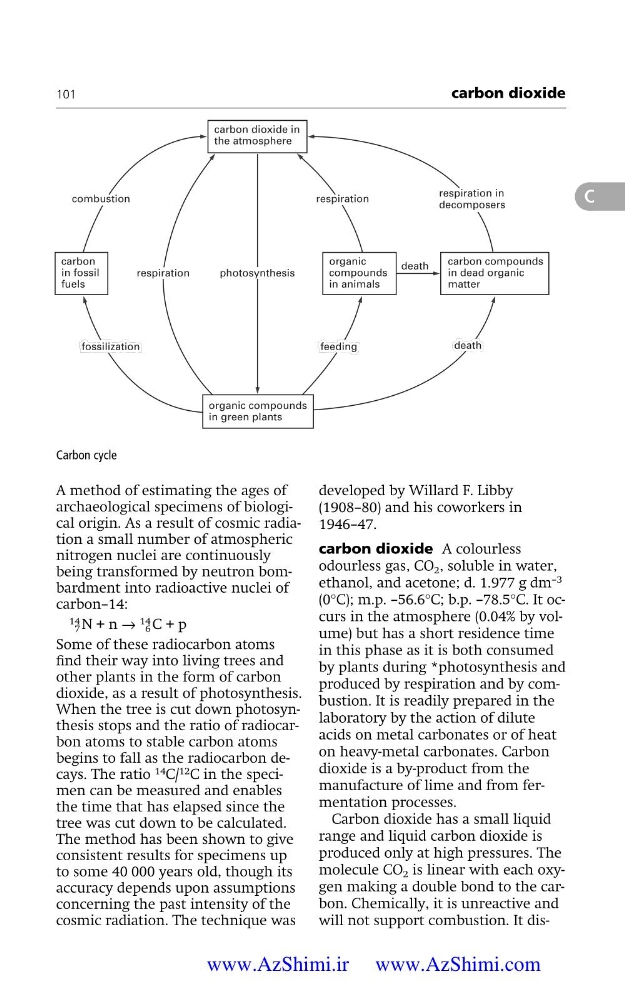
(0°C); m.p. –56.6°C; b.p. –78.5°C. It occurs in the atmosphere (0.04% by volume) but has a short residence time
in this phase as it is both consumed
by plants during *photosynthesis and
produced by respiration and by combustion. It is readily prepared in the
laboratory by the action of dilute
acids on metal carbonates or of heat
on heavy-metal carbonates. Carbon
dioxide is a by-product from the
manufacture of lime and from fermentation processes.
Carbon dioxide has a small liquid
range and liquid carbon dioxide is
produced only at high pressures. The
molecule CO 2 is linear with each oxygen making a double bond to the carbon. Chemically, it is unreactive and
will not support combustion. It dis101
carbon dioxide
c
carbon dioxide in
the atmosphere
combustion
respiration
respiration in
decomposers
respiration
photosynthesis
organic
compounds
in animals
carbon compounds
in dead organic
matter
death
death death death
organic compounds
in green plants
fossilization fossilization fossilization
feeding feeding feeding
carbon
in fossil
fuels
Carbon cycle
www.AzShimi.ir www.AzShimi.com
archaeological specimens of biological origin. As a result of cosmic radiation a small number of atmospheric
nitrogen nuclei are continuously
being transformed by neutron bombardment into radioactive nuclei of
carbon–14:
14
7 N + n →
14
6 C + p
Some of these radiocarbon atoms
Ünd their way into living trees and
other plants in the form of carbon
dioxide, as a result of photosynthesis.
When the tree is cut down photosynthesis stops and the ratio of radiocarbon atoms to stable carbon atoms
begins to fall as the radiocarbon decays. The ratio
14 C/
12 C in the specimen can be measured and enables
the time that has elapsed since the
tree was cut down to be calculated.
The method has been shown to give
consistent results for specimens up
to some 40 000 years old, though its
accuracy depends upon assumptions
concerning the past intensity of the
cosmic radiation. The technique was
developed by Willard F. Libby
(1908–80) and his coworkers in
1946–47.
carbon dioxide A colourless
odourless gas, CO 2 , soluble in water,
ethanol, and acetone; d. 1.977 g dm
–3
(0°C); m.p. –56.6°C; b.p. –78.5°C. It occurs in the atmosphere (0.04% by volume) but has a short residence time
in this phase as it is both consumed
by plants during *photosynthesis and
produced by respiration and by combustion. It is readily prepared in the
laboratory by the action of dilute
acids on metal carbonates or of heat
on heavy-metal carbonates. Carbon
dioxide is a by-product from the
manufacture of lime and from fermentation processes.
Carbon dioxide has a small liquid
range and liquid carbon dioxide is
produced only at high pressures. The
molecule CO 2 is linear with each oxygen making a double bond to the carbon. Chemically, it is unreactive and
will not support combustion. It dis101
carbon dioxide
c
carbon dioxide in
the atmosphere
combustion
respiration
respiration in
decomposers
respiration
photosynthesis
organic
compounds
in animals
carbon compounds
in dead organic
matter
death
death death death
organic compounds
in green plants
fossilization fossilization fossilization
feeding feeding feeding
carbon
in fossil
fuels
Carbon cycle
www.AzShimi.ir www.AzShimi.com