

Copyright © Glencoe/McGraw-Hill, a division of The McGraw-Hill Companies, Inc.
88 Chemistry: Matter and Change
Solving Problems: A Chemistry Handbook
SOLVING PROBLEMS:
A CHEMISTRY HANDBOOK
CHAPTER 9
particles that participate in a reaction is called a net ionic equation.
In the case of the reaction above, the net ionic equation from which
the sodium and nitrate ions have been removed is as follows.
Cl Ϫ (aq) ϩ Ag ϩ (aq) 0 AgCl(s)
Example Problem 9-4
Writing Ionic Equations
Write the balanced chemical equation for the reaction between aqueous solutions of strontium nitrate and potassium sulfate, which
forms the precipitate strontium sulfate. Then write the complete
ionic and net ionic equations.
Write the correct skeleton equation.
Sr(NO 3 ) 2 (aq) ϩ K 2 SO 4 (aq) 0 KNO 3 (aq) ϩ SrSO 4 (s)
Use coefficients to produce the balanced chemical equation.
Sr(NO 3 ) 2 (aq) ϩ K 2 SO 4 (aq) 0 2KNO 3 (aq) ϩ SrSO 4 (s)
Write the complete ionic equation.
Sr 2ϩ (aq) ϩ 2NO 3
Ϫ (aq) ϩ 2K ϩ (aq) ϩ SO 4
2Ϫ (aq) 0
2K ϩ (aq) ϩ 2NO 3
Ϫ (aq) ϩ SrSO 4 (s)
Cross out the spectator ions, which are those that are on both sides
of the equation.
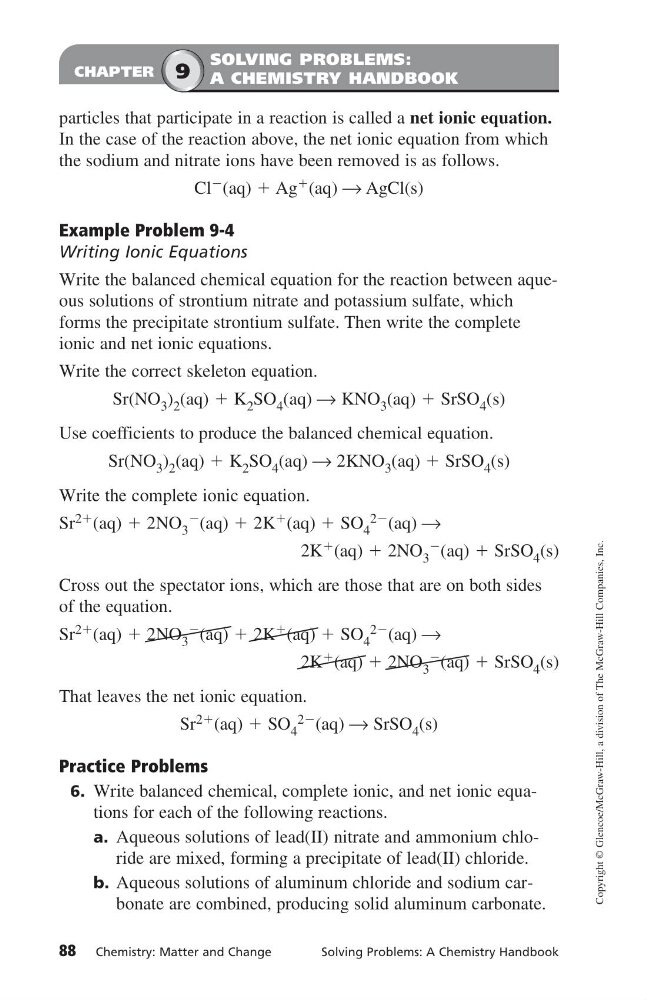
Sr 2ϩ (aq) ϩ 2NO 3
Ϫ (aq) ϩ 2K ϩ (aq) ϩ SO 4
2Ϫ (aq) 0
2K ϩ (aq) ϩ 2NO 3
Ϫ (aq) ϩ SrSO 4 (s)
That leaves the net ionic equation.
Sr 2ϩ (aq) ϩ SO 4
2Ϫ (aq) 0 SrSO 4 (s)
Practice Problems
6. Write balanced chemical, complete ionic, and net ionic equations for each of the following reactions.
a. Aqueous solutions of lead(II) nitrate and ammonium chloride are mixed, forming a precipitate of lead(II) chloride.
b. Aqueous solutions of aluminum chloride and sodium carbonate are combined, producing solid aluminum carbonate.
88 Chemistry: Matter and Change
Solving Problems: A Chemistry Handbook
SOLVING PROBLEMS:
A CHEMISTRY HANDBOOK
CHAPTER 9
particles that participate in a reaction is called a net ionic equation.
In the case of the reaction above, the net ionic equation from which
the sodium and nitrate ions have been removed is as follows.
Cl Ϫ (aq) ϩ Ag ϩ (aq) 0 AgCl(s)
Example Problem 9-4
Writing Ionic Equations
Write the balanced chemical equation for the reaction between aqueous solutions of strontium nitrate and potassium sulfate, which
forms the precipitate strontium sulfate. Then write the complete
ionic and net ionic equations.
Write the correct skeleton equation.
Sr(NO 3 ) 2 (aq) ϩ K 2 SO 4 (aq) 0 KNO 3 (aq) ϩ SrSO 4 (s)
Use coefficients to produce the balanced chemical equation.
Sr(NO 3 ) 2 (aq) ϩ K 2 SO 4 (aq) 0 2KNO 3 (aq) ϩ SrSO 4 (s)
Write the complete ionic equation.
Sr 2ϩ (aq) ϩ 2NO 3
Ϫ (aq) ϩ 2K ϩ (aq) ϩ SO 4
2Ϫ (aq) 0
2K ϩ (aq) ϩ 2NO 3
Ϫ (aq) ϩ SrSO 4 (s)
Cross out the spectator ions, which are those that are on both sides
of the equation.
Sr 2ϩ (aq) ϩ 2NO 3
Ϫ (aq) ϩ 2K ϩ (aq) ϩ SO 4
2Ϫ (aq) 0
2K ϩ (aq) ϩ 2NO 3
Ϫ (aq) ϩ SrSO 4 (s)
That leaves the net ionic equation.
Sr 2ϩ (aq) ϩ SO 4
2Ϫ (aq) 0 SrSO 4 (s)
Practice Problems
6. Write balanced chemical, complete ionic, and net ionic equations for each of the following reactions.
a. Aqueous solutions of lead(II) nitrate and ammonium chloride are mixed, forming a precipitate of lead(II) chloride.
b. Aqueous solutions of aluminum chloride and sodium carbonate are combined, producing solid aluminum carbonate.