

Copyright © Glencoe/McGraw-Hill, a division of The McGraw-Hill Companies, Inc.
Solving Problems: A Chemistry Handbook
Chemistry: Matter and Change
77
SOLVING PROBLEMS:
A CHEMISTRY HANDBOOK
CHAPTER 8
3. Divide the number of total available electrons by 2 to
find the number of bonding pairs:
a. 26/2 ϭ 13
b. 32/2 ϭ 16
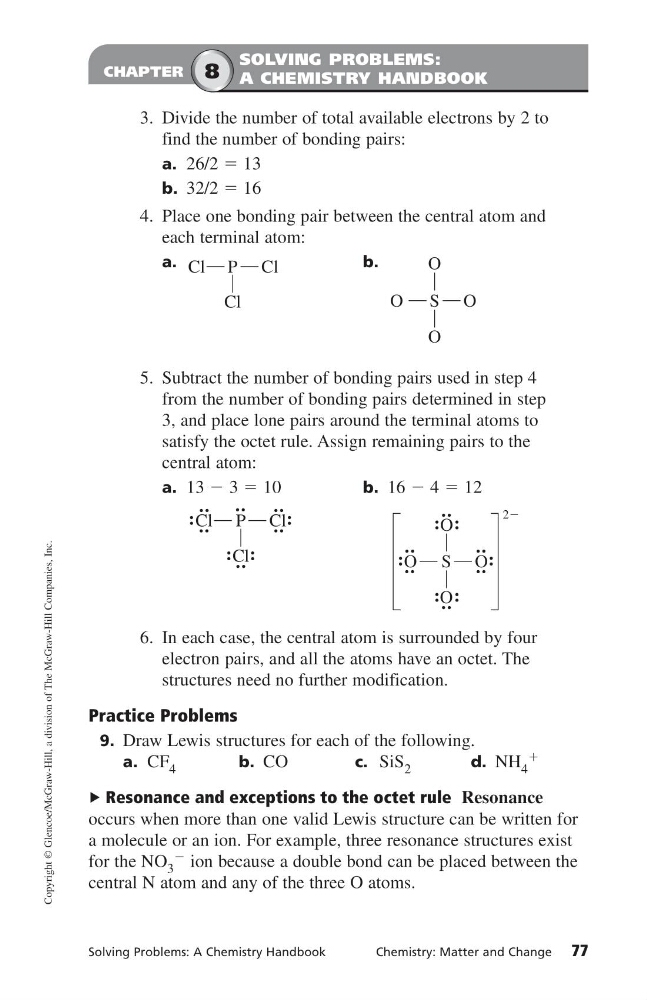
4. Place one bonding pair between the central atom and
each terminal atom:
a.
b.
5. Subtract the number of bonding pairs used in step 4
from the number of bonding pairs determined in step
3, and place lone pairs around the terminal atoms to
satisfy the octet rule. Assign remaining pairs to the
central atom:
a. 13 Ϫ 3 ϭ 10
b. 16 Ϫ 4 ϭ 12
6. In each case, the central atom is surrounded by four
electron pairs, and all the atoms have an octet. The
structures need no further modification.
Practice Problems
9. Draw Lewis structures for each of the following.
a. CF 4
b. CO
c. SiS 2
d. NH 4
ϩ
Resonance and exceptions to the octet rule Resonance
occurs when more than one valid Lewis structure can be written for
a molecule or an ion. For example, three resonance structures exist
for the NO 3
Ϫ ion because a double bond can be placed between the
central N atom and any of the three O atoms.
▲
O
O
2Ϫ
S
O
O
Cl
Cl
P
Cl
O
O
S
O
O
Cl
Cl
P
Cl
Solving Problems: A Chemistry Handbook
Chemistry: Matter and Change
77
SOLVING PROBLEMS:
A CHEMISTRY HANDBOOK
CHAPTER 8
3. Divide the number of total available electrons by 2 to
find the number of bonding pairs:
a. 26/2 ϭ 13
b. 32/2 ϭ 16
4. Place one bonding pair between the central atom and
each terminal atom:
a.
b.
5. Subtract the number of bonding pairs used in step 4
from the number of bonding pairs determined in step
3, and place lone pairs around the terminal atoms to
satisfy the octet rule. Assign remaining pairs to the
central atom:
a. 13 Ϫ 3 ϭ 10
b. 16 Ϫ 4 ϭ 12
6. In each case, the central atom is surrounded by four
electron pairs, and all the atoms have an octet. The
structures need no further modification.
Practice Problems
9. Draw Lewis structures for each of the following.
a. CF 4
b. CO
c. SiS 2
d. NH 4
ϩ
Resonance and exceptions to the octet rule Resonance
occurs when more than one valid Lewis structure can be written for
a molecule or an ion. For example, three resonance structures exist
for the NO 3
Ϫ ion because a double bond can be placed between the
central N atom and any of the three O atoms.
▲
O
O
2Ϫ
S
O
O
Cl
Cl
P
Cl
O
O
S
O
O
Cl
Cl
P
Cl