

Copyright © Glencoe/McGraw-Hill, a division of The McGraw-Hill Companies, Inc.
Solving Problems: A Chemistry Handbook
Chemistry: Matter and Change
71
Covalent Bonding
Covalent Bonding
SOLVING PROBLEMS:
A CHEMISTRY HANDBOOK
CHAPTER
8
8.1 The Covalent Bond
Atoms typically bond to achieve the stable configuration of a noble
gas, generally an octet of electrons. Two atoms that both need to gain
valence electrons may share them in a bond called a covalent bond.
When two or more atoms bond covalently, a molecule is formed. In
the formation of a covalent bond, the atoms move close enough so
that the repulsive forces due to like-charged particles are balanced by
the attractive forces between oppositely charged particles.
Pairs of electrons involved in forming covalent bonds are called
bonding pairs. When a single pair of electrons is shared, a single
covalent bond results. Remaining pairs of electrons not involved in
bonding are called lone pairs. The arrangement of electrons in molecules can be illustrated by Lewis structures, which use electron-dot
diagrams. In such diagrams, shared electron pairs are represented as
a pair of dots or a line.
Example Problem 8-1
Drawing a Lewis Structure for a Molecule
What is the Lewis structure for a molecule of the covalently bonded
compound nitrogen triiodide (NI 3 ), given that all the bonds are
single? State how many single covalent bonds there are and how
many lone pairs each bonded atom has.
As a group 15 element, nitrogen has five valence electrons and
therefore requires three more electrons to achieve a complete octet.
It must form three covalent bonds to do so. Iodine, a group 17 element, has seven valence electrons and needs one more electron to
achieve a complete octet. It must form only one bond to do so. The
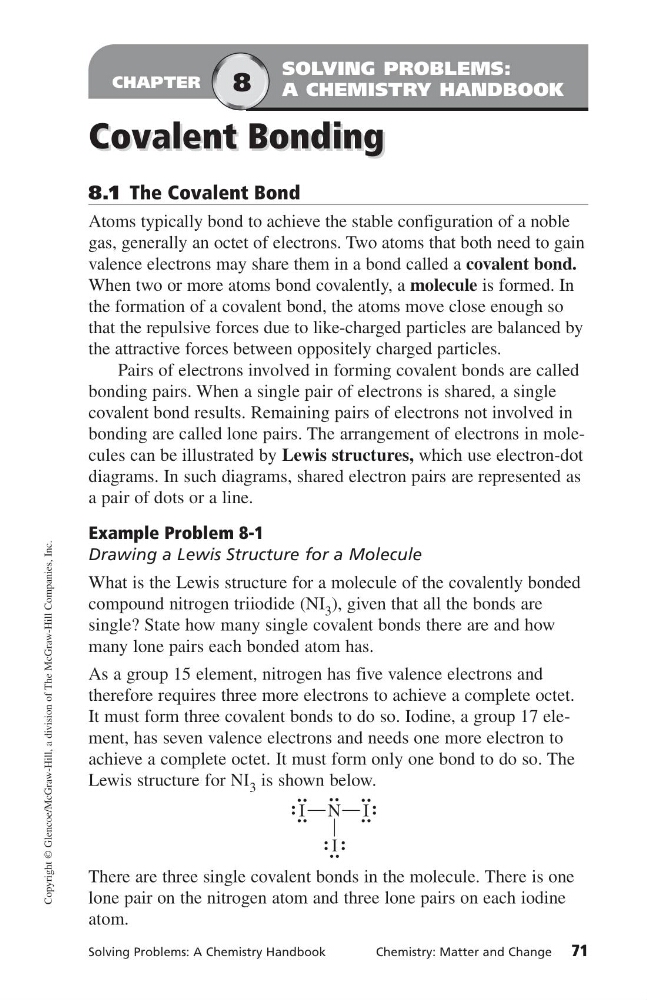
Lewis structure for NI 3 is shown below.
There are three single covalent bonds in the molecule. There is one
lone pair on the nitrogen atom and three lone pairs on each iodine
atom.
I
I
N
I
Solving Problems: A Chemistry Handbook
Chemistry: Matter and Change
71
Covalent Bonding
Covalent Bonding
SOLVING PROBLEMS:
A CHEMISTRY HANDBOOK
CHAPTER
8
8.1 The Covalent Bond
Atoms typically bond to achieve the stable configuration of a noble
gas, generally an octet of electrons. Two atoms that both need to gain
valence electrons may share them in a bond called a covalent bond.
When two or more atoms bond covalently, a molecule is formed. In
the formation of a covalent bond, the atoms move close enough so
that the repulsive forces due to like-charged particles are balanced by
the attractive forces between oppositely charged particles.
Pairs of electrons involved in forming covalent bonds are called
bonding pairs. When a single pair of electrons is shared, a single
covalent bond results. Remaining pairs of electrons not involved in
bonding are called lone pairs. The arrangement of electrons in molecules can be illustrated by Lewis structures, which use electron-dot
diagrams. In such diagrams, shared electron pairs are represented as
a pair of dots or a line.
Example Problem 8-1
Drawing a Lewis Structure for a Molecule
What is the Lewis structure for a molecule of the covalently bonded
compound nitrogen triiodide (NI 3 ), given that all the bonds are
single? State how many single covalent bonds there are and how
many lone pairs each bonded atom has.
As a group 15 element, nitrogen has five valence electrons and
therefore requires three more electrons to achieve a complete octet.
It must form three covalent bonds to do so. Iodine, a group 17 element, has seven valence electrons and needs one more electron to
achieve a complete octet. It must form only one bond to do so. The
Lewis structure for NI 3 is shown below.
There are three single covalent bonds in the molecule. There is one
lone pair on the nitrogen atom and three lone pairs on each iodine
atom.
I
I
N
I