

Copyright © Glencoe/McGraw-Hill, a division of The McGraw-Hill Companies, Inc.
40 Chemistry: Matter and Change
Solving Problems: A Chemistry Handbook
SOLVING PROBLEMS:
A CHEMISTRY HANDBOOK
CHAPTER 4
The third type of radiation is gamma radiation (␥-radiation),
which is high-energy electromagnetic radiation. Gamma radiation is
usually emitted along with ␣-particles and -particles.
Chapter 4 Review
15. Why were Dalton’s ideas about atoms considered a scientific
theory, whereas the ideas of ancient Greek philosophers
were not?
16. Why was the discovery of the electron considered evidence for
the existence of positively charged particles in the atom?
17. What led scientists to conclude that most of the atom’s mass is
concentrated in a very small nucleus? What particles are
responsible for that mass?
18. Explain the relationship between the number of protons and the
number of electrons in an atom of argon.
19. Can atoms of two different elements have the same number of
protons? Explain your answer.
20. What particles make up an atom of selenium-80?
21. Explain the meaning of the number printed at the bottom of
each box of the periodic table.
22. Write symbols for the following isotopes.
a. antimony-123
b. silicon-28
c. mercury-199
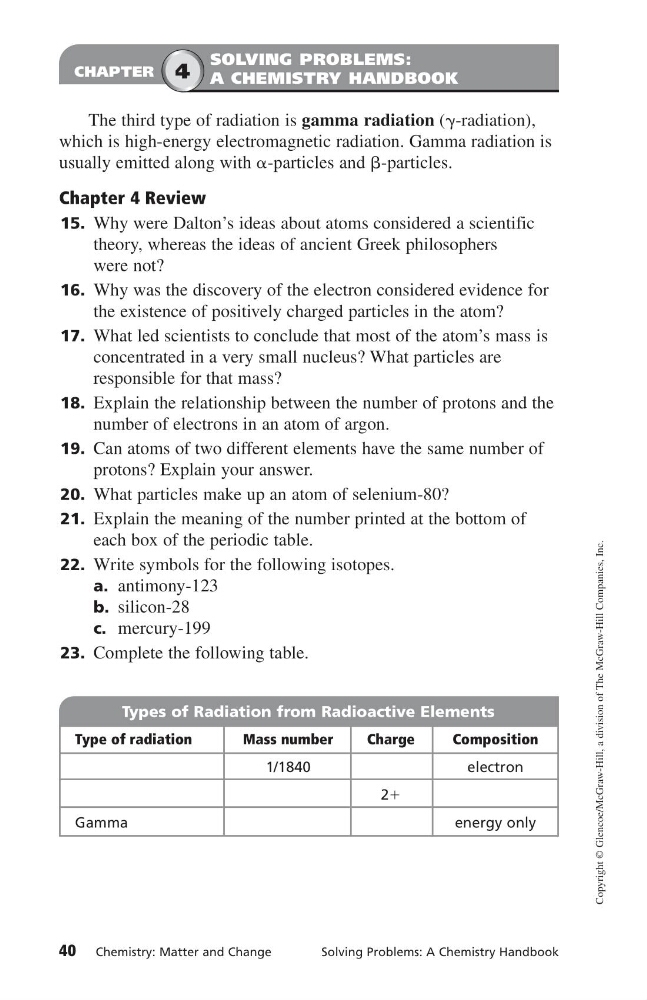
23. Complete the following table.
Types of Radiation from Radioactive Elements
Type of radiation
Mass number
Charge
Composition
1/1840
electron
2ϩ
Gamma
energy only
40 Chemistry: Matter and Change
Solving Problems: A Chemistry Handbook
SOLVING PROBLEMS:
A CHEMISTRY HANDBOOK
CHAPTER 4
The third type of radiation is gamma radiation (␥-radiation),
which is high-energy electromagnetic radiation. Gamma radiation is
usually emitted along with ␣-particles and -particles.
Chapter 4 Review
15. Why were Dalton’s ideas about atoms considered a scientific
theory, whereas the ideas of ancient Greek philosophers
were not?
16. Why was the discovery of the electron considered evidence for
the existence of positively charged particles in the atom?
17. What led scientists to conclude that most of the atom’s mass is
concentrated in a very small nucleus? What particles are
responsible for that mass?
18. Explain the relationship between the number of protons and the
number of electrons in an atom of argon.
19. Can atoms of two different elements have the same number of
protons? Explain your answer.
20. What particles make up an atom of selenium-80?
21. Explain the meaning of the number printed at the bottom of
each box of the periodic table.
22. Write symbols for the following isotopes.
a. antimony-123
b. silicon-28
c. mercury-199
23. Complete the following table.
Types of Radiation from Radioactive Elements
Type of radiation
Mass number
Charge
Composition
1/1840
electron
2ϩ
Gamma
energy only