

Copyright © Glencoe/McGraw-Hill, a division of The McGraw-Hill Companies, Inc.
32 Chemistry: Matter and Change
Solving Problems: A Chemistry Handbook
SOLVING PROBLEMS:
A CHEMISTRY HANDBOOK
CHAPTER 4
Later, in 1909, Robert Millikan accurately determined the mass
of an electron to be 1/1840 the mass of a hydrogen atom. He also
determined the electron’s charge to be 1Ϫ. This value was accepted
as a fundamental unit of electrical charge.
The nucleus of an atom Because atoms have no net electrical
charge, scientists reasoned that if an atom contains particles of negative charge, it must also contain particles of positive charge. In 1911,
Ernest Rutherford conducted experiments in which he aimed a beam
of alpha particles (positively charged helium nuclei) at a thin sheet
of gold. The fact that a few of these heavy particles were deflected
almost directly backwards revealed that the positive charge of an
atom, along with nearly all of the atom’s mass, is concentrated in a
very small region in the center of the atom. This positively charged
mass is called the nucleus of the atom. The particles that make up
the positive charge of the nucleus are called protons, and each has a
charge of 1ϩ (equal to but opposite the charge of an electron).
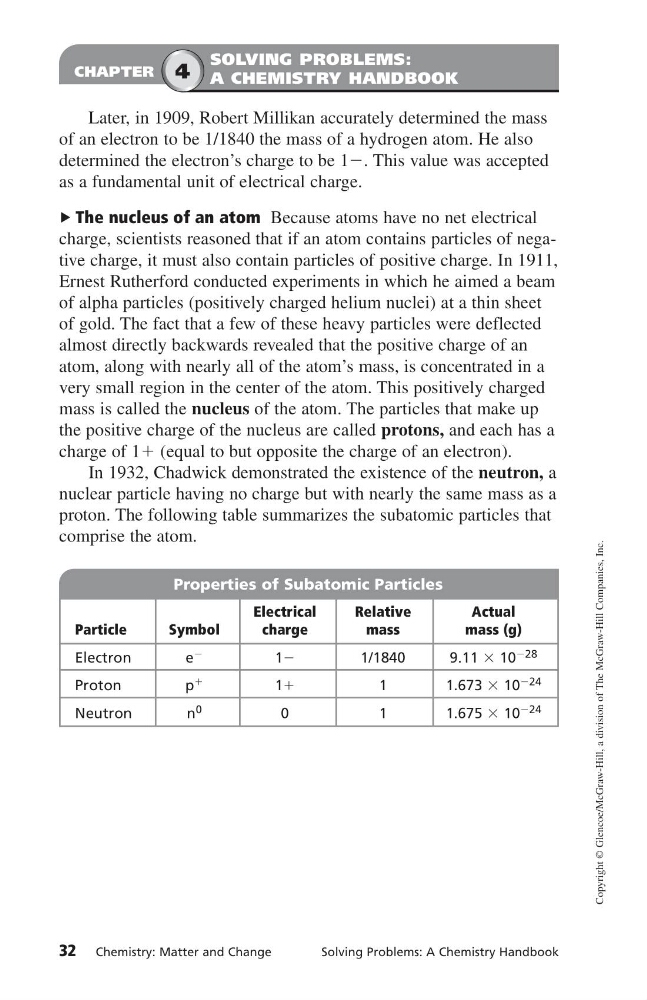
In 1932, Chadwick demonstrated the existence of the neutron, a
nuclear particle having no charge but with nearly the same mass as a
proton. The following table summarizes the subatomic particles that
comprise the atom.
▲
Properties of Subatomic Particles
Electrical
Relative
Actual
Particle
Symbol
charge
mass
mass (g)
Electron
e Ϫ
1Ϫ
1/1840
9.11 ϫ 10 Ϫ28
Proton
p ϩ
1ϩ
1
1.673 ϫ 10 Ϫ24
Neutron
n 0
0
1
1.675 ϫ 10 Ϫ24
32 Chemistry: Matter and Change
Solving Problems: A Chemistry Handbook
SOLVING PROBLEMS:
A CHEMISTRY HANDBOOK
CHAPTER 4
Later, in 1909, Robert Millikan accurately determined the mass
of an electron to be 1/1840 the mass of a hydrogen atom. He also
determined the electron’s charge to be 1Ϫ. This value was accepted
as a fundamental unit of electrical charge.
The nucleus of an atom Because atoms have no net electrical
charge, scientists reasoned that if an atom contains particles of negative charge, it must also contain particles of positive charge. In 1911,
Ernest Rutherford conducted experiments in which he aimed a beam
of alpha particles (positively charged helium nuclei) at a thin sheet
of gold. The fact that a few of these heavy particles were deflected
almost directly backwards revealed that the positive charge of an
atom, along with nearly all of the atom’s mass, is concentrated in a
very small region in the center of the atom. This positively charged
mass is called the nucleus of the atom. The particles that make up
the positive charge of the nucleus are called protons, and each has a
charge of 1ϩ (equal to but opposite the charge of an electron).
In 1932, Chadwick demonstrated the existence of the neutron, a
nuclear particle having no charge but with nearly the same mass as a
proton. The following table summarizes the subatomic particles that
comprise the atom.
▲
Properties of Subatomic Particles
Electrical
Relative
Actual
Particle
Symbol
charge
mass
mass (g)
Electron
e Ϫ
1Ϫ
1/1840
9.11 ϫ 10 Ϫ28
Proton
p ϩ
1ϩ
1
1.673 ϫ 10 Ϫ24
Neutron
n 0
0
1
1.675 ϫ 10 Ϫ24