

Copyright © Glencoe/McGraw-Hill, a division of The McGraw-Hill Companies, Inc.
Solving Problems: A Chemistry Handbook
Chemistry: Matter and Change
251
SOLVING PROBLEMS:
A CHEMISTRY HANDBOOK
CHAPTER 24
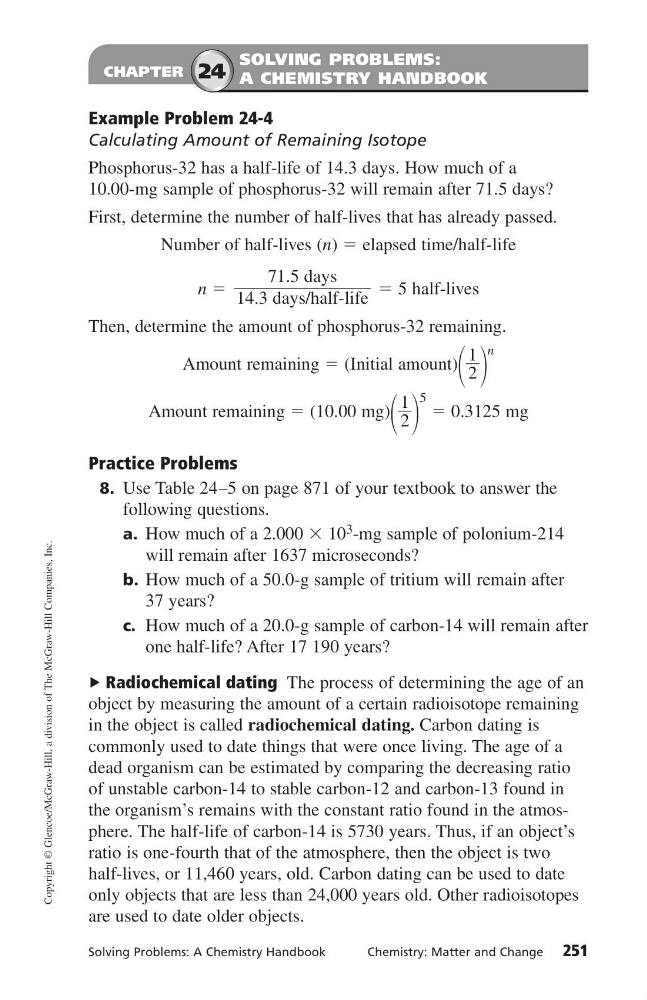
Example Problem 24-4
Calculating Amount of Remaining Isotope
Phosphorus-32 has a half-life of 14.3 days. How much of a
10.00-mg sample of phosphorus-32 will remain after 71.5 days?
First, determine the number of half-lives that has already passed.
Number of half-lives (n) ϭ elapsed time/half-life
n ϭ
ϭ 5 half-lives
Then, determine the amount of phosphorus-32 remaining.
Amount remaining ϭ (Initial amount)
ᎏ
1
2
ᎏ
n
Amount remaining ϭ (10.00 mg)
ᎏ
1
2
ᎏ
5 ϭ 0.3125 mg
Practice Problems
8. Use Table 24–5 on page 871 of your textbook to answer the
following questions.
a. How much of a 2.000 ϫ 10 3 -mg sample of polonium-214
will remain after 1637 microseconds?
b. How much of a 50.0-g sample of tritium will remain after
37 years?
c. How much of a 20.0-g sample of carbon-14 will remain after
one half-life? After 17 190 years?
Radiochemical dating The process of determining the age of an
object by measuring the amount of a certain radioisotope remaining
in the object is called radiochemical dating. Carbon dating is
commonly used to date things that were once living. The age of a
dead organism can be estimated by comparing the decreasing ratio
of unstable carbon-14 to stable carbon-12 and carbon-13 found in
the organism’s remains with the constant ratio found in the atmosphere. The half-life of carbon-14 is 5730 years. Thus, if an object’s
ratio is one-fourth that of the atmosphere, then the object is two
half-lives, or 11,460 years, old. Carbon dating can be used to date
only objects that are less than 24,000 years old. Other radioisotopes
are used to date older objects.
▲
71.5 days
ᎏᎏ
14.3 days/half-life
Solving Problems: A Chemistry Handbook
Chemistry: Matter and Change
251
SOLVING PROBLEMS:
A CHEMISTRY HANDBOOK
CHAPTER 24
Example Problem 24-4
Calculating Amount of Remaining Isotope
Phosphorus-32 has a half-life of 14.3 days. How much of a
10.00-mg sample of phosphorus-32 will remain after 71.5 days?
First, determine the number of half-lives that has already passed.
Number of half-lives (n) ϭ elapsed time/half-life
n ϭ
ϭ 5 half-lives
Then, determine the amount of phosphorus-32 remaining.
Amount remaining ϭ (Initial amount)
ᎏ
1
2
ᎏ
n
Amount remaining ϭ (10.00 mg)
ᎏ
1
2
ᎏ
5 ϭ 0.3125 mg
Practice Problems
8. Use Table 24–5 on page 871 of your textbook to answer the
following questions.
a. How much of a 2.000 ϫ 10 3 -mg sample of polonium-214
will remain after 1637 microseconds?
b. How much of a 50.0-g sample of tritium will remain after
37 years?
c. How much of a 20.0-g sample of carbon-14 will remain after
one half-life? After 17 190 years?
Radiochemical dating The process of determining the age of an
object by measuring the amount of a certain radioisotope remaining
in the object is called radiochemical dating. Carbon dating is
commonly used to date things that were once living. The age of a
dead organism can be estimated by comparing the decreasing ratio
of unstable carbon-14 to stable carbon-12 and carbon-13 found in
the organism’s remains with the constant ratio found in the atmosphere. The half-life of carbon-14 is 5730 years. Thus, if an object’s
ratio is one-fourth that of the atmosphere, then the object is two
half-lives, or 11,460 years, old. Carbon dating can be used to date
only objects that are less than 24,000 years old. Other radioisotopes
are used to date older objects.
▲
71.5 days
ᎏᎏ
14.3 days/half-life