

Copyright © Glencoe/McGraw-Hill, a division of The McGraw-Hill Companies, Inc.
248 Chemistry: Matter and Change
Solving Problems: A Chemistry Handbook
SOLVING PROBLEMS:
A CHEMISTRY HANDBOOK
CHAPTER 24
within the band of stability. All elements with an atomic number
greater than 83 fall outside the band of stability and therefore are
radioactive.
Types of radioactive decay Atoms located above the band of
stability usually have too many neutrons to be stable. Those located
below the band of stability usually have too many protons to be stable. How does the number of neutrons and protons correlate to the
type of decay a radioisotope undergoes? Beta decay decreases the
number of neutrons in a nucleus and increases the stability of neutron-rich atoms by lowering the neutron-to-proton ratio. Alpha decay
reduces the number of neutrons and the number of protons in a
nucleus equally. Thus, the neutron-to-proton ratio does not change.
Nuclei with more than 83 protons need to have both the number of
neutrons and the number of protons reduced in order to become
stable. These very heavy nuclei often undergo alpha decay.
Nuclei with low neutron-to-proton ratios, lying below the band
of stability, are often more stable when the neutron-to-proton ratio
increases. Positron emission and electron capture are two radioactive
processes that increase the neutron-to-proton ratio of a nucleus.
Positron emission is a radioactive decay process that involves
the emission of a positron from a nucleus. A positron is a particle
with the same mass as an electron but with a positive charge ( 0
1 ).
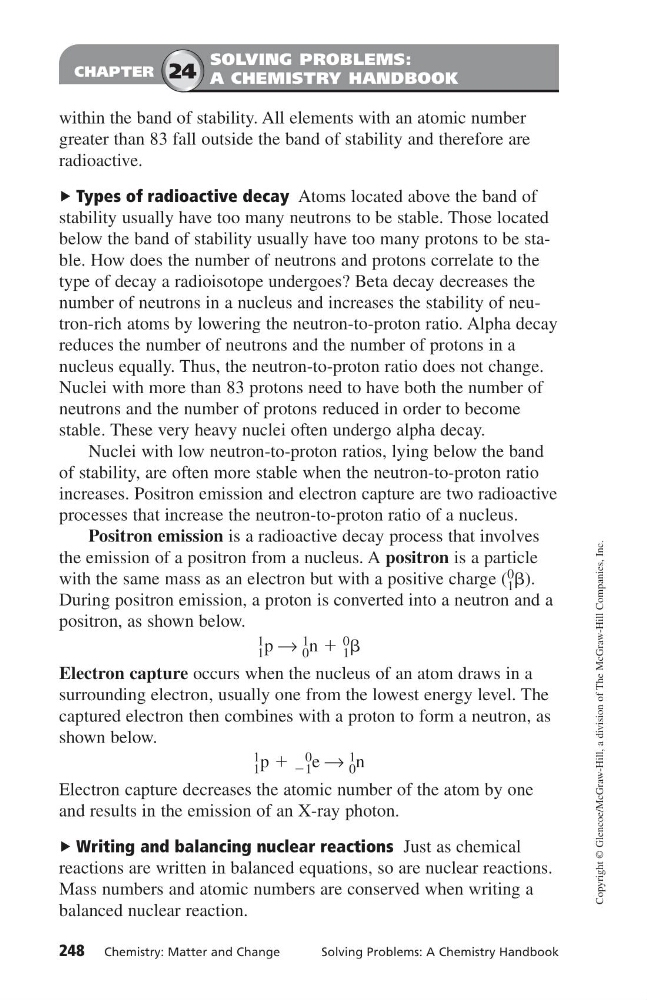
During positron emission, a proton is converted into a neutron and a
positron, as shown below.
1
1 p 0 1
0 n ϩ 0
1 
Electron capture occurs when the nucleus of an atom draws in a
surrounding electron, usually one from the lowest energy level. The
captured electron then combines with a proton to form a neutron, as
shown below.
1
1 p ϩ Ϫ1
0 e 0 1
0 n
Electron capture decreases the atomic number of the atom by one
and results in the emission of an X-ray photon.
Writing and balancing nuclear reactions Just as chemical
reactions are written in balanced equations, so are nuclear reactions.
Mass numbers and atomic numbers are conserved when writing a
balanced nuclear reaction.
▲
▲
248 Chemistry: Matter and Change
Solving Problems: A Chemistry Handbook
SOLVING PROBLEMS:
A CHEMISTRY HANDBOOK
CHAPTER 24
within the band of stability. All elements with an atomic number
greater than 83 fall outside the band of stability and therefore are
radioactive.
Types of radioactive decay Atoms located above the band of
stability usually have too many neutrons to be stable. Those located
below the band of stability usually have too many protons to be stable. How does the number of neutrons and protons correlate to the
type of decay a radioisotope undergoes? Beta decay decreases the
number of neutrons in a nucleus and increases the stability of neutron-rich atoms by lowering the neutron-to-proton ratio. Alpha decay
reduces the number of neutrons and the number of protons in a
nucleus equally. Thus, the neutron-to-proton ratio does not change.
Nuclei with more than 83 protons need to have both the number of
neutrons and the number of protons reduced in order to become
stable. These very heavy nuclei often undergo alpha decay.
Nuclei with low neutron-to-proton ratios, lying below the band
of stability, are often more stable when the neutron-to-proton ratio
increases. Positron emission and electron capture are two radioactive
processes that increase the neutron-to-proton ratio of a nucleus.
Positron emission is a radioactive decay process that involves
the emission of a positron from a nucleus. A positron is a particle
with the same mass as an electron but with a positive charge ( 0
1 ).
During positron emission, a proton is converted into a neutron and a
positron, as shown below.
1
1 p 0 1
0 n ϩ 0
1 
Electron capture occurs when the nucleus of an atom draws in a
surrounding electron, usually one from the lowest energy level. The
captured electron then combines with a proton to form a neutron, as
shown below.
1
1 p ϩ Ϫ1
0 e 0 1
0 n
Electron capture decreases the atomic number of the atom by one
and results in the emission of an X-ray photon.
Writing and balancing nuclear reactions Just as chemical
reactions are written in balanced equations, so are nuclear reactions.
Mass numbers and atomic numbers are conserved when writing a
balanced nuclear reaction.
▲
▲