

Copyright © Glencoe/McGraw-Hill, a division of The McGraw-Hill Companies, Inc.
Solving Problems: A Chemistry Handbook
Chemistry: Matter and Change
245
Nuclear Chemistry
Nuclear Chemistry
SOLVING PROBLEMS:
A CHEMISTRY HANDBOOK
CHAPTER 24
24.1 Nuclear Radiation
In 1895, William Roentgen found that certain materials emit invisible rays when bombarded with electrons. He named these emissions
X rays. Around the same time, Henri Becquerel was studying minerals that give off light after being exposed to sunlight—a process
called phosphorescence. While trying to determine whether phosphorescent minerals also emit X rays, Becquerel found that
phosphorescent uranium salts emit rays that darken photographic
plates, even if they are not first exposed to sunlight. Subsequently,
Marie Curie and her husband, Pierre, discovered that the darkening
of the photographic plates was due to rays emitted from the uranium
atoms themselves.
Marie Curie named the process by which materials emit rays
radioactivity. The rays and particles that are emitted by radioactive
materials are called radiation. Marie and Pierre Curie’s work helped
establish the field of nuclear chemistry.
Types of radiation Isotopes of atoms with unstable nuclei are
called radioisotopes. An unstable nucleus emits radiation to become
more stable—a process called radioactive decay. Radioisotopes emit
various types of radiation, including alpha particles (␣), beta particles (), and gamma (␥) rays.
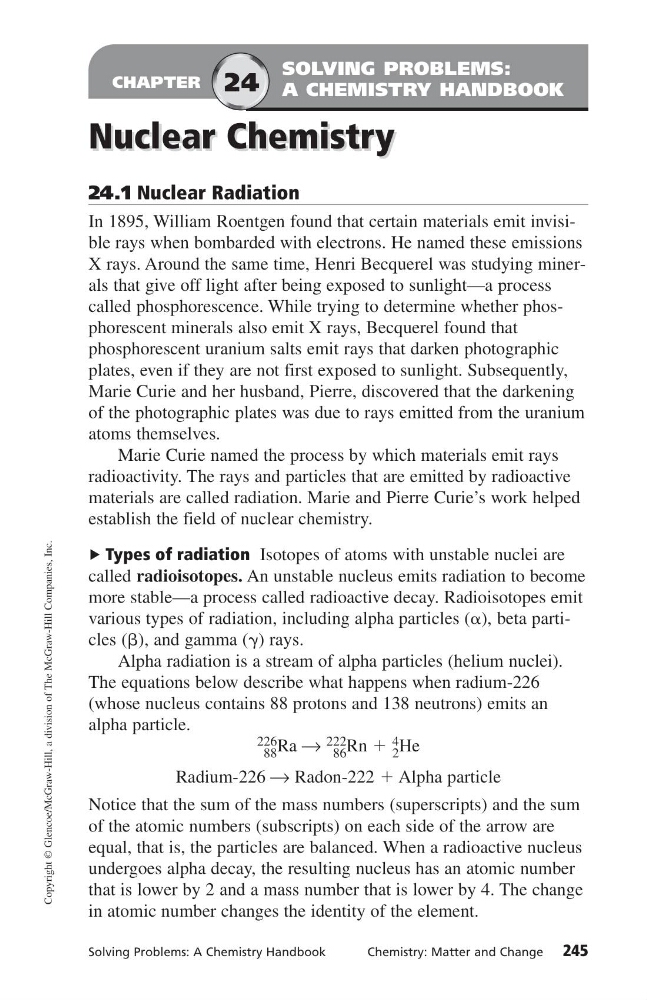
Alpha radiation is a stream of alpha particles (helium nuclei).
The equations below describe what happens when radium-226
(whose nucleus contains 88 protons and 138 neutrons) emits an
alpha particle.
226
88 Ra 0 222
86 Rn ϩ 4
2 He
Radium-226 0 Radon-222 ϩ Alpha particle
Notice that the sum of the mass numbers (superscripts) and the sum
of the atomic numbers (subscripts) on each side of the arrow are
equal, that is, the particles are balanced. When a radioactive nucleus
undergoes alpha decay, the resulting nucleus has an atomic number
that is lower by 2 and a mass number that is lower by 4. The change
in atomic number changes the identity of the element.
▲
Solving Problems: A Chemistry Handbook
Chemistry: Matter and Change
245
Nuclear Chemistry
Nuclear Chemistry
SOLVING PROBLEMS:
A CHEMISTRY HANDBOOK
CHAPTER 24
24.1 Nuclear Radiation
In 1895, William Roentgen found that certain materials emit invisible rays when bombarded with electrons. He named these emissions
X rays. Around the same time, Henri Becquerel was studying minerals that give off light after being exposed to sunlight—a process
called phosphorescence. While trying to determine whether phosphorescent minerals also emit X rays, Becquerel found that
phosphorescent uranium salts emit rays that darken photographic
plates, even if they are not first exposed to sunlight. Subsequently,
Marie Curie and her husband, Pierre, discovered that the darkening
of the photographic plates was due to rays emitted from the uranium
atoms themselves.
Marie Curie named the process by which materials emit rays
radioactivity. The rays and particles that are emitted by radioactive
materials are called radiation. Marie and Pierre Curie’s work helped
establish the field of nuclear chemistry.
Types of radiation Isotopes of atoms with unstable nuclei are
called radioisotopes. An unstable nucleus emits radiation to become
more stable—a process called radioactive decay. Radioisotopes emit
various types of radiation, including alpha particles (␣), beta particles (), and gamma (␥) rays.
Alpha radiation is a stream of alpha particles (helium nuclei).
The equations below describe what happens when radium-226
(whose nucleus contains 88 protons and 138 neutrons) emits an
alpha particle.
226
88 Ra 0 222
86 Rn ϩ 4
2 He
Radium-226 0 Radon-222 ϩ Alpha particle
Notice that the sum of the mass numbers (superscripts) and the sum
of the atomic numbers (subscripts) on each side of the arrow are
equal, that is, the particles are balanced. When a radioactive nucleus
undergoes alpha decay, the resulting nucleus has an atomic number
that is lower by 2 and a mass number that is lower by 4. The change
in atomic number changes the identity of the element.
▲