

Copyright © Glencoe/McGraw-Hill, a division of The McGraw-Hill Companies, Inc.
Solving Problems: A Chemistry Handbook
Chemistry: Matter and Change
225
Substituted Hydrocarbons
and Their Reactions
Substituted Hydrocarbons
and Their Reactions
SOLVING PROBLEMS:
A CHEMISTRY HANDBOOK
CHAPTER
22
22.1 Functional Groups
A functional group in an organic molecule is an atom or a group
of atoms that always reacts in a certain way. A halocarbon is any
organic compound that contains a halogen substituent. An alkyl
halide is an organic compound containing a halogen atom covalently bonded to an aliphatic carbon atom. An aryl halide is an
organic compound containing a halogen atom bonded to a benzene
ring or other aromatic group.
Halocarbons are named by the use of the prefixes fluoro-,
chloro-, bromo-, and iodo- attached to the name of the alkane structure. If there is more than one kind of halogen present, the atoms are
listed alphabetically. Numbers are used to identify the positions of
the halogens. The chain is numbered in such a way that the lowest
possible position number is given to the substituent that comes first
alphabetically. In the case of aryl halides, the additional rule is that
the numbering gives the substituents the lowest numbers possible.
Example Problem 22-1
Naming Halocarbons
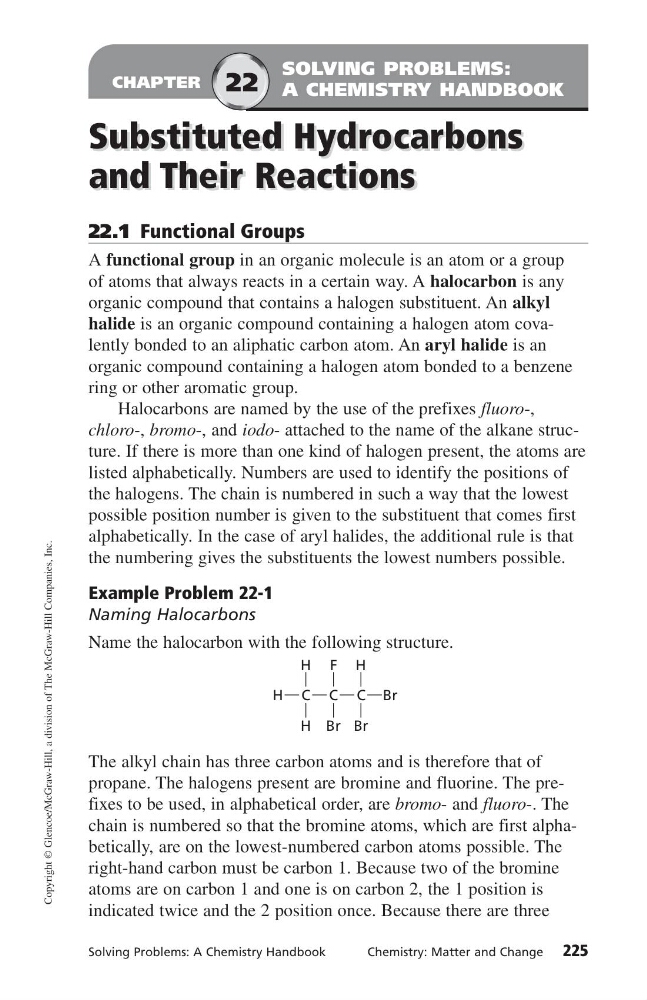
Name the halocarbon with the following structure.
The alkyl chain has three carbon atoms and is therefore that of
propane. The halogens present are bromine and fluorine. The prefixes to be used, in alphabetical order, are bromo- and fluoro-. The
chain is numbered so that the bromine atoms, which are first alphabetically, are on the lowest-numbered carbon atoms possible. The
right-hand carbon must be carbon 1. Because two of the bromine
atoms are on carbon 1 and one is on carbon 2, the 1 position is
indicated twice and the 2 position once. Because there are three
H C
H
H
C C
Br
F
Br
H
Br
Solving Problems: A Chemistry Handbook
Chemistry: Matter and Change
225
Substituted Hydrocarbons
and Their Reactions
Substituted Hydrocarbons
and Their Reactions
SOLVING PROBLEMS:
A CHEMISTRY HANDBOOK
CHAPTER
22
22.1 Functional Groups
A functional group in an organic molecule is an atom or a group
of atoms that always reacts in a certain way. A halocarbon is any
organic compound that contains a halogen substituent. An alkyl
halide is an organic compound containing a halogen atom covalently bonded to an aliphatic carbon atom. An aryl halide is an
organic compound containing a halogen atom bonded to a benzene
ring or other aromatic group.
Halocarbons are named by the use of the prefixes fluoro-,
chloro-, bromo-, and iodo- attached to the name of the alkane structure. If there is more than one kind of halogen present, the atoms are
listed alphabetically. Numbers are used to identify the positions of
the halogens. The chain is numbered in such a way that the lowest
possible position number is given to the substituent that comes first
alphabetically. In the case of aryl halides, the additional rule is that
the numbering gives the substituents the lowest numbers possible.
Example Problem 22-1
Naming Halocarbons
Name the halocarbon with the following structure.
The alkyl chain has three carbon atoms and is therefore that of
propane. The halogens present are bromine and fluorine. The prefixes to be used, in alphabetical order, are bromo- and fluoro-. The
chain is numbered so that the bromine atoms, which are first alphabetically, are on the lowest-numbered carbon atoms possible. The
right-hand carbon must be carbon 1. Because two of the bromine
atoms are on carbon 1 and one is on carbon 2, the 1 position is
indicated twice and the 2 position once. Because there are three
H C
H
H
C C
Br
F
Br
H
Br