

Copyright © Glencoe/McGraw-Hill, a division of The McGraw-Hill Companies, Inc.
Solving Problems: A Chemistry Handbook
Chemistry: Matter and Change
223
SOLVING PROBLEMS:
A CHEMISTRY HANDBOOK
CHAPTER 21
Organic compounds that contain benzene rings as part of their
molecular structure are called aromatic compounds. Nonaromatic
hydrocarbons such as alkanes, alkenes, and alkynes are called
aliphatic compounds. Some aromatic compounds contain two or
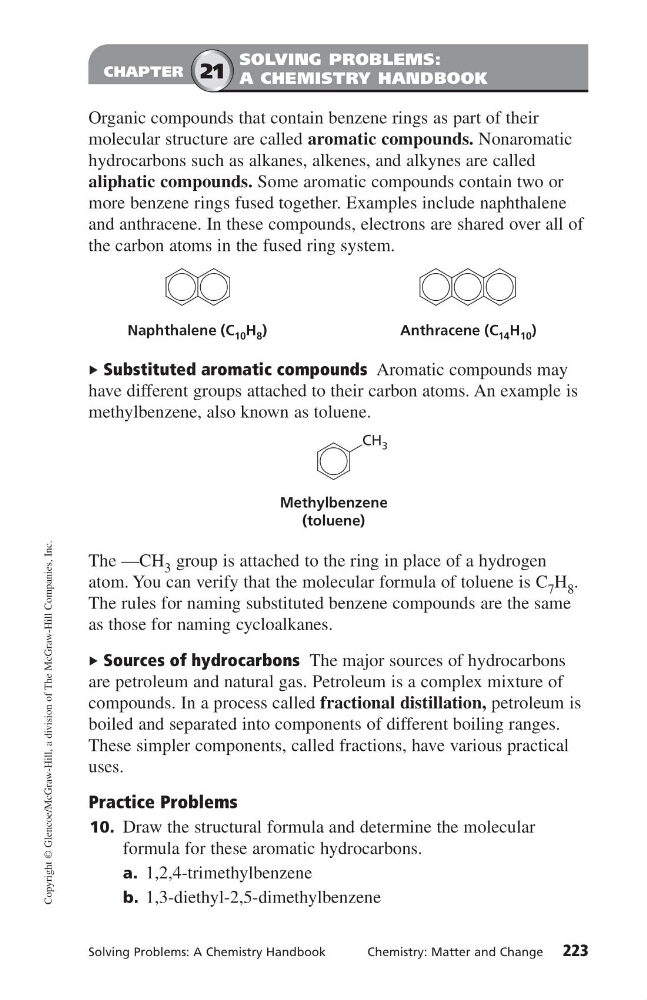
more benzene rings fused together. Examples include naphthalene
and anthracene. In these compounds, electrons are shared over all of
the carbon atoms in the fused ring system.
Substituted aromatic compounds Aromatic compounds may
have different groups attached to their carbon atoms. An example is
methylbenzene, also known as toluene.
The —CH 3 group is attached to the ring in place of a hydrogen
atom. You can verify that the molecular formula of toluene is C 7 H 8 .
The rules for naming substituted benzene compounds are the same
as those for naming cycloalkanes.
Sources of hydrocarbons The major sources of hydrocarbons
are petroleum and natural gas. Petroleum is a complex mixture of
compounds. In a process called fractional distillation, petroleum is
boiled and separated into components of different boiling ranges.
These simpler components, called fractions, have various practical
uses.
Practice Problems
10. Draw the structural formula and determine the molecular
formula for these aromatic hydrocarbons.
a. 1,2,4-trimethylbenzene
b. 1,3-diethyl-2,5-dimethylbenzene
▲
CH 3
Methylbenzene
(toluene)
▲
Naphthalene (C 10 H 8 )
Anthracene (C 14 H 10 )
Solving Problems: A Chemistry Handbook
Chemistry: Matter and Change
223
SOLVING PROBLEMS:
A CHEMISTRY HANDBOOK
CHAPTER 21
Organic compounds that contain benzene rings as part of their
molecular structure are called aromatic compounds. Nonaromatic
hydrocarbons such as alkanes, alkenes, and alkynes are called
aliphatic compounds. Some aromatic compounds contain two or
more benzene rings fused together. Examples include naphthalene
and anthracene. In these compounds, electrons are shared over all of
the carbon atoms in the fused ring system.
Substituted aromatic compounds Aromatic compounds may
have different groups attached to their carbon atoms. An example is
methylbenzene, also known as toluene.
The —CH 3 group is attached to the ring in place of a hydrogen
atom. You can verify that the molecular formula of toluene is C 7 H 8 .
The rules for naming substituted benzene compounds are the same
as those for naming cycloalkanes.
Sources of hydrocarbons The major sources of hydrocarbons
are petroleum and natural gas. Petroleum is a complex mixture of
compounds. In a process called fractional distillation, petroleum is
boiled and separated into components of different boiling ranges.
These simpler components, called fractions, have various practical
uses.
Practice Problems
10. Draw the structural formula and determine the molecular
formula for these aromatic hydrocarbons.
a. 1,2,4-trimethylbenzene
b. 1,3-diethyl-2,5-dimethylbenzene
▲
CH 3
Methylbenzene
(toluene)
▲
Naphthalene (C 10 H 8 )
Anthracene (C 14 H 10 )