

Copyright © Glencoe/McGraw-Hill, a division of The McGraw-Hill Companies, Inc.
Solving Problems: A Chemistry Handbook
Chemistry: Matter and Change
221
SOLVING PROBLEMS:
A CHEMISTRY HANDBOOK
CHAPTER 21
21.4 Isomers
Two or more compounds that have the same molecular formula but
different molecular structures are called isomers. The two main
classes of isomers are structural isomers and stereoisomers.
Structural isomers differ in the order in which atoms are bonded
to each other. For example, hexane, 2-methylpentane, and 3methylpentane are structural isomers because they all have the
molecular formula C 6 H 14 , but they have different carbon chains.
Structural isomers have different physical and chemical properties.
Isomers that have all atoms bonded in the same order but
arranged differently in space are called stereoisomers. The two types
of stereoisomers are geometric isomers and optical isomers.
Geometric isomers result from different arrangements of groups
around carbon-carbon double bonds of alkenes. The double bond
prevents free rotation, so the groups attached to a double bond are
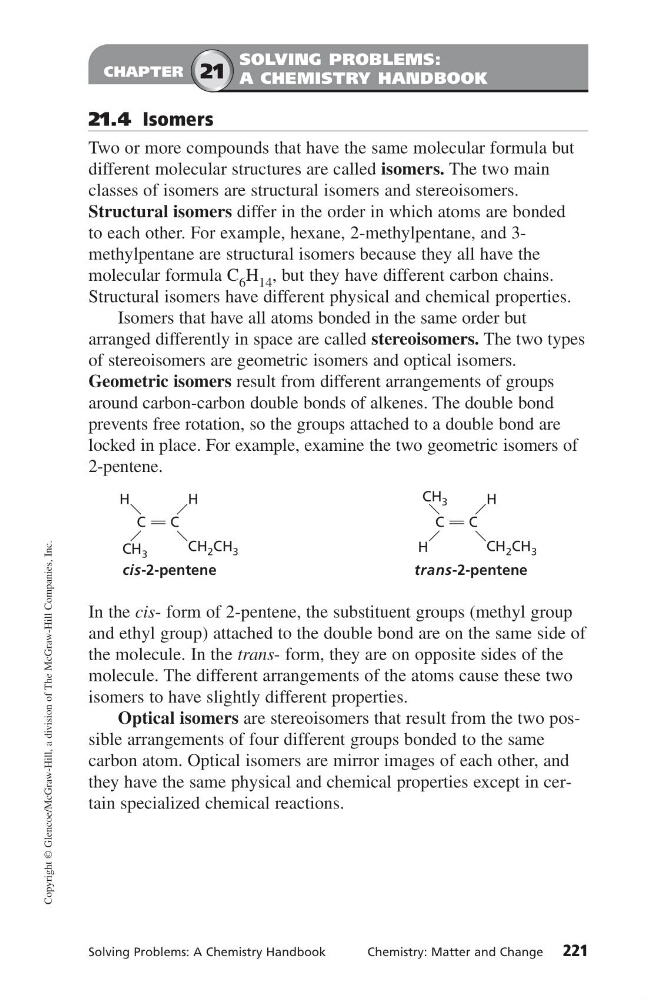
locked in place. For example, examine the two geometric isomers of
2-pentene.
In the cis- form of 2-pentene, the substituent groups (methyl group
and ethyl group) attached to the double bond are on the same side of
the molecule. In the trans- form, they are on opposite sides of the
molecule. The different arrangements of the atoms cause these two
isomers to have slightly different properties.
Optical isomers are stereoisomers that result from the two possible arrangements of four different groups bonded to the same
carbon atom. Optical isomers are mirror images of each other, and
they have the same physical and chemical properties except in certain specialized chemical reactions.
cis-2-pentene
trans-2-pentene
CH 2 CH 3
CH 3
C
C
H
H
CH 2 CH 3
CH 3
C
C
H
H
Solving Problems: A Chemistry Handbook
Chemistry: Matter and Change
221
SOLVING PROBLEMS:
A CHEMISTRY HANDBOOK
CHAPTER 21
21.4 Isomers
Two or more compounds that have the same molecular formula but
different molecular structures are called isomers. The two main
classes of isomers are structural isomers and stereoisomers.
Structural isomers differ in the order in which atoms are bonded
to each other. For example, hexane, 2-methylpentane, and 3methylpentane are structural isomers because they all have the
molecular formula C 6 H 14 , but they have different carbon chains.
Structural isomers have different physical and chemical properties.
Isomers that have all atoms bonded in the same order but
arranged differently in space are called stereoisomers. The two types
of stereoisomers are geometric isomers and optical isomers.
Geometric isomers result from different arrangements of groups
around carbon-carbon double bonds of alkenes. The double bond
prevents free rotation, so the groups attached to a double bond are
locked in place. For example, examine the two geometric isomers of
2-pentene.
In the cis- form of 2-pentene, the substituent groups (methyl group
and ethyl group) attached to the double bond are on the same side of
the molecule. In the trans- form, they are on opposite sides of the
molecule. The different arrangements of the atoms cause these two
isomers to have slightly different properties.
Optical isomers are stereoisomers that result from the two possible arrangements of four different groups bonded to the same
carbon atom. Optical isomers are mirror images of each other, and
they have the same physical and chemical properties except in certain specialized chemical reactions.
cis-2-pentene
trans-2-pentene
CH 2 CH 3
CH 3
C
C
H
H
CH 2 CH 3
CH 3
C
C
H
H