

Copyright © Glencoe/McGraw-Hill, a division of The McGraw-Hill Companies, Inc.
218 Chemistry: Matter and Change
Solving Problems: A Chemistry Handbook
SOLVING PROBLEMS:
A CHEMISTRY HANDBOOK
CHAPTER 21
Practice Problems
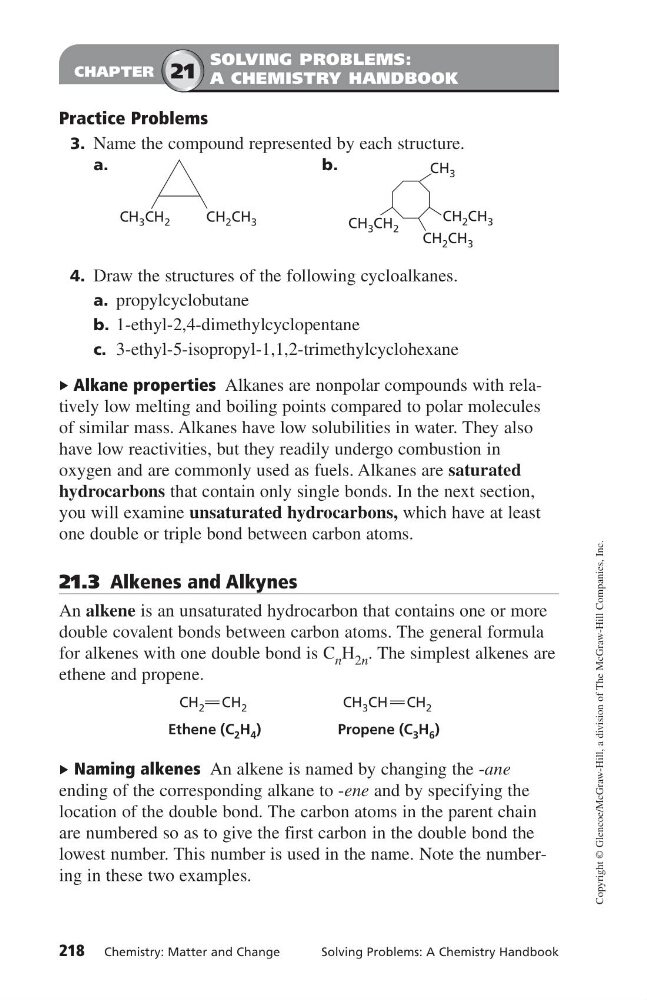
3. Name the compound represented by each structure.
a.
b.
4. Draw the structures of the following cycloalkanes.
a. propylcyclobutane
b. 1-ethyl-2,4-dimethylcyclopentane
c. 3-ethyl-5-isopropyl-1,1,2-trimethylcyclohexane
Alkane properties Alkanes are nonpolar compounds with relatively low melting and boiling points compared to polar molecules
of similar mass. Alkanes have low solubilities in water. They also
have low reactivities, but they readily undergo combustion in
oxygen and are commonly used as fuels. Alkanes are saturated
hydrocarbons that contain only single bonds. In the next section,
you will examine unsaturated hydrocarbons, which have at least
one double or triple bond between carbon atoms.
21.3 Alkenes and Alkynes
An alkene is an unsaturated hydrocarbon that contains one or more
double covalent bonds between carbon atoms. The general formula
for alkenes with one double bond is C n H 2n . The simplest alkenes are
ethene and propene.
Naming alkenes An alkene is named by changing the -ane
ending of the corresponding alkane to -ene and by specifying the
location of the double bond. The carbon atoms in the parent chain
are numbered so as to give the first carbon in the double bond the
lowest number. This number is used in the name. Note the numbering in these two examples.
▲
Ethene (C 2 H 4 )
P r opene (C 3 H 6 )
CH 2
CH 3 CH
CH 2
CH 2
▲
CH 2 CH 3
CH 2 CH 3
CH 3
CH 3 CH 2
CH 2 CH 3
CH 3 CH 2
218 Chemistry: Matter and Change
Solving Problems: A Chemistry Handbook
SOLVING PROBLEMS:
A CHEMISTRY HANDBOOK
CHAPTER 21
Practice Problems
3. Name the compound represented by each structure.
a.
b.
4. Draw the structures of the following cycloalkanes.
a. propylcyclobutane
b. 1-ethyl-2,4-dimethylcyclopentane
c. 3-ethyl-5-isopropyl-1,1,2-trimethylcyclohexane
Alkane properties Alkanes are nonpolar compounds with relatively low melting and boiling points compared to polar molecules
of similar mass. Alkanes have low solubilities in water. They also
have low reactivities, but they readily undergo combustion in
oxygen and are commonly used as fuels. Alkanes are saturated
hydrocarbons that contain only single bonds. In the next section,
you will examine unsaturated hydrocarbons, which have at least
one double or triple bond between carbon atoms.
21.3 Alkenes and Alkynes
An alkene is an unsaturated hydrocarbon that contains one or more
double covalent bonds between carbon atoms. The general formula
for alkenes with one double bond is C n H 2n . The simplest alkenes are
ethene and propene.
Naming alkenes An alkene is named by changing the -ane
ending of the corresponding alkane to -ene and by specifying the
location of the double bond. The carbon atoms in the parent chain
are numbered so as to give the first carbon in the double bond the
lowest number. This number is used in the name. Note the numbering in these two examples.
▲
Ethene (C 2 H 4 )
P r opene (C 3 H 6 )
CH 2
CH 3 CH
CH 2
CH 2
▲
CH 2 CH 3
CH 2 CH 3
CH 3
CH 3 CH 2
CH 2 CH 3
CH 3 CH 2