

Copyright © Glencoe/McGraw-Hill, a division of The McGraw-Hill Companies, Inc.
216 Chemistry: Matter and Change
Solving Problems: A Chemistry Handbook
SOLVING PROBLEMS:
A CHEMISTRY HANDBOOK
CHAPTER 21
d.
2. Write a condensed structural formula for each of these
branched-chain alkanes.
a. 3-ethylpentane
b. 2,2-dimethyl-6-propylnonane
c. 2,3,3,5-tetramethylheptane
d. 4-ethyl-3,4,5-trimethyloctane
21.2 Cyclic Alkanes and Alkane Properties
Carbon atoms can bond with each other to form ring structures. A
hydrocarbon ring contains three or more carbon atoms. An alkane
that contains a hydrocarbon ring is called a cycloalkane.
Cycloalkanes have the general molecular formula C n H 2n .
The name of a cycloalkane reveals the number of carbon atoms
in the ring. For example, cyclopropane (C 3 H 6 ) is the smallest
cycloalkane, with three carbon atoms in the ring. Cyclobutane
(C 4 H 8 ) has a ring with four carbon atoms. A cyclic hydrocarbon can
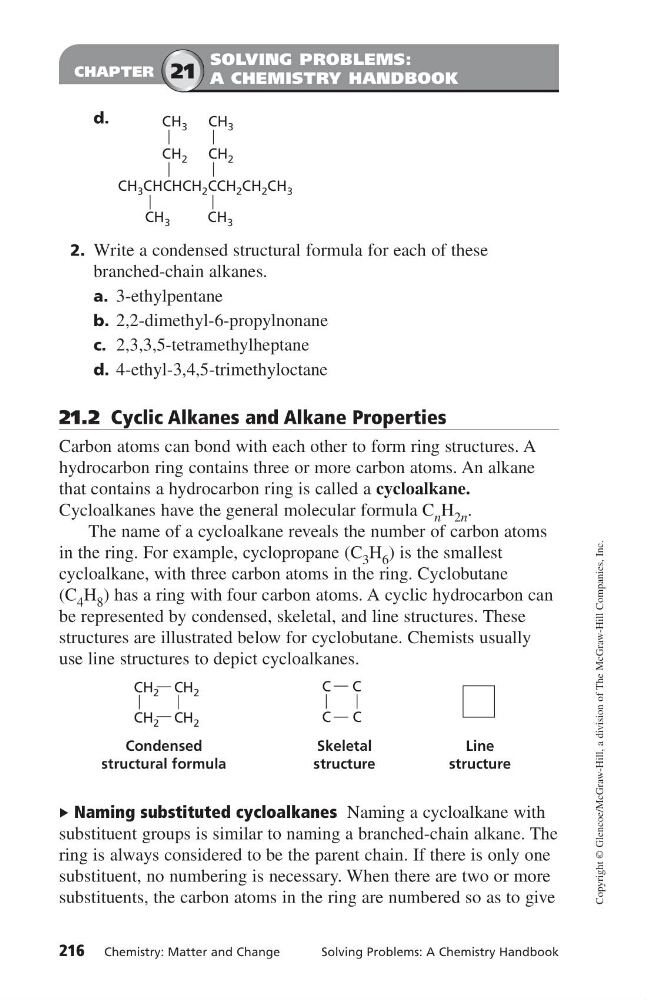
be represented by condensed, skeletal, and line structures. These
structures are illustrated below for cyclobutane. Chemists usually
use line structures to depict cycloalkanes.
Naming substituted cycloalkanes Naming a cycloalkane with
substituent groups is similar to naming a branched-chain alkane. The
ring is always considered to be the parent chain. If there is only one
substituent, no numbering is necessary. When there are two or more
substituents, the carbon atoms in the ring are numbered so as to give
▲
Condensed
structural formula
CH 2
CH 2
CH 2
CH 2
Skeletal
structure
Line
structure
C
C
C C
CH 3 CHCHCH 2 CCH 2 CH 2 CH 3
CH 3
CH 3
CH 2
CH 3
CH 2
CH 3
216 Chemistry: Matter and Change
Solving Problems: A Chemistry Handbook
SOLVING PROBLEMS:
A CHEMISTRY HANDBOOK
CHAPTER 21
d.
2. Write a condensed structural formula for each of these
branched-chain alkanes.
a. 3-ethylpentane
b. 2,2-dimethyl-6-propylnonane
c. 2,3,3,5-tetramethylheptane
d. 4-ethyl-3,4,5-trimethyloctane
21.2 Cyclic Alkanes and Alkane Properties
Carbon atoms can bond with each other to form ring structures. A
hydrocarbon ring contains three or more carbon atoms. An alkane
that contains a hydrocarbon ring is called a cycloalkane.
Cycloalkanes have the general molecular formula C n H 2n .
The name of a cycloalkane reveals the number of carbon atoms
in the ring. For example, cyclopropane (C 3 H 6 ) is the smallest
cycloalkane, with three carbon atoms in the ring. Cyclobutane
(C 4 H 8 ) has a ring with four carbon atoms. A cyclic hydrocarbon can
be represented by condensed, skeletal, and line structures. These
structures are illustrated below for cyclobutane. Chemists usually
use line structures to depict cycloalkanes.
Naming substituted cycloalkanes Naming a cycloalkane with
substituent groups is similar to naming a branched-chain alkane. The
ring is always considered to be the parent chain. If there is only one
substituent, no numbering is necessary. When there are two or more
substituents, the carbon atoms in the ring are numbered so as to give
▲
Condensed
structural formula
CH 2
CH 2
CH 2
CH 2
Skeletal
structure
Line
structure
C
C
C C
CH 3 CHCHCH 2 CCH 2 CH 2 CH 3
CH 3
CH 3
CH 2
CH 3
CH 2
CH 3