

Copyright © Glencoe/McGraw-Hill, a division of The McGraw-Hill Companies, Inc.
182 Chemistry: Matter and Change
Solving Problems: A Chemistry Handbook
SOLVING PROBLEMS:
A CHEMISTRY HANDBOOK
CHAPTER 18
Monoprotic and polyprotic acids An acid that can donate only
one hydrogen ion is called a monoprotic acid. For example,
hydrochloric acid (HCl) and formic acid (HCOOH) are monoprotic
acids because they each contain only one ionizable hydrogen atom.
Note that only those hydrogen atoms that are bonded to electronegative elements are ionizable.
Some acids can donate more than one hydrogen ion. For example, sulfuric acid (H 2 SO 4 ) contains two ionizable hydrogen atoms,
so it is called a diprotic acid. Boric acid (H 3 BO 3 ) contains three
ionizable hydrogen atoms, so it is a triprotic acid. More generally, an
acid that contains two or more ionizable hydrogen atoms is called a
polyprotic acid.
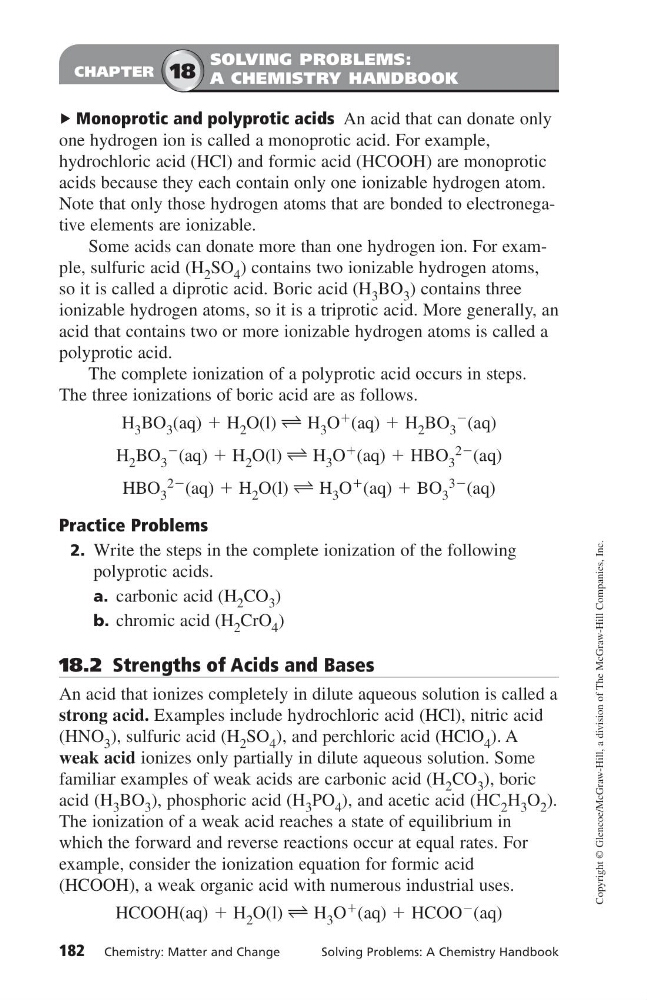
The complete ionization of a polyprotic acid occurs in steps.
The three ionizations of boric acid are as follows.
H 3 BO 3 (aq) ϩ H 2 O(l) 3 H 3 O ϩ (aq) ϩ H 2 BO 3
Ϫ (aq)
H 2 BO 3
Ϫ (aq) ϩ H 2 O(l) 3 H 3 O ϩ (aq) ϩ HBO 3
2Ϫ (aq)
HBO 3
2Ϫ (aq) ϩ H 2 O(l) 3 H 3 O ϩ (aq) ϩ BO 3
3Ϫ (aq)
Practice Problems
2. Write the steps in the complete ionization of the following
polyprotic acids.
a. carbonic acid (H 2 CO 3 )
b. chromic acid (H 2 CrO 4 )
18.2 Strengths of Acids and Bases
An acid that ionizes completely in dilute aqueous solution is called a
strong acid. Examples include hydrochloric acid (HCl), nitric acid
(HNO 3 ), sulfuric acid (H 2 SO 4 ), and perchloric acid (HClO 4 ). A
weak acid ionizes only partially in dilute aqueous solution. Some
familiar examples of weak acids are carbonic acid (H 2 CO 3 ), boric
acid (H 3 BO 3 ), phosphoric acid (H 3 PO 4 ), and acetic acid (HC 2 H 3 O 2 ).
The ionization of a weak acid reaches a state of equilibrium in
which the forward and reverse reactions occur at equal rates. For
example, consider the ionization equation for formic acid
(HCOOH), a weak organic acid with numerous industrial uses.
HCOOH(aq) ϩ H 2 O(l) 3 H 3 O ϩ (aq) ϩ HCOO Ϫ (aq)
▲
182 Chemistry: Matter and Change
Solving Problems: A Chemistry Handbook
SOLVING PROBLEMS:
A CHEMISTRY HANDBOOK
CHAPTER 18
Monoprotic and polyprotic acids An acid that can donate only
one hydrogen ion is called a monoprotic acid. For example,
hydrochloric acid (HCl) and formic acid (HCOOH) are monoprotic
acids because they each contain only one ionizable hydrogen atom.
Note that only those hydrogen atoms that are bonded to electronegative elements are ionizable.
Some acids can donate more than one hydrogen ion. For example, sulfuric acid (H 2 SO 4 ) contains two ionizable hydrogen atoms,
so it is called a diprotic acid. Boric acid (H 3 BO 3 ) contains three
ionizable hydrogen atoms, so it is a triprotic acid. More generally, an
acid that contains two or more ionizable hydrogen atoms is called a
polyprotic acid.
The complete ionization of a polyprotic acid occurs in steps.
The three ionizations of boric acid are as follows.
H 3 BO 3 (aq) ϩ H 2 O(l) 3 H 3 O ϩ (aq) ϩ H 2 BO 3
Ϫ (aq)
H 2 BO 3
Ϫ (aq) ϩ H 2 O(l) 3 H 3 O ϩ (aq) ϩ HBO 3
2Ϫ (aq)
HBO 3
2Ϫ (aq) ϩ H 2 O(l) 3 H 3 O ϩ (aq) ϩ BO 3
3Ϫ (aq)
Practice Problems
2. Write the steps in the complete ionization of the following
polyprotic acids.
a. carbonic acid (H 2 CO 3 )
b. chromic acid (H 2 CrO 4 )
18.2 Strengths of Acids and Bases
An acid that ionizes completely in dilute aqueous solution is called a
strong acid. Examples include hydrochloric acid (HCl), nitric acid
(HNO 3 ), sulfuric acid (H 2 SO 4 ), and perchloric acid (HClO 4 ). A
weak acid ionizes only partially in dilute aqueous solution. Some
familiar examples of weak acids are carbonic acid (H 2 CO 3 ), boric
acid (H 3 BO 3 ), phosphoric acid (H 3 PO 4 ), and acetic acid (HC 2 H 3 O 2 ).
The ionization of a weak acid reaches a state of equilibrium in
which the forward and reverse reactions occur at equal rates. For
example, consider the ionization equation for formic acid
(HCOOH), a weak organic acid with numerous industrial uses.
HCOOH(aq) ϩ H 2 O(l) 3 H 3 O ϩ (aq) ϩ HCOO Ϫ (aq)
▲