

Copyright © Glencoe/McGraw-Hill, a division of The McGraw-Hill Companies, Inc.
Solving Problems: A Chemistry Handbook
Chemistry: Matter and Change
179
SOLVING PROBLEMS:
A CHEMISTRY HANDBOOK
CHAPTER 17
You know that NaCl is a soluble compound and will not form a
precipitate. However, Ca(OH) 2 is sparingly soluble with K sp
ϭ 5.0 ϫ 10 Ϫ6 , so it might precipitate if the concentrations of its
ions are high enough.
Write the equation for the dissolving of Ca(OH) 2 .
Ca(OH) 2 (s) 3 Ca 2ϩ (aq) ϩ 2OH Ϫ (aq)
The ion product expression is as follows.
Q sp ϭ [Ca 2ϩ ][OH Ϫ ] 2
Q sp is a trial value that will be compared to K sp .
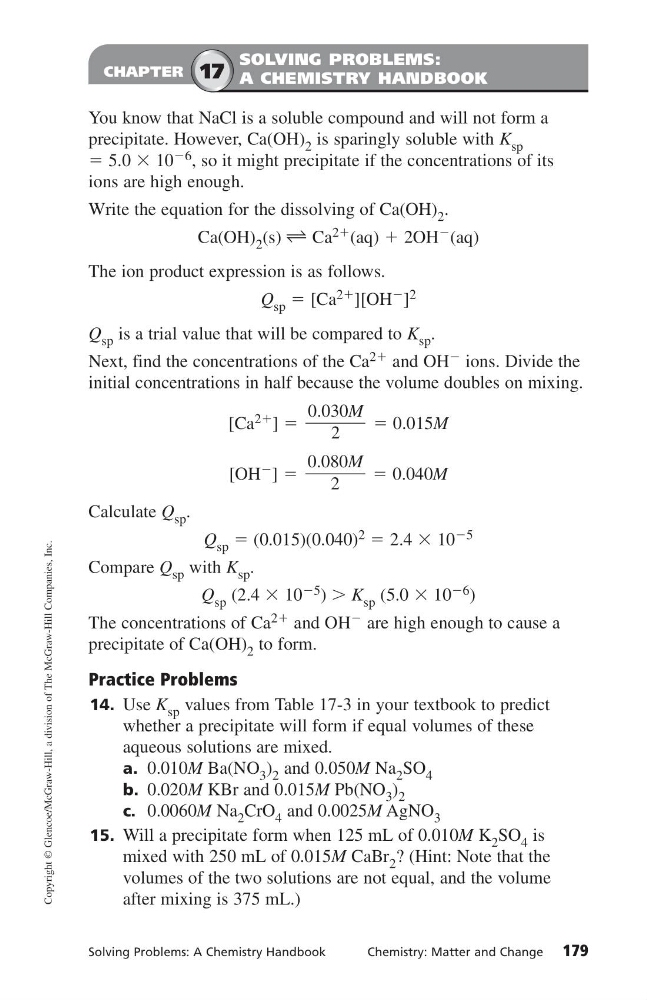
Next, find the concentrations of the Ca 2ϩ and OH Ϫ ions. Divide the
initial concentrations in half because the volume doubles on mixing.
[Ca 2ϩ ] ϭ
ϭ0.015M
[OH Ϫ ] ϭ
ϭ0.040M
Calculate Q sp .
Q sp ϭ (0.015)(0.040) 2 ϭ 2.4 ϫ 10 Ϫ5
Compare Q sp with K sp .
Q sp (2.4 ϫ 10 Ϫ5 ) Ͼ K sp (5.0 ϫ 10 Ϫ6 )
The concentrations of Ca 2ϩ and OH Ϫ are high enough to cause a
precipitate of Ca(OH) 2 to form.
Practice Problems
14. Use K sp values from Table 17-3 in your textbook to predict
whether a precipitate will form if equal volumes of these
aqueous solutions are mixed.
a. 0.010M Ba(NO 3 ) 2 and 0.050M Na 2 SO 4
b. 0.020M KBr and 0.015M Pb(NO 3 ) 2
c. 0.0060M Na 2 CrO 4 and 0.0025M AgNO 3
15. Will a precipitate form when 125 mL of 0.010M K 2 SO 4 is
mixed with 250 mL of 0.015M CaBr 2 ? (Hint: Note that the
volumes of the two solutions are not equal, and the volume
after mixing is 375 mL.)
0.080M
ᎏ
2
0.030M
ᎏ
2
Solving Problems: A Chemistry Handbook
Chemistry: Matter and Change
179
SOLVING PROBLEMS:
A CHEMISTRY HANDBOOK
CHAPTER 17
You know that NaCl is a soluble compound and will not form a
precipitate. However, Ca(OH) 2 is sparingly soluble with K sp
ϭ 5.0 ϫ 10 Ϫ6 , so it might precipitate if the concentrations of its
ions are high enough.
Write the equation for the dissolving of Ca(OH) 2 .
Ca(OH) 2 (s) 3 Ca 2ϩ (aq) ϩ 2OH Ϫ (aq)
The ion product expression is as follows.
Q sp ϭ [Ca 2ϩ ][OH Ϫ ] 2
Q sp is a trial value that will be compared to K sp .
Next, find the concentrations of the Ca 2ϩ and OH Ϫ ions. Divide the
initial concentrations in half because the volume doubles on mixing.
[Ca 2ϩ ] ϭ
ϭ0.015M
[OH Ϫ ] ϭ
ϭ0.040M
Calculate Q sp .
Q sp ϭ (0.015)(0.040) 2 ϭ 2.4 ϫ 10 Ϫ5
Compare Q sp with K sp .
Q sp (2.4 ϫ 10 Ϫ5 ) Ͼ K sp (5.0 ϫ 10 Ϫ6 )
The concentrations of Ca 2ϩ and OH Ϫ are high enough to cause a
precipitate of Ca(OH) 2 to form.
Practice Problems
14. Use K sp values from Table 17-3 in your textbook to predict
whether a precipitate will form if equal volumes of these
aqueous solutions are mixed.
a. 0.010M Ba(NO 3 ) 2 and 0.050M Na 2 SO 4
b. 0.020M KBr and 0.015M Pb(NO 3 ) 2
c. 0.0060M Na 2 CrO 4 and 0.0025M AgNO 3
15. Will a precipitate form when 125 mL of 0.010M K 2 SO 4 is
mixed with 250 mL of 0.015M CaBr 2 ? (Hint: Note that the
volumes of the two solutions are not equal, and the volume
after mixing is 375 mL.)
0.080M
ᎏ
2
0.030M
ᎏ
2