

Copyright © Glencoe/McGraw-Hill, a division of The McGraw-Hill Companies, Inc.
170 Chemistry: Matter and Change
Solving Problems: A Chemistry Handbook
SOLVING PROBLEMS:
A CHEMISTRY HANDBOOK
CHAPTER 17
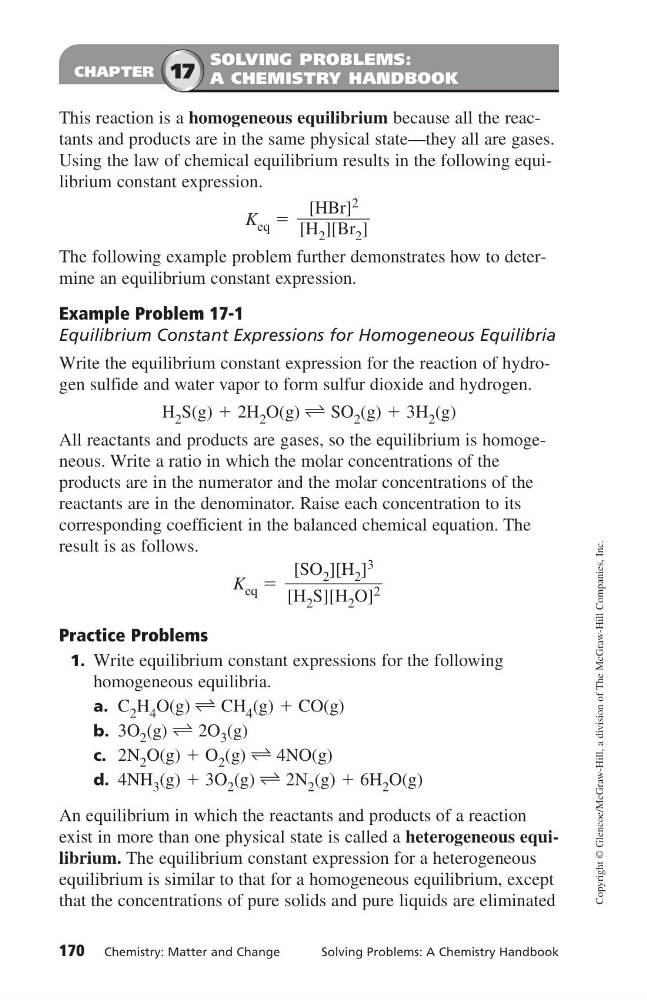
This reaction is a homogeneous equilibrium because all the reactants and products are in the same physical state—they all are gases.
Using the law of chemical equilibrium results in the following equilibrium constant expression.
K eq ϭ
The following example problem further demonstrates how to determine an equilibrium constant expression.
Example Problem 17-1
Equilibrium Constant Expressions for Homogeneous Equilibria
Write the equilibrium constant expression for the reaction of hydrogen sulfide and water vapor to form sulfur dioxide and hydrogen.
H 2 S(g) ϩ 2H 2 O(g) 3 SO 2 (g) ϩ 3H 2 (g)
All reactants and products are gases, so the equilibrium is homogeneous. Write a ratio in which the molar concentrations of the
products are in the numerator and the molar concentrations of the
reactants are in the denominator. Raise each concentration to its
corresponding coefficient in the balanced chemical equation. The
result is as follows.
K eq ϭ
Practice Problems
1. Write equilibrium constant expressions for the following
homogeneous equilibria.
a. C 2 H 4 O(g) 3 CH 4 (g) ϩ CO(g)
b. 3O 2 (g) 3 2O 3 (g)
c. 2N 2 O(g) ϩ O 2 (g) 3 4NO(g)
d. 4NH 3 (g) ϩ 3O 2 (g) 3 2N 2 (g) ϩ 6H 2 O(g)
An equilibrium in which the reactants and products of a reaction
exist in more than one physical state is called a heterogeneous equilibrium. The equilibrium constant expression for a heterogeneous
equilibrium is similar to that for a homogeneous equilibrium, except
that the concentrations of pure solids and pure liquids are eliminated
[SO 2 ][H 2 ] 3
ᎏᎏ
[H 2 S][H 2 O] 2
[HBr] 2
ᎏᎏ
[H 2 ][Br 2 ]
170 Chemistry: Matter and Change
Solving Problems: A Chemistry Handbook
SOLVING PROBLEMS:
A CHEMISTRY HANDBOOK
CHAPTER 17
This reaction is a homogeneous equilibrium because all the reactants and products are in the same physical state—they all are gases.
Using the law of chemical equilibrium results in the following equilibrium constant expression.
K eq ϭ
The following example problem further demonstrates how to determine an equilibrium constant expression.
Example Problem 17-1
Equilibrium Constant Expressions for Homogeneous Equilibria
Write the equilibrium constant expression for the reaction of hydrogen sulfide and water vapor to form sulfur dioxide and hydrogen.
H 2 S(g) ϩ 2H 2 O(g) 3 SO 2 (g) ϩ 3H 2 (g)
All reactants and products are gases, so the equilibrium is homogeneous. Write a ratio in which the molar concentrations of the
products are in the numerator and the molar concentrations of the
reactants are in the denominator. Raise each concentration to its
corresponding coefficient in the balanced chemical equation. The
result is as follows.
K eq ϭ
Practice Problems
1. Write equilibrium constant expressions for the following
homogeneous equilibria.
a. C 2 H 4 O(g) 3 CH 4 (g) ϩ CO(g)
b. 3O 2 (g) 3 2O 3 (g)
c. 2N 2 O(g) ϩ O 2 (g) 3 4NO(g)
d. 4NH 3 (g) ϩ 3O 2 (g) 3 2N 2 (g) ϩ 6H 2 O(g)
An equilibrium in which the reactants and products of a reaction
exist in more than one physical state is called a heterogeneous equilibrium. The equilibrium constant expression for a heterogeneous
equilibrium is similar to that for a homogeneous equilibrium, except
that the concentrations of pure solids and pure liquids are eliminated
[SO 2 ][H 2 ] 3
ᎏᎏ
[H 2 S][H 2 O] 2
[HBr] 2
ᎏᎏ
[H 2 ][Br 2 ]