

Copyright © Glencoe/McGraw-Hill, a division of The McGraw-Hill Companies, Inc.
Solving Problems: A Chemistry Handbook
Chemistry: Matter and Change
147
SOLVING PROBLEMS:
A CHEMISTRY HANDBOOK
CHAPTER 14
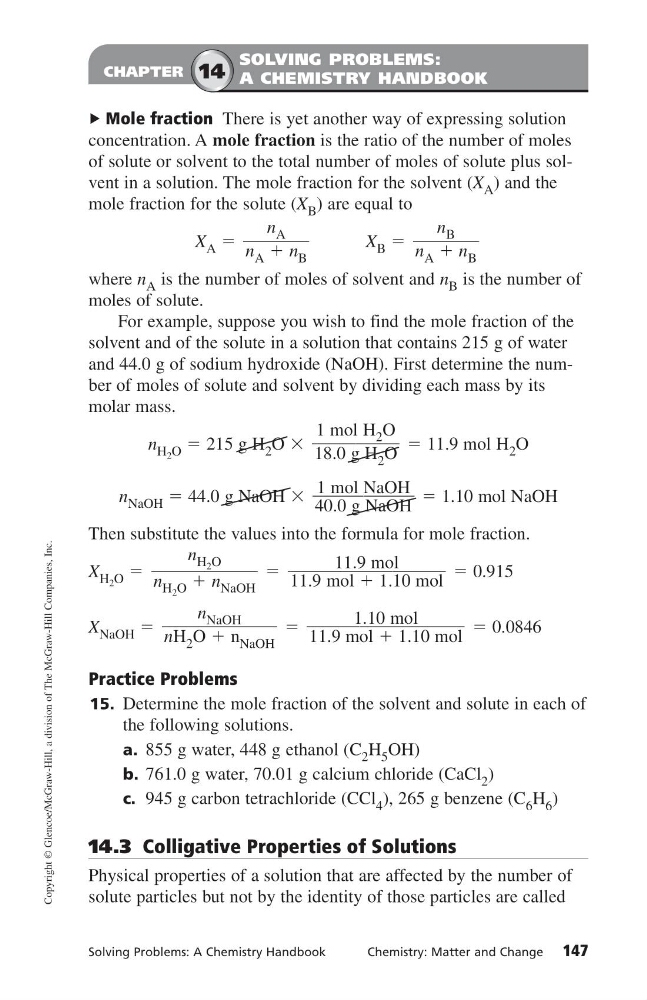
Mole fraction There is yet another way of expressing solution
concentration. A mole fraction is the ratio of the number of moles
of solute or solvent to the total number of moles of solute plus solvent in a solution. The mole fraction for the solvent (X A ) and the
mole fraction for the solute (X B ) are equal to
X A ϭ
X B ϭ
where n A is the number of moles of solvent and n B is the number of
moles of solute.
For example, suppose you wish to find the mole fraction of the
solvent and of the solute in a solution that contains 215 g of water
and 44.0 g of sodium hydroxide (NaOH). First determine the number of moles of solute and solvent by dividing each mass by its
molar mass.
n H 2 O ϭ 215 g H 2 O ϫ
ϭ11.9 mol H 2 O
n NaOH ϭ 44.0 g NaOH ϫ
ϭ 1.10 mol NaOH
Then substitute the values into the formula for mole fraction.
X H 2 O ϭ
ϭ
ϭ 0.915
X NaOH ϭ
ϭ
ϭ 0.0846
Practice Problems
15. Determine the mole fraction of the solvent and solute in each of
the following solutions.
a. 855 g water, 448 g ethanol (C 2 H 5 OH)
b. 761.0 g water, 70.01 g calcium chloride (CaCl 2 )
c. 945 g carbon tetrachloride (CCl 4 ), 265 g benzene (C 6 H 6 )
14.3 Colligative Properties of Solutions
Physical properties of a solution that are affected by the number of
solute particles but not by the identity of those particles are called
1.10 mol
ᎏᎏᎏ
11.9 mol ϩ 1.10 mol
n NaOH
ᎏᎏ
nH 2 O ϩ n NaOH
11.9 mol
ᎏᎏᎏ
11.9 mol ϩ 1.10 mol
n H 2 O
ᎏᎏ
n H 2 O ϩ n NaOH
1 mol NaOH
ᎏᎏ
40.0 g NaOH
1 mol H 2 O
ᎏᎏ
18.0 g H 2 O
n B
ᎏ
n A ϩ n B
n A
ᎏ
n A ϩ n B
▲
Solving Problems: A Chemistry Handbook
Chemistry: Matter and Change
147
SOLVING PROBLEMS:
A CHEMISTRY HANDBOOK
CHAPTER 14
Mole fraction There is yet another way of expressing solution
concentration. A mole fraction is the ratio of the number of moles
of solute or solvent to the total number of moles of solute plus solvent in a solution. The mole fraction for the solvent (X A ) and the
mole fraction for the solute (X B ) are equal to
X A ϭ
X B ϭ
where n A is the number of moles of solvent and n B is the number of
moles of solute.
For example, suppose you wish to find the mole fraction of the
solvent and of the solute in a solution that contains 215 g of water
and 44.0 g of sodium hydroxide (NaOH). First determine the number of moles of solute and solvent by dividing each mass by its
molar mass.
n H 2 O ϭ 215 g H 2 O ϫ
ϭ11.9 mol H 2 O
n NaOH ϭ 44.0 g NaOH ϫ
ϭ 1.10 mol NaOH
Then substitute the values into the formula for mole fraction.
X H 2 O ϭ
ϭ
ϭ 0.915
X NaOH ϭ
ϭ
ϭ 0.0846
Practice Problems
15. Determine the mole fraction of the solvent and solute in each of
the following solutions.
a. 855 g water, 448 g ethanol (C 2 H 5 OH)
b. 761.0 g water, 70.01 g calcium chloride (CaCl 2 )
c. 945 g carbon tetrachloride (CCl 4 ), 265 g benzene (C 6 H 6 )
14.3 Colligative Properties of Solutions
Physical properties of a solution that are affected by the number of
solute particles but not by the identity of those particles are called
1.10 mol
ᎏᎏᎏ
11.9 mol ϩ 1.10 mol
n NaOH
ᎏᎏ
nH 2 O ϩ n NaOH
11.9 mol
ᎏᎏᎏ
11.9 mol ϩ 1.10 mol
n H 2 O
ᎏᎏ
n H 2 O ϩ n NaOH
1 mol NaOH
ᎏᎏ
40.0 g NaOH
1 mol H 2 O
ᎏᎏ
18.0 g H 2 O
n B
ᎏ
n A ϩ n B
n A
ᎏ
n A ϩ n B
▲