

Copyright © Glencoe/McGraw-Hill, a division of The McGraw-Hill Companies, Inc.
144 Chemistry: Matter and Change
Solving Problems: A Chemistry Handbook
SOLVING PROBLEMS:
A CHEMISTRY HANDBOOK
CHAPTER 14
Molarity A common way to express solution concentrations is
molarity (M), the number of moles of solute per liter of solution.
Molarity (M) ϭ
Example Problem 14-4
Calculating Molarity and Preparing Molar Solutions
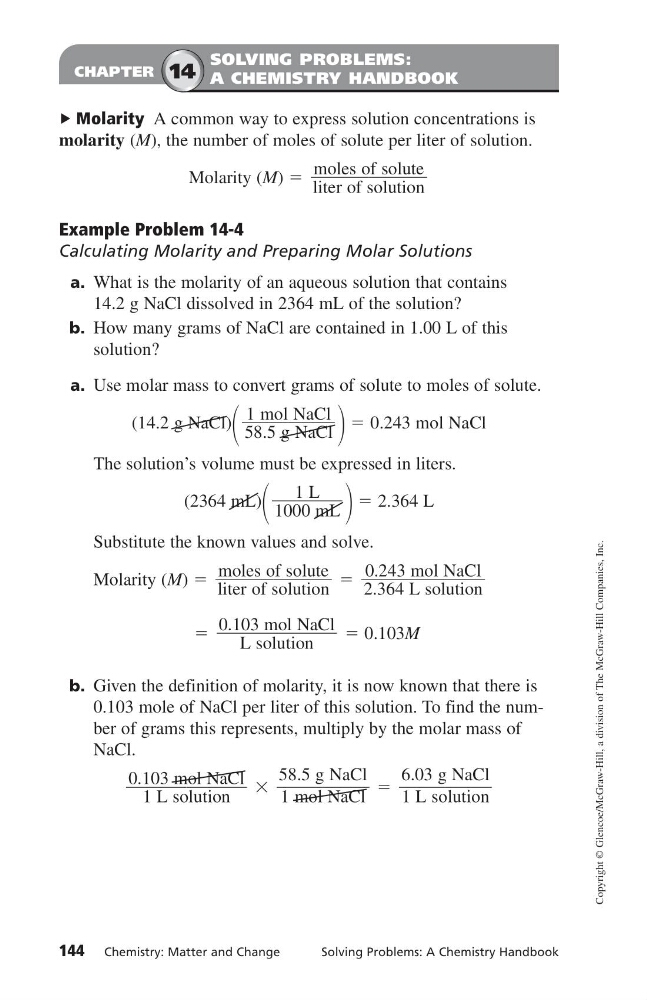
a. What is the molarity of an aqueous solution that contains
14.2 g NaCl dissolved in 2364 mL of the solution?
b. How many grams of NaCl are contained in 1.00 L of this
solution?
a. Use molar mass to convert grams of solute to moles of solute.
(14.2 g NaCl)
ϭ 0.243 mol NaCl
The solution’s volume must be expressed in liters.
(2364 mL)
ϭ 2.364 L
Substitute the known values and solve.
Molarity (M) ϭ
ϭ
ϭ
ϭ 0.103M
b. Given the definition of molarity, it is now known that there is
0.103 mole of NaCl per liter of this solution. To find the number of grams this represents, multiply by the molar mass of
NaCl.
ϫ
ϭ
6.03 g NaCl
ᎏᎏ
1 L solution
58.5 g NaCl
ᎏᎏ
1 mol NaCl
0.103 mol NaCl
ᎏᎏ
1 L solution
0.103 mol NaCl
ᎏᎏ
L solution
0.243 mol NaCl
ᎏᎏ
2.364 L solution
moles of solute
ᎏᎏ
liter of solution
1 L
ᎏ
1000 mL
1 mol NaCl
ᎏᎏ
58.5 g NaCl
moles of solute
ᎏᎏ
liter of solution
▲
144 Chemistry: Matter and Change
Solving Problems: A Chemistry Handbook
SOLVING PROBLEMS:
A CHEMISTRY HANDBOOK
CHAPTER 14
Molarity A common way to express solution concentrations is
molarity (M), the number of moles of solute per liter of solution.
Molarity (M) ϭ
Example Problem 14-4
Calculating Molarity and Preparing Molar Solutions
a. What is the molarity of an aqueous solution that contains
14.2 g NaCl dissolved in 2364 mL of the solution?
b. How many grams of NaCl are contained in 1.00 L of this
solution?
a. Use molar mass to convert grams of solute to moles of solute.
(14.2 g NaCl)
ϭ 0.243 mol NaCl
The solution’s volume must be expressed in liters.
(2364 mL)
ϭ 2.364 L
Substitute the known values and solve.
Molarity (M) ϭ
ϭ
ϭ
ϭ 0.103M
b. Given the definition of molarity, it is now known that there is
0.103 mole of NaCl per liter of this solution. To find the number of grams this represents, multiply by the molar mass of
NaCl.
ϫ
ϭ
6.03 g NaCl
ᎏᎏ
1 L solution
58.5 g NaCl
ᎏᎏ
1 mol NaCl
0.103 mol NaCl
ᎏᎏ
1 L solution
0.103 mol NaCl
ᎏᎏ
L solution
0.243 mol NaCl
ᎏᎏ
2.364 L solution
moles of solute
ᎏᎏ
liter of solution
1 L
ᎏ
1000 mL
1 mol NaCl
ᎏᎏ
58.5 g NaCl
moles of solute
ᎏᎏ
liter of solution
▲