

Copyright © Glencoe/McGraw-Hill, a division of The McGraw-Hill Companies, Inc.
Solving Problems: A Chemistry Handbook
Chemistry: Matter and Change
7
Analyzing Data
Analyzing Data
SOLVING PROBLEMS:
A CHEMISTRY HANDBOOK
CHAPTER
2
2.1 Units of Measurement
You probably know your height in feet and inches. Most people
outside the United States, however, measure height in meters and
centimeters. The system of standard units that includes the meter is
called the metric system. Scientists today use a revised form of the
metric system called the Système Internationale d’Unités, or SI.
Base units There are seven base units in SI. A base unit is a unit
of measure that is based on an object or event in the physical world.
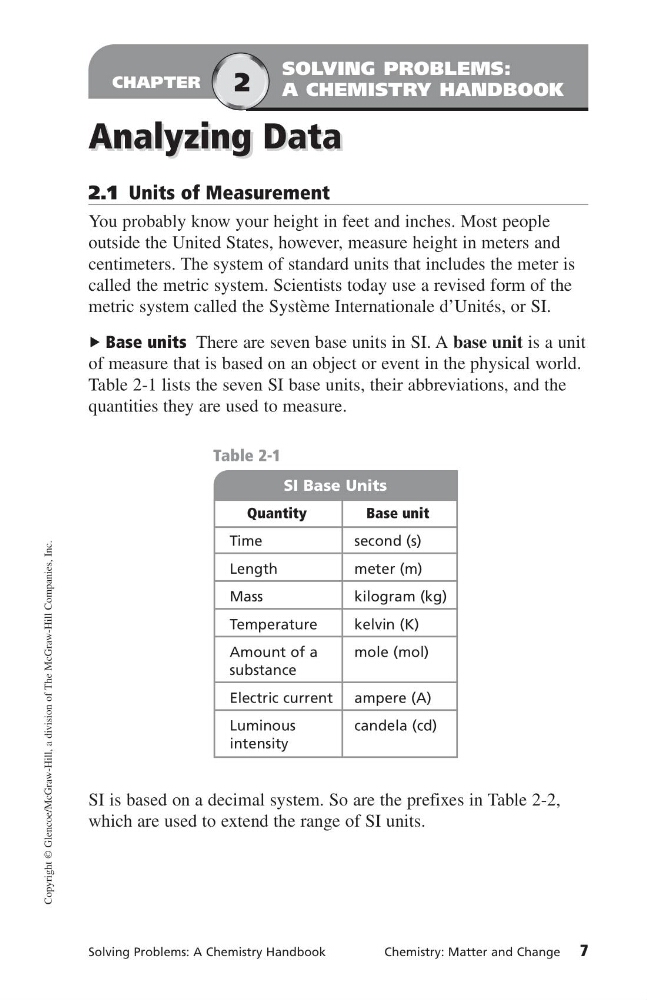
Table 2-1 lists the seven SI base units, their abbreviations, and the
quantities they are used to measure.
SI is based on a decimal system. So are the prefixes in Table 2-2,
which are used to extend the range of SI units.
▲
SI Base Units
Quantity
Base unit
Time
second (s)
Length
meter (m)
Mass
kilogram (kg)
Temperature
kelvin (K)
Amount of a
mole (mol)
substance
Electric current ampere (A)
Luminous
candela (cd)
intensity
Table 2-1
Solving Problems: A Chemistry Handbook
Chemistry: Matter and Change
7
Analyzing Data
Analyzing Data
SOLVING PROBLEMS:
A CHEMISTRY HANDBOOK
CHAPTER
2
2.1 Units of Measurement
You probably know your height in feet and inches. Most people
outside the United States, however, measure height in meters and
centimeters. The system of standard units that includes the meter is
called the metric system. Scientists today use a revised form of the
metric system called the Système Internationale d’Unités, or SI.
Base units There are seven base units in SI. A base unit is a unit
of measure that is based on an object or event in the physical world.
Table 2-1 lists the seven SI base units, their abbreviations, and the
quantities they are used to measure.
SI is based on a decimal system. So are the prefixes in Table 2-2,
which are used to extend the range of SI units.
▲
SI Base Units
Quantity
Base unit
Time
second (s)
Length
meter (m)
Mass
kilogram (kg)
Temperature
kelvin (K)
Amount of a
mole (mol)
substance
Electric current ampere (A)
Luminous
candela (cd)
intensity
Table 2-1