

Copyright © Glencoe/McGraw-Hill, a division of The McGraw-Hill Companies, Inc.
136 Chemistry: Matter and Change
Solving Problems: A Chemistry Handbook
SOLVING PROBLEMS:
A CHEMISTRY HANDBOOK
CHAPTER 13
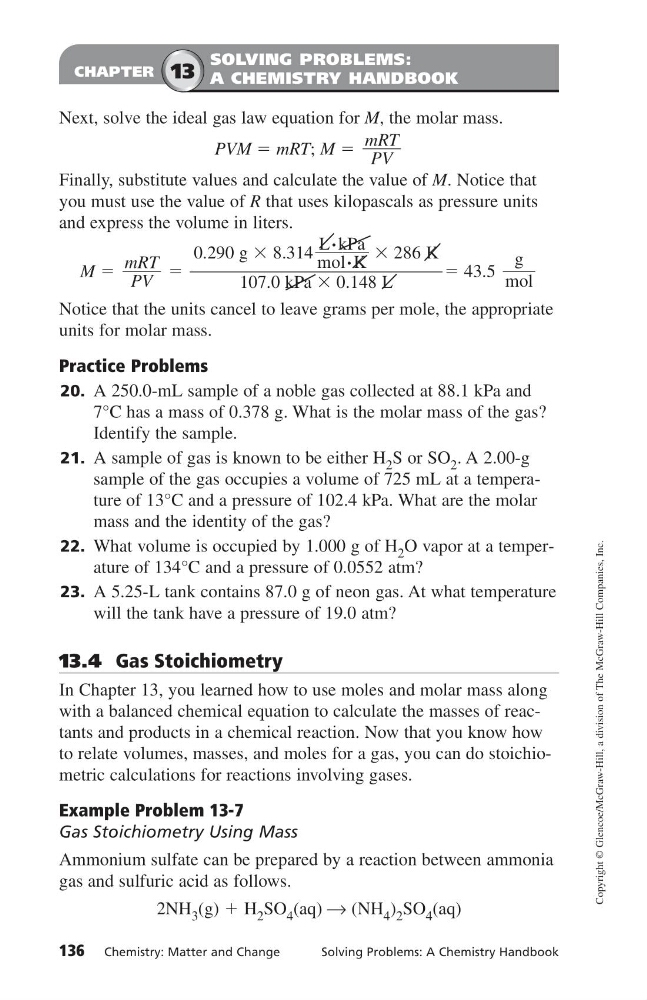
Next, solve the ideal gas law equation for M, the molar mass.
PVM ϭ mRT; M ϭ
Finally, substitute values and calculate the value of M. Notice that
you must use the value of R that uses kilopascals as pressure units
and express the volume in liters.
M ϭ
ϭ
ϭ43.5
Notice that the units cancel to leave grams per mole, the appropriate
units for molar mass.
Practice Problems
20. A 250.0-mL sample of a noble gas collected at 88.1 kPa and
7°C has a mass of 0.378 g. What is the molar mass of the gas?
Identify the sample.
21. A sample of gas is known to be either H 2 S or SO 2 . A 2.00-g
sample of the gas occupies a volume of 725 mL at a temperature of 13°C and a pressure of 102.4 kPa. What are the molar
mass and the identity of the gas?
22. What volume is occupied by 1.000 g of H 2 O vapor at a temperature of 134°C and a pressure of 0.0552 atm?
23. A 5.25-L tank contains 87.0 g of neon gas. At what temperature
will the tank have a pressure of 19.0 atm?
13.4 Gas Stoichiometry
In Chapter 13, you learned how to use moles and molar mass along
with a balanced chemical equation to calculate the masses of reactants and products in a chemical reaction. Now that you know how
to relate volumes, masses, and moles for a gas, you can do stoichiometric calculations for reactions involving gases.
Example Problem 13-7
Gas Stoichiometry Using Mass
Ammonium sulfate can be prepared by a reaction between ammonia
gas and sulfuric acid as follows.
2NH 3 (g) ϩ H 2 SO 4 (aq) 0 (NH 4 ) 2 SO 4 (aq)
g
ᎏ
mol
0.290 g ϫ 8.314ᎏ
m
L и
o
k
l и
P
K
a
ᎏ ϫ 286 K
107.0 kPa ϫ 0.148 L
mRT
ᎏ
PV
mRT
ᎏ
PV
136 Chemistry: Matter and Change
Solving Problems: A Chemistry Handbook
SOLVING PROBLEMS:
A CHEMISTRY HANDBOOK
CHAPTER 13
Next, solve the ideal gas law equation for M, the molar mass.
PVM ϭ mRT; M ϭ
Finally, substitute values and calculate the value of M. Notice that
you must use the value of R that uses kilopascals as pressure units
and express the volume in liters.
M ϭ
ϭ
ϭ43.5
Notice that the units cancel to leave grams per mole, the appropriate
units for molar mass.
Practice Problems
20. A 250.0-mL sample of a noble gas collected at 88.1 kPa and
7°C has a mass of 0.378 g. What is the molar mass of the gas?
Identify the sample.
21. A sample of gas is known to be either H 2 S or SO 2 . A 2.00-g
sample of the gas occupies a volume of 725 mL at a temperature of 13°C and a pressure of 102.4 kPa. What are the molar
mass and the identity of the gas?
22. What volume is occupied by 1.000 g of H 2 O vapor at a temperature of 134°C and a pressure of 0.0552 atm?
23. A 5.25-L tank contains 87.0 g of neon gas. At what temperature
will the tank have a pressure of 19.0 atm?
13.4 Gas Stoichiometry
In Chapter 13, you learned how to use moles and molar mass along
with a balanced chemical equation to calculate the masses of reactants and products in a chemical reaction. Now that you know how
to relate volumes, masses, and moles for a gas, you can do stoichiometric calculations for reactions involving gases.
Example Problem 13-7
Gas Stoichiometry Using Mass
Ammonium sulfate can be prepared by a reaction between ammonia
gas and sulfuric acid as follows.
2NH 3 (g) ϩ H 2 SO 4 (aq) 0 (NH 4 ) 2 SO 4 (aq)
g
ᎏ
mol
0.290 g ϫ 8.314ᎏ
m
L и
o
k
l и
P
K
a
ᎏ ϫ 286 K
107.0 kPa ϫ 0.148 L
mRT
ᎏ
PV
mRT
ᎏ
PV