

Copyright © Glencoe/McGraw-Hill, a division of The McGraw-Hill Companies, Inc.
Solving Problems: A Chemistry Handbook
Chemistry: Matter and Change
113
SOLVING PROBLEMS:
A CHEMISTRY HANDBOOK
CHAPTER 11
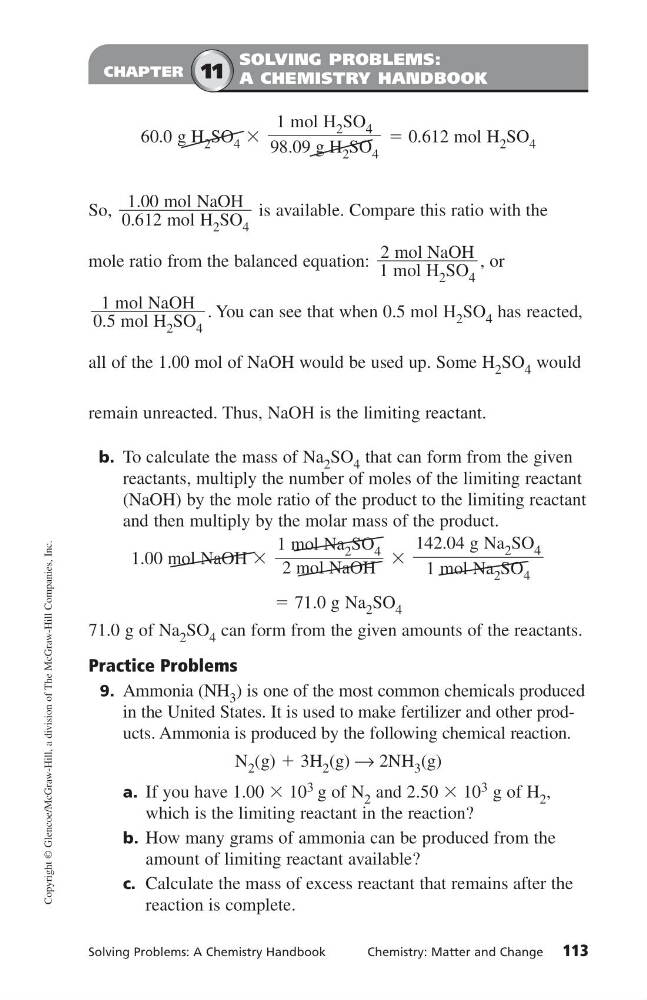
60.0 g H 2 SO 4 ϫ
ϭ 0.612 mol H 2 SO 4
So,
is available. Compare this ratio with the
mole ratio from the balanced equation:
, or
. You can see that when 0.5 mol H 2 SO 4 has reacted,
all of the 1.00 mol of NaOH would be used up. Some H 2 SO 4 would
remain unreacted. Thus, NaOH is the limiting reactant.
b. To calculate the mass of Na 2 SO 4 that can form from the given
reactants, multiply the number of moles of the limiting reactant
(NaOH) by the mole ratio of the product to the limiting reactant
and then multiply by the molar mass of the product.
1.00 mol NaOH ϫ
ϫ
ϭ 71.0 g Na 2 SO 4
71.0 g of Na 2 SO 4 can form from the given amounts of the reactants.
Practice Problems
9. Ammonia (NH 3 ) is one of the most common chemicals produced
in the United States. It is used to make fertilizer and other products. Ammonia is produced by the following chemical reaction.
N 2 (g) ϩ 3H 2 (g) 0 2NH 3 (g)
a. If you have 1.00 ϫ 10 3 g of N 2 and 2.50 ϫ 10 3 g of H 2 ,
which is the limiting reactant in the reaction?
b. How many grams of ammonia can be produced from the
amount of limiting reactant available?
c. Calculate the mass of excess reactant that remains after the
reaction is complete.
142.04 g Na 2 SO 4
ᎏᎏ
1 mol Na 2 SO 4
1 mol Na 2 SO 4
ᎏᎏ
2 mol NaOH
1 mol NaOH
ᎏᎏ
0.5 mol H 2 SO 4
2 mol NaOH
ᎏᎏ
1 mol H 2 SO 4
1.00 mol NaOH
ᎏᎏ
0.612 mol H 2 SO 4
1 mol H 2 SO 4
ᎏᎏ
98.09 g H 2 SO 4
Solving Problems: A Chemistry Handbook
Chemistry: Matter and Change
113
SOLVING PROBLEMS:
A CHEMISTRY HANDBOOK
CHAPTER 11
60.0 g H 2 SO 4 ϫ
ϭ 0.612 mol H 2 SO 4
So,
is available. Compare this ratio with the
mole ratio from the balanced equation:
, or
. You can see that when 0.5 mol H 2 SO 4 has reacted,
all of the 1.00 mol of NaOH would be used up. Some H 2 SO 4 would
remain unreacted. Thus, NaOH is the limiting reactant.
b. To calculate the mass of Na 2 SO 4 that can form from the given
reactants, multiply the number of moles of the limiting reactant
(NaOH) by the mole ratio of the product to the limiting reactant
and then multiply by the molar mass of the product.
1.00 mol NaOH ϫ
ϫ
ϭ 71.0 g Na 2 SO 4
71.0 g of Na 2 SO 4 can form from the given amounts of the reactants.
Practice Problems
9. Ammonia (NH 3 ) is one of the most common chemicals produced
in the United States. It is used to make fertilizer and other products. Ammonia is produced by the following chemical reaction.
N 2 (g) ϩ 3H 2 (g) 0 2NH 3 (g)
a. If you have 1.00 ϫ 10 3 g of N 2 and 2.50 ϫ 10 3 g of H 2 ,
which is the limiting reactant in the reaction?
b. How many grams of ammonia can be produced from the
amount of limiting reactant available?
c. Calculate the mass of excess reactant that remains after the
reaction is complete.
142.04 g Na 2 SO 4
ᎏᎏ
1 mol Na 2 SO 4
1 mol Na 2 SO 4
ᎏᎏ
2 mol NaOH
1 mol NaOH
ᎏᎏ
0.5 mol H 2 SO 4
2 mol NaOH
ᎏᎏ
1 mol H 2 SO 4
1.00 mol NaOH
ᎏᎏ
0.612 mol H 2 SO 4
1 mol H 2 SO 4
ᎏᎏ
98.09 g H 2 SO 4