

Copyright © Glencoe/McGraw-Hill, a division of The McGraw-Hill Companies, Inc.
4 Chemistry: Matter and Change
Solving Problems: A Chemistry Handbook
SOLVING PROBLEMS:
A CHEMISTRY HANDBOOK
CHAPTER
1
any given time, they are always subject to new experimental data
and are modified to include new data.
A scientific law describes a relationship in nature that is supported by many experiments and for which no exception has been
found. Scientists may use models and theories to explain why this
relationship exists.
1.4 Scientific Research
Pure research is done to gain knowledge for the sake of knowledge
itself. Molina and Rowland’s research on the behavior of CFCs—
showing that in the lab CFCs could speed up the breakdown of
ozone—was motivated by their curiosity and is an example of pure
research. Applied research is undertaken to solve a specific problem. Scientists are conducting experiments to find chemicals to
replace CFCs. These experiments are examples of applied research.
Laboratory safety During your study of chemistry, you will
conduct experiments in the laboratory. When working in the lab, you
are responsible for the safety of yourself and others working around
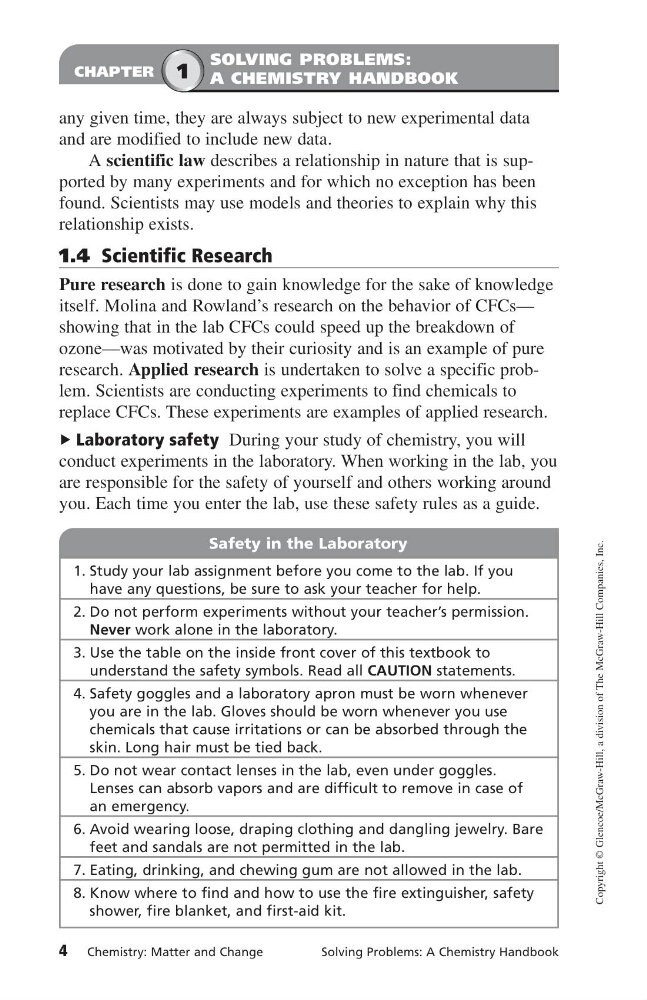
you. Each time you enter the lab, use these safety rules as a guide.
▲
Safety in the Laboratory
1. Study your lab assignment before you come to the lab. If you
have any questions, be sure to ask your teacher for help.
2. Do not perform experiments without your teacher’s permission.
Never work alone in the laboratory.
3. Use the table on the inside front cover of this textbook to
understand the safety symbols. Read all CAUTION statements.
4. Safety goggles and a laboratory apron must be worn whenever
you are in the lab. Gloves should be worn whenever you use
chemicals that cause irritations or can be absorbed through the
skin. Long hair must be tied back.
5. Do not wear contact lenses in the lab, even under goggles.
Lenses can absorb vapors and are difficult to remove in case of
an emergency.
6. Avoid wearing loose, draping clothing and dangling jewelry. Bare
feet and sandals are not permitted in the lab.
7. Eating, drinking, and chewing gum are not allowed in the lab.
8. Know where to find and how to use the fire extinguisher, safety
shower, fire blanket, and first-aid kit.
4 Chemistry: Matter and Change
Solving Problems: A Chemistry Handbook
SOLVING PROBLEMS:
A CHEMISTRY HANDBOOK
CHAPTER
1
any given time, they are always subject to new experimental data
and are modified to include new data.
A scientific law describes a relationship in nature that is supported by many experiments and for which no exception has been
found. Scientists may use models and theories to explain why this
relationship exists.
1.4 Scientific Research
Pure research is done to gain knowledge for the sake of knowledge
itself. Molina and Rowland’s research on the behavior of CFCs—
showing that in the lab CFCs could speed up the breakdown of
ozone—was motivated by their curiosity and is an example of pure
research. Applied research is undertaken to solve a specific problem. Scientists are conducting experiments to find chemicals to
replace CFCs. These experiments are examples of applied research.
Laboratory safety During your study of chemistry, you will
conduct experiments in the laboratory. When working in the lab, you
are responsible for the safety of yourself and others working around
you. Each time you enter the lab, use these safety rules as a guide.
▲
Safety in the Laboratory
1. Study your lab assignment before you come to the lab. If you
have any questions, be sure to ask your teacher for help.
2. Do not perform experiments without your teacher’s permission.
Never work alone in the laboratory.
3. Use the table on the inside front cover of this textbook to
understand the safety symbols. Read all CAUTION statements.
4. Safety goggles and a laboratory apron must be worn whenever
you are in the lab. Gloves should be worn whenever you use
chemicals that cause irritations or can be absorbed through the
skin. Long hair must be tied back.
5. Do not wear contact lenses in the lab, even under goggles.
Lenses can absorb vapors and are difficult to remove in case of
an emergency.
6. Avoid wearing loose, draping clothing and dangling jewelry. Bare
feet and sandals are not permitted in the lab.
7. Eating, drinking, and chewing gum are not allowed in the lab.
8. Know where to find and how to use the fire extinguisher, safety
shower, fire blanket, and first-aid kit.