

Copyright © Glencoe/McGraw-Hill, a division of The McGraw-Hill Companies, Inc.
Solving Problems: A Chemistry Handbook
Chemistry: Matter and Change
109
SOLVING PROBLEMS:
A CHEMISTRY HANDBOOK
CHAPTER 11
4. Balance the following equation and answer the questions below.
KClO 3 (s) 0 KCl(s) ϩ O 2 (g)
a. How many moles of O 2 are produced from 10 moles of
KClO 3 ?
b. How many moles of KCl are produced using 3 moles of
KClO 3 ?
c. How many moles of KClO 3 are needed to produce 50 moles
of O 2 ?
Stoichiometric mole-to-mass conversion A mole-to-mass
conversion allows you to calculate the mass of a product or reactant
in a chemical reaction given the number of moles of a reactant or
product.
Example Problem 11-3
Stoichiometric Mole-to-Mass Conversion
The following reaction occurs in plants undergoing photosynthesis.
6CO 2 (g) ϩ 6H 2 O(l) 0 C 6 H 12 O 6 (s) ϩ 6O 2 (g)
How many grams of glucose (C 6 H 12 O 6 ) are produced when
24.0 moles of carbon dioxide reacts in excess water?
Determine the number of moles of glucose produced by the given
amount of carbon dioxide.
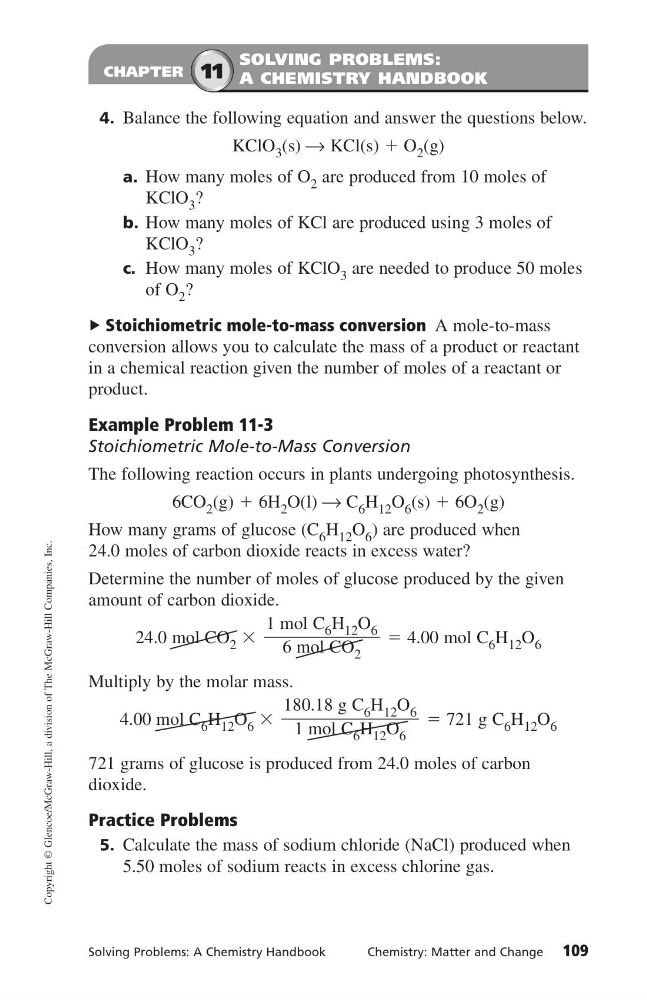
24.0 mol CO 2 ϫ
ϭ 4.00 mol C 6 H 12 O 6
Multiply by the molar mass.
4.00 mol C 6 H 12 O 6 ϫ
ϭ 721 g C 6 H 12 O 6
721 grams of glucose is produced from 24.0 moles of carbon
dioxide.
Practice Problems
5. Calculate the mass of sodium chloride (NaCl) produced when
5.50 moles of sodium reacts in excess chlorine gas.
180.18 g C 6 H 12 O 6
ᎏᎏ
1 mol C 6 H 12 O 6
1 mol C 6 H 12 O 6
ᎏᎏ
6 mol CO 2
▲
Solving Problems: A Chemistry Handbook
Chemistry: Matter and Change
109
SOLVING PROBLEMS:
A CHEMISTRY HANDBOOK
CHAPTER 11
4. Balance the following equation and answer the questions below.
KClO 3 (s) 0 KCl(s) ϩ O 2 (g)
a. How many moles of O 2 are produced from 10 moles of
KClO 3 ?
b. How many moles of KCl are produced using 3 moles of
KClO 3 ?
c. How many moles of KClO 3 are needed to produce 50 moles
of O 2 ?
Stoichiometric mole-to-mass conversion A mole-to-mass
conversion allows you to calculate the mass of a product or reactant
in a chemical reaction given the number of moles of a reactant or
product.
Example Problem 11-3
Stoichiometric Mole-to-Mass Conversion
The following reaction occurs in plants undergoing photosynthesis.
6CO 2 (g) ϩ 6H 2 O(l) 0 C 6 H 12 O 6 (s) ϩ 6O 2 (g)
How many grams of glucose (C 6 H 12 O 6 ) are produced when
24.0 moles of carbon dioxide reacts in excess water?
Determine the number of moles of glucose produced by the given
amount of carbon dioxide.
24.0 mol CO 2 ϫ
ϭ 4.00 mol C 6 H 12 O 6
Multiply by the molar mass.
4.00 mol C 6 H 12 O 6 ϫ
ϭ 721 g C 6 H 12 O 6
721 grams of glucose is produced from 24.0 moles of carbon
dioxide.
Practice Problems
5. Calculate the mass of sodium chloride (NaCl) produced when
5.50 moles of sodium reacts in excess chlorine gas.
180.18 g C 6 H 12 O 6
ᎏᎏ
1 mol C 6 H 12 O 6
1 mol C 6 H 12 O 6
ᎏᎏ
6 mol CO 2
▲