

Copyright © Glencoe/McGraw-Hill, a division of The McGraw-Hill Companies, Inc.
96 Chemistry: Matter and Change
Solving Problems: A Chemistry Handbook
SOLVING PROBLEMS:
A CHEMISTRY HANDBOOK
CHAPTER 10
Example Problem 10-6
Converting Mass of a Compound to Moles
At 4.0°C, water has a density of 1.000 g/mL. How many moles of
water are in 1.000 kg of water (1.000 L at 4.0°C)?
Before you can calculate moles, you must determine the molar mass
of water (H 2 O). A mole of water consists of two moles of hydrogen
atoms and one mole of oxygen atoms.
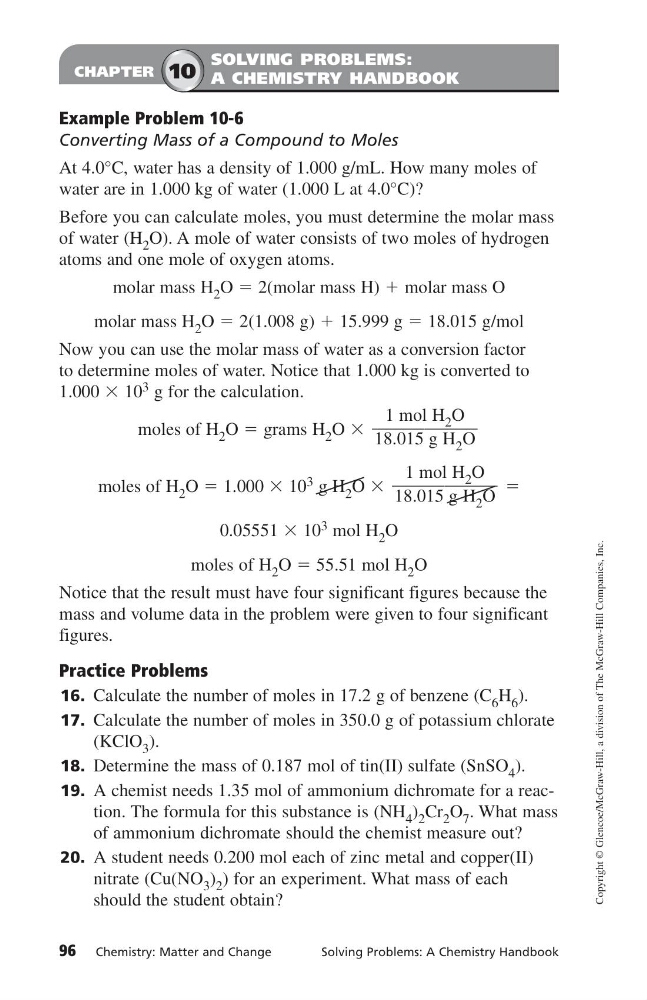
molar mass H 2 O ϭ 2(molar mass H) ϩ molar mass O
molar mass H 2 O ϭ 2(1.008 g) ϩ 15.999 g ϭ 18.015 g/mol
Now you can use the molar mass of water as a conversion factor
to determine moles of water. Notice that 1.000 kg is converted to
1.000 ϫ 10 3 g for the calculation.
moles of H 2 O ϭ grams H 2 O ϫ
moles of H 2 O ϭ 1.000 ϫ 10 3 g H 2 O ϫ
ϭ
0.05551 ϫ 10 3 mol H 2 O
moles of H 2 O ϭ 55.51 mol H 2 O
Notice that the result must have four significant figures because the
mass and volume data in the problem were given to four significant
figures.
Practice Problems
16. Calculate the number of moles in 17.2 g of benzene (C 6 H 6 ).
17. Calculate the number of moles in 350.0 g of potassium chlorate
(KClO 3 ).
18. Determine the mass of 0.187 mol of tin(II) sulfate (SnSO 4 ).
19. A chemist needs 1.35 mol of ammonium dichromate for a reaction. The formula for this substance is (NH 4 ) 2 Cr 2 O 7 . What mass
of ammonium dichromate should the chemist measure out?
20. A student needs 0.200 mol each of zinc metal and copper(II)
nitrate (Cu(NO 3 ) 2 ) for an experiment. What mass of each
should the student obtain?
1 mol H 2 O
ᎏᎏ
18.015 g H 2 O
1 mol H 2 O
ᎏᎏ
18.015 g H 2 O
96 Chemistry: Matter and Change
Solving Problems: A Chemistry Handbook
SOLVING PROBLEMS:
A CHEMISTRY HANDBOOK
CHAPTER 10
Example Problem 10-6
Converting Mass of a Compound to Moles
At 4.0°C, water has a density of 1.000 g/mL. How many moles of
water are in 1.000 kg of water (1.000 L at 4.0°C)?
Before you can calculate moles, you must determine the molar mass
of water (H 2 O). A mole of water consists of two moles of hydrogen
atoms and one mole of oxygen atoms.
molar mass H 2 O ϭ 2(molar mass H) ϩ molar mass O
molar mass H 2 O ϭ 2(1.008 g) ϩ 15.999 g ϭ 18.015 g/mol
Now you can use the molar mass of water as a conversion factor
to determine moles of water. Notice that 1.000 kg is converted to
1.000 ϫ 10 3 g for the calculation.
moles of H 2 O ϭ grams H 2 O ϫ
moles of H 2 O ϭ 1.000 ϫ 10 3 g H 2 O ϫ
ϭ
0.05551 ϫ 10 3 mol H 2 O
moles of H 2 O ϭ 55.51 mol H 2 O
Notice that the result must have four significant figures because the
mass and volume data in the problem were given to four significant
figures.
Practice Problems
16. Calculate the number of moles in 17.2 g of benzene (C 6 H 6 ).
17. Calculate the number of moles in 350.0 g of potassium chlorate
(KClO 3 ).
18. Determine the mass of 0.187 mol of tin(II) sulfate (SnSO 4 ).
19. A chemist needs 1.35 mol of ammonium dichromate for a reaction. The formula for this substance is (NH 4 ) 2 Cr 2 O 7 . What mass
of ammonium dichromate should the chemist measure out?
20. A student needs 0.200 mol each of zinc metal and copper(II)
nitrate (Cu(NO 3 ) 2 ) for an experiment. What mass of each
should the student obtain?
1 mol H 2 O
ᎏᎏ
18.015 g H 2 O
1 mol H 2 O
ᎏᎏ
18.015 g H 2 O