

formation of a covalent bond with a trihalo compound
contained in the PA gel [52]. The sensitivity is comparable to
that of Coomassie staining (20–50 ng protein). The modifications of the protein are minimal and do not mimic posttranslational modifications so that the protein can be directly
used in downstream applications such as MS and western blotting. The modified proteins can be visualized repeatedly on the
gel or on blotting membranes. Provided the protein has Trp
residues, stain-free methods are simple and highly reliable.
The most sensitive method to detect proteins is autoradiography or fluorography. Radioactive labeled proteins are visualized after gel electrophoresis by detecting radioactive emission
of the protein bands on X-ray films. Autoradiography, however,
is usually not used on an every-day-basis in protein QC and
requires specialized equipment; see Ref. 53 for protocols.
9. Detailed settings will be instrument dependent. A typical starting point is 1 nm bandwidth, 0.2 –0.5 nm data pitch, 0.5 –1 s
response time per point or scanning speed 50 nm/min, and
5–10 accumulations. The far-UV wavelength range is
260–185 nm and the near-UV wavelength range is
340–250 nm.
10. Quantitative comparison of spectra may require, or can be
enhanced by, additional analyses. Since the measured CD signal
will be proportional to the number of amino acids in the
protein in addition to the concentration, in order to enable
comparison between spectra of different proteins, the ellipticity
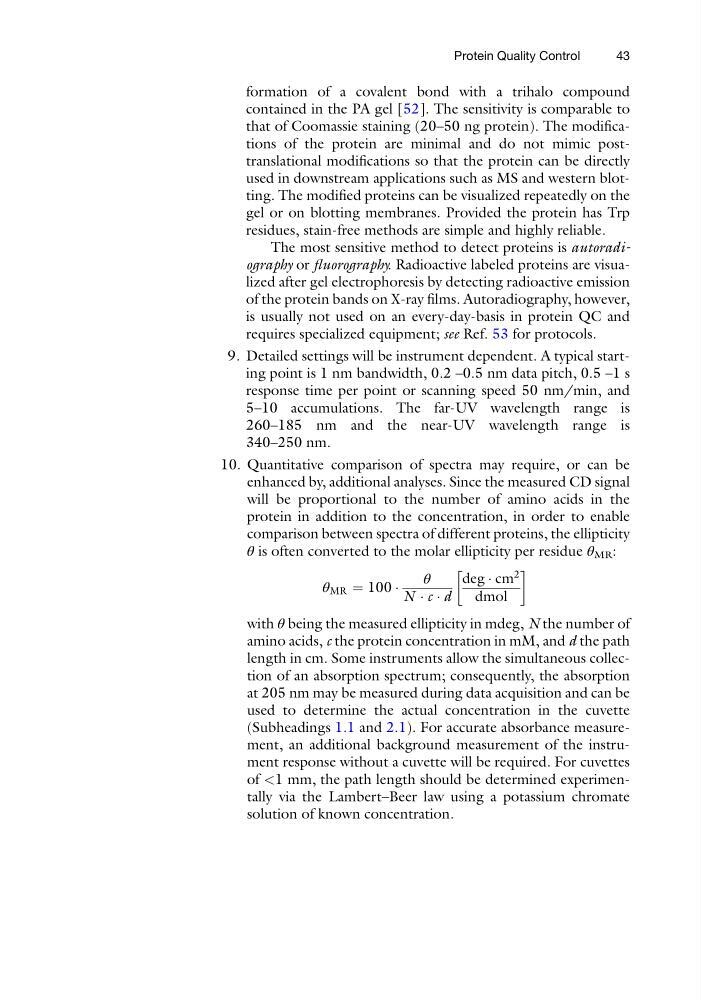
θ is often converted to the molar ellipticity per residue θ MR :
θ MR ¼ 100 Á
θ
N Á c Á d
deg Á cm
2
dmol
with θ being the measured ellipticity in mdeg, N the number of
amino acids, c the protein concentration in mM, and d the path
length in cm. Some instruments allow the simultaneous collection of an absorption spectrum; consequently, the absorption
at 205 nm may be measured during data acquisition and can be
used to determine the actual concentration in the cuvette
(Subheadings 1.1 and 2.1). For accurate absorbance measurement, an additional background measurement of the instrument response without a cuvette will be required. For cuvettes
of <1 mm, the path length should be determined experimentally via the Lambert–Beer law using a potassium chromate
solution of known concentration.
Protein Quality Control
43
contained in the PA gel [52]. The sensitivity is comparable to
that of Coomassie staining (20–50 ng protein). The modifications of the protein are minimal and do not mimic posttranslational modifications so that the protein can be directly
used in downstream applications such as MS and western blotting. The modified proteins can be visualized repeatedly on the
gel or on blotting membranes. Provided the protein has Trp
residues, stain-free methods are simple and highly reliable.
The most sensitive method to detect proteins is autoradiography or fluorography. Radioactive labeled proteins are visualized after gel electrophoresis by detecting radioactive emission
of the protein bands on X-ray films. Autoradiography, however,
is usually not used on an every-day-basis in protein QC and
requires specialized equipment; see Ref. 53 for protocols.
9. Detailed settings will be instrument dependent. A typical starting point is 1 nm bandwidth, 0.2 –0.5 nm data pitch, 0.5 –1 s
response time per point or scanning speed 50 nm/min, and
5–10 accumulations. The far-UV wavelength range is
260–185 nm and the near-UV wavelength range is
340–250 nm.
10. Quantitative comparison of spectra may require, or can be
enhanced by, additional analyses. Since the measured CD signal
will be proportional to the number of amino acids in the
protein in addition to the concentration, in order to enable
comparison between spectra of different proteins, the ellipticity
θ is often converted to the molar ellipticity per residue θ MR :
θ MR ¼ 100 Á
θ
N Á c Á d
deg Á cm
2
dmol
with θ being the measured ellipticity in mdeg, N the number of
amino acids, c the protein concentration in mM, and d the path
length in cm. Some instruments allow the simultaneous collection of an absorption spectrum; consequently, the absorption
at 205 nm may be measured during data acquisition and can be
used to determine the actual concentration in the cuvette
(Subheadings 1.1 and 2.1). For accurate absorbance measurement, an additional background measurement of the instrument response without a cuvette will be required. For cuvettes
of <1 mm, the path length should be determined experimentally via the Lambert–Beer law using a potassium chromate
solution of known concentration.
Protein Quality Control
43