

with that of the complex. In this case, the s-values will not
change with loading concentrations and binding affinity can be
easily estimated by determination of the concentrations of free
interaction partner and complex from the area under the peaks
in the c(s) distributions. However, it is important to check
whether the quantum yield of the labeled molecule is changed
by complex formation. Two peaks could also occur in case of a
fast reaction if the labeled molecule has a lower s-value than the
unlabeled interaction partner. Depending on the concentrations used, peaks of free labeled molecules as well as of the
reaction boundary can occur in the c(s) distributions. In this
case, the s-value of the reaction boundary is expected to change
with loading concentrations. In such a case, it would be easier
to label the faster sedimenting partner so that it can sediment in
a constant bath of an excess of the slower one.
16. Since SEDPHAT is not able to handle a concentration of 0 in
its fitting procedure, a very low concentration of A (e.g.,
0.001 μM) has to be entered into the file for the sample
where only B was present.
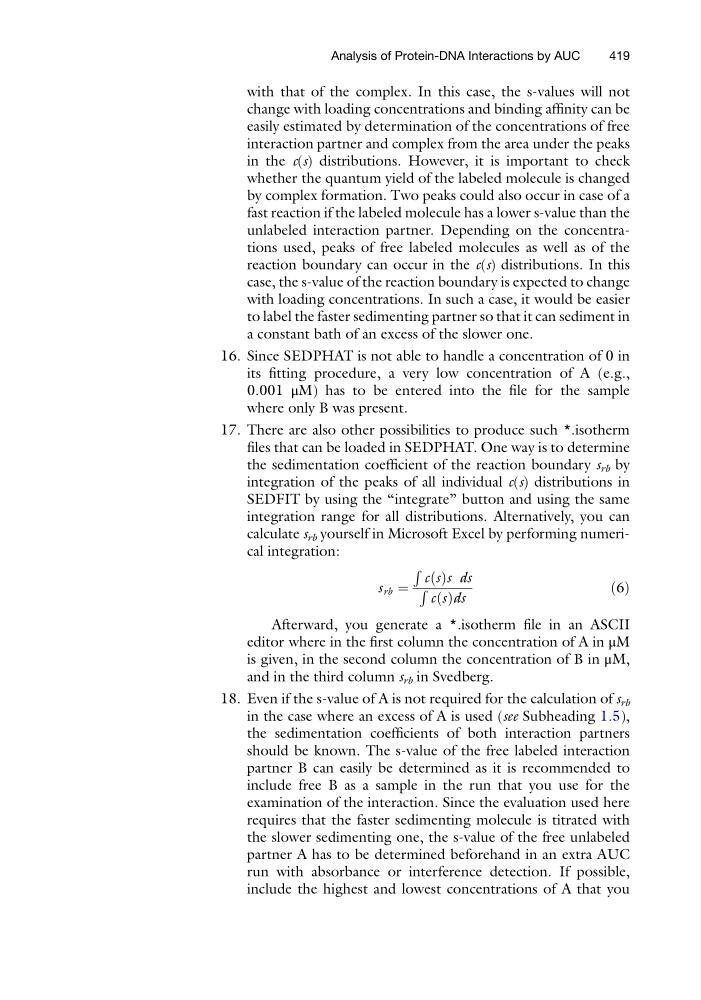
17. There are also other possibilities to produce such *.isotherm
files that can be loaded in SEDPHAT. One way is to determine
the sedimentation coefficient of the reaction boundary s rb by
integration of the peaks of all individual c(s) distributions in
SEDFIT by using the “integrate” button and using the same
integration range for all distributions. Alternatively, you can
calculate s rb yourself in Microsoft Excel by performing numerical integration:
s rb ¼
R
c s
ð Þs ds
R
c s
ð Þds
ð6Þ
Afterward, you generate a *.isotherm file in an ASCII
editor where in the first column the concentration of A in μM
is given, in the second column the concentration of B in μM,
and in the third column s rb in Svedberg.
18. Even if the s-value of A is not required for the calculation of s rb
in the case where an excess of A is used (see Subheading 1.5),
the sedimentation coefficients of both interaction partners
should be known. The s-value of the free labeled interaction
partner B can easily be determined as it is recommended to
include free B as a sample in the run that you use for the
examination of the interaction. Since the evaluation used here
requires that the faster sedimenting molecule is titrated with
the slower sedimenting one, the s-value of the free unlabeled
partner A has to be determined beforehand in an extra AUC
run with absorbance or interference detection. If possible,
include the highest and lowest concentrations of A that you
Analysis of Protein-DNA Interactions by AUC
419
change with loading concentrations and binding affinity can be
easily estimated by determination of the concentrations of free
interaction partner and complex from the area under the peaks
in the c(s) distributions. However, it is important to check
whether the quantum yield of the labeled molecule is changed
by complex formation. Two peaks could also occur in case of a
fast reaction if the labeled molecule has a lower s-value than the
unlabeled interaction partner. Depending on the concentrations used, peaks of free labeled molecules as well as of the
reaction boundary can occur in the c(s) distributions. In this
case, the s-value of the reaction boundary is expected to change
with loading concentrations. In such a case, it would be easier
to label the faster sedimenting partner so that it can sediment in
a constant bath of an excess of the slower one.
16. Since SEDPHAT is not able to handle a concentration of 0 in
its fitting procedure, a very low concentration of A (e.g.,
0.001 μM) has to be entered into the file for the sample
where only B was present.
17. There are also other possibilities to produce such *.isotherm
files that can be loaded in SEDPHAT. One way is to determine
the sedimentation coefficient of the reaction boundary s rb by
integration of the peaks of all individual c(s) distributions in
SEDFIT by using the “integrate” button and using the same
integration range for all distributions. Alternatively, you can
calculate s rb yourself in Microsoft Excel by performing numerical integration:
s rb ¼
R
c s
ð Þs ds
R
c s
ð Þds
ð6Þ
Afterward, you generate a *.isotherm file in an ASCII
editor where in the first column the concentration of A in μM
is given, in the second column the concentration of B in μM,
and in the third column s rb in Svedberg.
18. Even if the s-value of A is not required for the calculation of s rb
in the case where an excess of A is used (see Subheading 1.5),
the sedimentation coefficients of both interaction partners
should be known. The s-value of the free labeled interaction
partner B can easily be determined as it is recommended to
include free B as a sample in the run that you use for the
examination of the interaction. Since the evaluation used here
requires that the faster sedimenting molecule is titrated with
the slower sedimenting one, the s-value of the free unlabeled
partner A has to be determined beforehand in an extra AUC
run with absorbance or interference detection. If possible,
include the highest and lowest concentrations of A that you
Analysis of Protein-DNA Interactions by AUC
419