

of single components even in complex protein or protein/DNA
mixtures. Since additives like nucleotides also do not contribute to
the fluorescence signal, they can be used without disturbing the
measurement.
1.2 Interaction
of the Pol III Clamp
Loader
with SSB-Saturated
Template/Primer
At the bacterial replication fork, several protein complexes are
involved in the protein–DNA and protein–protein interactions
that are required for the exact duplication of the bacterial chromosome. In E. coli, the main replication enzyme is DNA polymerase
III holoenzyme (pol III). It consists of three subcomplexes: the
core polymerase αεθ that holds the actual 5
0 –3
0 DNA polymerase
activity and the 3
0 –5
0 exonucleolytical proofreading activity, the
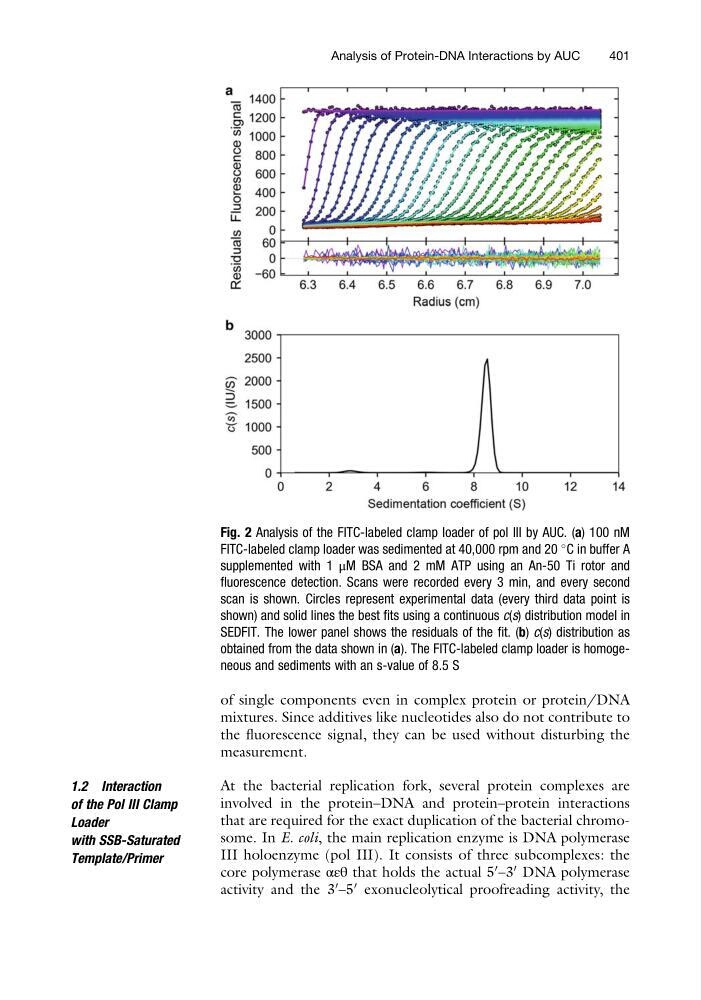
Fig. 2 Analysis of the FITC-labeled clamp loader of pol III by AUC. (a) 100 nM
FITC-labeled clamp loader was sedimented at 40,000 rpm and 20
C in buffer A
supplemented with 1 μM BSA and 2 mM ATP using an An-50 Ti rotor and
fluorescence detection. Scans were recorded every 3 min, and every second
scan is shown. Circles represent experimental data (every third data point is
shown) and solid lines the best fits using a continuous c(s) distribution model in
SEDFIT. The lower panel shows the residuals of the fit. (b) c(s) distribution as
obtained from the data shown in (a). The FITC-labeled clamp loader is homogeneous and sediments with an s-value of 8.5 S
Analysis of Protein-DNA Interactions by AUC
401
mixtures. Since additives like nucleotides also do not contribute to
the fluorescence signal, they can be used without disturbing the
measurement.
1.2 Interaction
of the Pol III Clamp
Loader
with SSB-Saturated
Template/Primer
At the bacterial replication fork, several protein complexes are
involved in the protein–DNA and protein–protein interactions
that are required for the exact duplication of the bacterial chromosome. In E. coli, the main replication enzyme is DNA polymerase
III holoenzyme (pol III). It consists of three subcomplexes: the
core polymerase αεθ that holds the actual 5
0 –3
0 DNA polymerase
activity and the 3
0 –5
0 exonucleolytical proofreading activity, the
Fig. 2 Analysis of the FITC-labeled clamp loader of pol III by AUC. (a) 100 nM
FITC-labeled clamp loader was sedimented at 40,000 rpm and 20
C in buffer A
supplemented with 1 μM BSA and 2 mM ATP using an An-50 Ti rotor and
fluorescence detection. Scans were recorded every 3 min, and every second
scan is shown. Circles represent experimental data (every third data point is
shown) and solid lines the best fits using a continuous c(s) distribution model in
SEDFIT. The lower panel shows the residuals of the fit. (b) c(s) distribution as
obtained from the data shown in (a). The FITC-labeled clamp loader is homogeneous and sediments with an s-value of 8.5 S
Analysis of Protein-DNA Interactions by AUC
401