

1.1 Basic Principles
of Light Scattering
Measurement
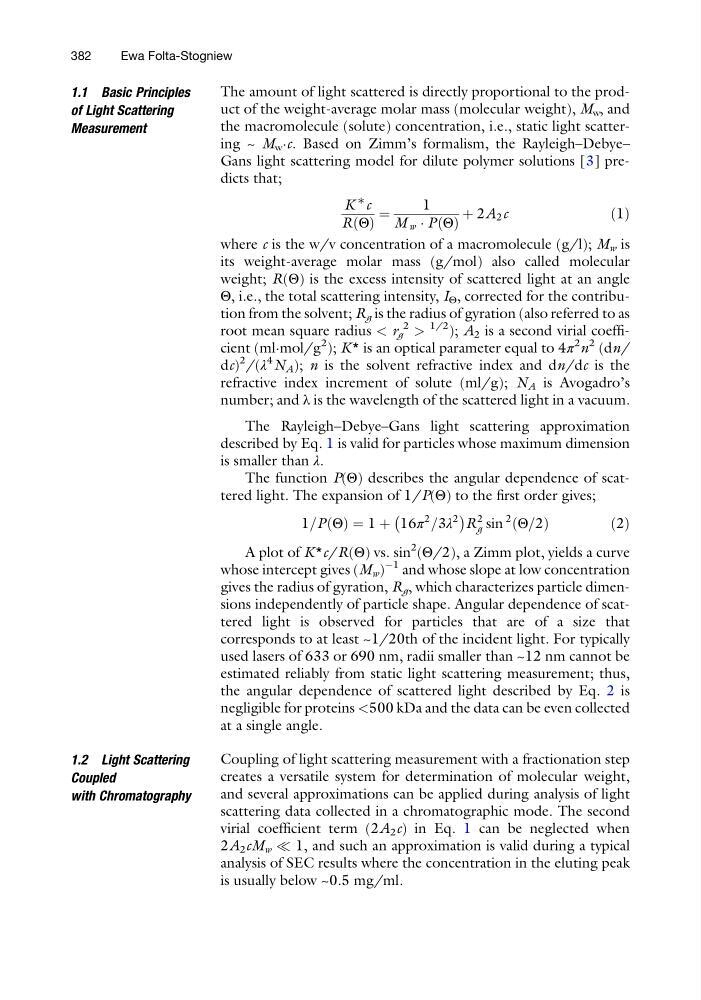
The amount of light scattered is directly proportional to the product of the weight-average molar mass (molecular weight), M w , and
the macromolecule (solute) concentration, i.e., static light scattering ~ M w ·c. Based on Zimm’s formalism, the Rayleigh–Debye–
Gans light scattering model for dilute polymer solutions [3] predicts that;
K
∗ c
RðΘÞ
¼
1
M w Á PðΘÞ
þ 2A 2 c
ð1Þ
where c is the w/v concentration of a macromolecule (g/l); M w is
its weight-average molar mass (g/mol) also called molecular
weight; R(Θ) is the excess intensity of scattered light at an angle
Θ, i.e., the total scattering intensity, I Θ , corrected for the contribution from the solvent; R g is the radius of gyration (also referred to as
root mean square radius < r g
2
>
1/2
); A 2 is a second virial coefficient (ml·mol/g
2 ); K* is an optical parameter equal to 4π
2
n
2 (dn/
dc)
2 /(λ
4 N A ); n is the solvent refractive index and dn/dc is the
refractive index increment of solute (ml/g); N A is Avogadro’s
number; and λ is the wavelength of the scattered light in a vacuum.
The Rayleigh–Debye–Gans light scattering approximation
described by Eq. 1 is valid for particles whose maximum dimension
is smaller than λ.
The function P(Θ) describes the angular dependence of scattered light. The expansion of 1/P(Θ) to the first order gives;
1=P Θ
ð Þ ¼ 1 þ 16π
2
=3λ
2
À
Á
R
2
g sin
2
Θ=2
ð
Þ
ð2Þ
A plot of K*c/R(Θ) vs. sin
2 (Θ/2), a Zimm plot, yields a curve
whose intercept gives (M w )
À1 and whose slope at low concentration
gives the radius of gyration, R g , which characterizes particle dimensions independently of particle shape. Angular dependence of scattered light is observed for particles that are of a size that
corresponds to at least ~1/20th of the incident light. For typically
used lasers of 633 or 690 nm, radii smaller than ~12 nm cannot be
estimated reliably from static light scattering measurement; thus,
the angular dependence of scattered light described by Eq. 2 is
negligible for proteins <500 kDa and the data can be even collected
at a single angle.
1.2 Light Scattering
Coupled
with Chromatography
Coupling of light scattering measurement with a fractionation step
creates a versatile system for determination of molecular weight,
and several approximations can be applied during analysis of light
scattering data collected in a chromatographic mode. The second
virial coefficient term (2A 2 c) in Eq. 1 can be neglected when
2A 2 cM w ( 1, and such an approximation is valid during a typical
analysis of SEC results where the concentration in the eluting peak
is usually below ~0.5 mg/ml.
382
Ewa Folta-Stogniew
of Light Scattering
Measurement
The amount of light scattered is directly proportional to the product of the weight-average molar mass (molecular weight), M w , and
the macromolecule (solute) concentration, i.e., static light scattering ~ M w ·c. Based on Zimm’s formalism, the Rayleigh–Debye–
Gans light scattering model for dilute polymer solutions [3] predicts that;
K
∗ c
RðΘÞ
¼
1
M w Á PðΘÞ
þ 2A 2 c
ð1Þ
where c is the w/v concentration of a macromolecule (g/l); M w is
its weight-average molar mass (g/mol) also called molecular
weight; R(Θ) is the excess intensity of scattered light at an angle
Θ, i.e., the total scattering intensity, I Θ , corrected for the contribution from the solvent; R g is the radius of gyration (also referred to as
root mean square radius < r g
2
>
1/2
); A 2 is a second virial coefficient (ml·mol/g
2 ); K* is an optical parameter equal to 4π
2
n
2 (dn/
dc)
2 /(λ
4 N A ); n is the solvent refractive index and dn/dc is the
refractive index increment of solute (ml/g); N A is Avogadro’s
number; and λ is the wavelength of the scattered light in a vacuum.
The Rayleigh–Debye–Gans light scattering approximation
described by Eq. 1 is valid for particles whose maximum dimension
is smaller than λ.
The function P(Θ) describes the angular dependence of scattered light. The expansion of 1/P(Θ) to the first order gives;
1=P Θ
ð Þ ¼ 1 þ 16π
2
=3λ
2
À
Á
R
2
g sin
2
Θ=2
ð
Þ
ð2Þ
A plot of K*c/R(Θ) vs. sin
2 (Θ/2), a Zimm plot, yields a curve
whose intercept gives (M w )
À1 and whose slope at low concentration
gives the radius of gyration, R g , which characterizes particle dimensions independently of particle shape. Angular dependence of scattered light is observed for particles that are of a size that
corresponds to at least ~1/20th of the incident light. For typically
used lasers of 633 or 690 nm, radii smaller than ~12 nm cannot be
estimated reliably from static light scattering measurement; thus,
the angular dependence of scattered light described by Eq. 2 is
negligible for proteins <500 kDa and the data can be even collected
at a single angle.
1.2 Light Scattering
Coupled
with Chromatography
Coupling of light scattering measurement with a fractionation step
creates a versatile system for determination of molecular weight,
and several approximations can be applied during analysis of light
scattering data collected in a chromatographic mode. The second
virial coefficient term (2A 2 c) in Eq. 1 can be neglected when
2A 2 cM w ( 1, and such an approximation is valid during a typical
analysis of SEC results where the concentration in the eluting peak
is usually below ~0.5 mg/ml.
382
Ewa Folta-Stogniew