

varying hyperbolically with protein concentration. For the
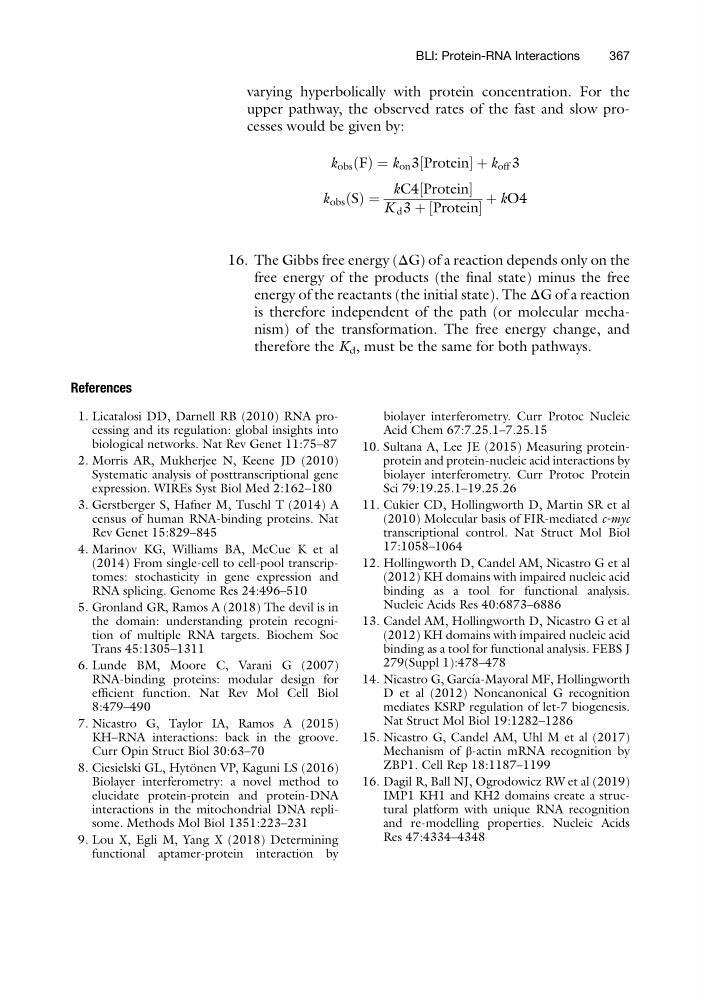
upper pathway, the observed rates of the fast and slow processes would be given by:
k obs F
ð Þ ¼ k on 3 Protein
½
þ k off 3
k obs S
ð Þ ¼
kC4 Protein
½
K d 3 þ Protein
½
þ kO4
16. The Gibbs free energy (ΔG) of a reaction depends only on the
free energy of the products (the final state) minus the free
energy of the reactants (the initial state). The ΔG of a reaction
is therefore independent of the path (or molecular mechanism) of the transformation. The free energy change, and
therefore the K d , must be the same for both pathways.
References
1. Licatalosi DD, Darnell RB (2010) RNA processing and its regulation: global insights into
biological networks. Nat Rev Genet 11:75–87
2. Morris AR, Mukherjee N, Keene JD (2010)
Systematic analysis of posttranscriptional gene
expression. WIREs Syst Biol Med 2:162–180
3. Gerstberger S, Hafner M, Tuschl T (2014) A
census of human RNA-binding proteins. Nat
Rev Genet 15:829–845
4. Marinov KG, Williams BA, McCue K et al
(2014) From single-cell to cell-pool transcriptomes: stochasticity in gene expression and
RNA splicing. Genome Res 24:496–510
5. Gronland GR, Ramos A (2018) The devil is in
the domain: understanding protein recognition of multiple RNA targets. Biochem Soc
Trans 45:1305–1311
6. Lunde BM, Moore C, Varani G (2007)
RNA-binding proteins: modular design for
efficient function. Nat Rev Mol Cell Biol
8:479–490
7. Nicastro G, Taylor IA, Ramos A (2015)
KH–RNA interactions: back in the groove.
Curr Opin Struct Biol 30:63–70
8. Ciesielski GL, Hyto ¨nen VP, Kaguni LS (2016)
Biolayer interferometry: a novel method to
elucidate protein-protein and protein-DNA
interactions in the mitochondrial DNA replisome. Methods Mol Biol 1351:223–231
9. Lou X, Egli M, Yang X (2018) Determining
functional aptamer-protein interaction by
biolayer interferometry. Curr Protoc Nucleic
Acid Chem 67:7.25.1–7.25.15
10. Sultana A, Lee JE (2015) Measuring proteinprotein and protein-nucleic acid interactions by
biolayer interferometry. Curr Protoc Protein
Sci 79:19.25.1–19.25.26
11. Cukier CD, Hollingworth D, Martin SR et al
(2010) Molecular basis of FIR-mediated c-myc
transcriptional control. Nat Struct Mol Biol
17:1058–1064
12. Hollingworth D, Candel AM, Nicastro G et al
(2012) KH domains with impaired nucleic acid
binding as a tool for functional analysis.
Nucleic Acids Res 40:6873–6886
13. Candel AM, Hollingworth D, Nicastro G et al
(2012) KH domains with impaired nucleic acid
binding as a tool for functional analysis. FEBS J
279(Suppl 1):478–478
14. Nicastro G, Garcı ´a-Mayoral MF, Hollingworth
D et al (2012) Noncanonical G recognition
mediates KSRP regulation of let-7 biogenesis.
Nat Struct Mol Biol 19:1282–1286
15. Nicastro G, Candel AM, Uhl M et al (2017)
Mechanism of β-actin mRNA recognition by
ZBP1. Cell Rep 18:1187–1199
16. Dagil R, Ball NJ, Ogrodowicz RW et al (2019)
IMP1 KH1 and KH2 domains create a structural platform with unique RNA recognition
and re-modelling properties. Nucleic Acids
Res 47:4334–4348
BLI: Protein-RNA Interactions
367
upper pathway, the observed rates of the fast and slow processes would be given by:
k obs F
ð Þ ¼ k on 3 Protein
½
þ k off 3
k obs S
ð Þ ¼
kC4 Protein
½
K d 3 þ Protein
½
þ kO4
16. The Gibbs free energy (ΔG) of a reaction depends only on the
free energy of the products (the final state) minus the free
energy of the reactants (the initial state). The ΔG of a reaction
is therefore independent of the path (or molecular mechanism) of the transformation. The free energy change, and
therefore the K d , must be the same for both pathways.
References
1. Licatalosi DD, Darnell RB (2010) RNA processing and its regulation: global insights into
biological networks. Nat Rev Genet 11:75–87
2. Morris AR, Mukherjee N, Keene JD (2010)
Systematic analysis of posttranscriptional gene
expression. WIREs Syst Biol Med 2:162–180
3. Gerstberger S, Hafner M, Tuschl T (2014) A
census of human RNA-binding proteins. Nat
Rev Genet 15:829–845
4. Marinov KG, Williams BA, McCue K et al
(2014) From single-cell to cell-pool transcriptomes: stochasticity in gene expression and
RNA splicing. Genome Res 24:496–510
5. Gronland GR, Ramos A (2018) The devil is in
the domain: understanding protein recognition of multiple RNA targets. Biochem Soc
Trans 45:1305–1311
6. Lunde BM, Moore C, Varani G (2007)
RNA-binding proteins: modular design for
efficient function. Nat Rev Mol Cell Biol
8:479–490
7. Nicastro G, Taylor IA, Ramos A (2015)
KH–RNA interactions: back in the groove.
Curr Opin Struct Biol 30:63–70
8. Ciesielski GL, Hyto ¨nen VP, Kaguni LS (2016)
Biolayer interferometry: a novel method to
elucidate protein-protein and protein-DNA
interactions in the mitochondrial DNA replisome. Methods Mol Biol 1351:223–231
9. Lou X, Egli M, Yang X (2018) Determining
functional aptamer-protein interaction by
biolayer interferometry. Curr Protoc Nucleic
Acid Chem 67:7.25.1–7.25.15
10. Sultana A, Lee JE (2015) Measuring proteinprotein and protein-nucleic acid interactions by
biolayer interferometry. Curr Protoc Protein
Sci 79:19.25.1–19.25.26
11. Cukier CD, Hollingworth D, Martin SR et al
(2010) Molecular basis of FIR-mediated c-myc
transcriptional control. Nat Struct Mol Biol
17:1058–1064
12. Hollingworth D, Candel AM, Nicastro G et al
(2012) KH domains with impaired nucleic acid
binding as a tool for functional analysis.
Nucleic Acids Res 40:6873–6886
13. Candel AM, Hollingworth D, Nicastro G et al
(2012) KH domains with impaired nucleic acid
binding as a tool for functional analysis. FEBS J
279(Suppl 1):478–478
14. Nicastro G, Garcı ´a-Mayoral MF, Hollingworth
D et al (2012) Noncanonical G recognition
mediates KSRP regulation of let-7 biogenesis.
Nat Struct Mol Biol 19:1282–1286
15. Nicastro G, Candel AM, Uhl M et al (2017)
Mechanism of β-actin mRNA recognition by
ZBP1. Cell Rep 18:1187–1199
16. Dagil R, Ball NJ, Ogrodowicz RW et al (2019)
IMP1 KH1 and KH2 domains create a structural platform with unique RNA recognition
and re-modelling properties. Nucleic Acids
Res 47:4334–4348
BLI: Protein-RNA Interactions
367