

The interaction of a binding partner with a molecule immobilized on the biosensor tip gives an increase in the distance between
the internal reference layer and material attached to the biosensor.
This results in a wavelength shift in the maximum of the interference pattern which is monitored in real time.
BLI can be used to analyze binding interactions of small molecules, proteins, antibodies, nucleic acids, viruses, or whole cells. It
can determine specificity, binding kinetics, and affinity and perform
quantitation assays. The tips of the biosensors are derivatized with a
range of different surface chemistries and can be used to analyze
macromolecules with different tags (e.g., His-tag, GST-tag, biotin). In the case of protein–nucleic acid interactions, biotinylated
nucleic acids can be immobilized on streptavidin sensors and binding of the protein partner can be recorded. One significant advantage of BLI is that only molecules binding to or dissociating from
the biosensor will change the interference pattern and generate an
instrument response. Unbound molecules and changes in the
refractive index of the solvent have no effect on the interference
pattern. A further advantage is that the measurement is nondestructive and samples are recoverable.
1.3 Kinetic Theory
Although all the Octet instruments come with built-in software for
curve analysis, it is of course advisable to fully understand the
kinetic theory that underpins the technique. In addition, if
in-house software for kinetic analysis is available, then complex
instrument response curves can be downloaded and analyzed
using more sophisticated approaches than those available with the
instrument.
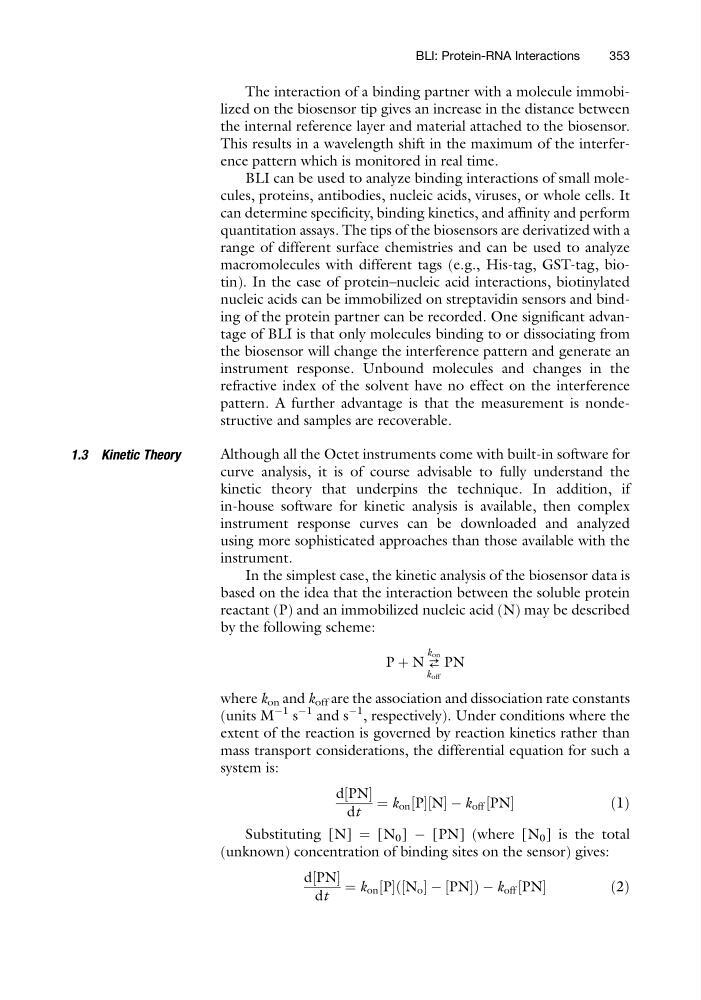
In the simplest case, the kinetic analysis of the biosensor data is
based on the idea that the interaction between the soluble protein
reactant (P) and an immobilized nucleic acid (N) may be described
by the following scheme:
P þ N ⇄
k on
k off
PN
where k on and k off are the association and dissociation rate constants
(units M
À1 s
À1 and s
À1
, respectively). Under conditions where the
extent of the reaction is governed by reaction kinetics rather than
mass transport considerations, the differential equation for such a
system is:
d PN
½
dt
¼ k on P
½ N
½ À k off PN
½
ð1Þ
Substituting [N] ¼ [N 0 ] À [PN] (where [N 0 ] is the total
(unknown) concentration of binding sites on the sensor) gives:
d PN
½
dt
¼ k on P
½ N o
½ À PN
½
ð
ÞÀk off PN
½
ð2Þ
BLI: Protein-RNA Interactions
353
the internal reference layer and material attached to the biosensor.
This results in a wavelength shift in the maximum of the interference pattern which is monitored in real time.
BLI can be used to analyze binding interactions of small molecules, proteins, antibodies, nucleic acids, viruses, or whole cells. It
can determine specificity, binding kinetics, and affinity and perform
quantitation assays. The tips of the biosensors are derivatized with a
range of different surface chemistries and can be used to analyze
macromolecules with different tags (e.g., His-tag, GST-tag, biotin). In the case of protein–nucleic acid interactions, biotinylated
nucleic acids can be immobilized on streptavidin sensors and binding of the protein partner can be recorded. One significant advantage of BLI is that only molecules binding to or dissociating from
the biosensor will change the interference pattern and generate an
instrument response. Unbound molecules and changes in the
refractive index of the solvent have no effect on the interference
pattern. A further advantage is that the measurement is nondestructive and samples are recoverable.
1.3 Kinetic Theory
Although all the Octet instruments come with built-in software for
curve analysis, it is of course advisable to fully understand the
kinetic theory that underpins the technique. In addition, if
in-house software for kinetic analysis is available, then complex
instrument response curves can be downloaded and analyzed
using more sophisticated approaches than those available with the
instrument.
In the simplest case, the kinetic analysis of the biosensor data is
based on the idea that the interaction between the soluble protein
reactant (P) and an immobilized nucleic acid (N) may be described
by the following scheme:
P þ N ⇄
k on
k off
PN
where k on and k off are the association and dissociation rate constants
(units M
À1 s
À1 and s
À1
, respectively). Under conditions where the
extent of the reaction is governed by reaction kinetics rather than
mass transport considerations, the differential equation for such a
system is:
d PN
½
dt
¼ k on P
½ N
½ À k off PN
½
ð1Þ
Substituting [N] ¼ [N 0 ] À [PN] (where [N 0 ] is the total
(unknown) concentration of binding sites on the sensor) gives:
d PN
½
dt
¼ k on P
½ N o
½ À PN
½
ð
ÞÀk off PN
½
ð2Þ
BLI: Protein-RNA Interactions
353