

B
C
A
1D
STD
Water-LOGSY
T2 filter
No competitor
+ competitor
No competitor
+ competitor
No competitor
+ competitor
No competitor
+ competitor
*
*
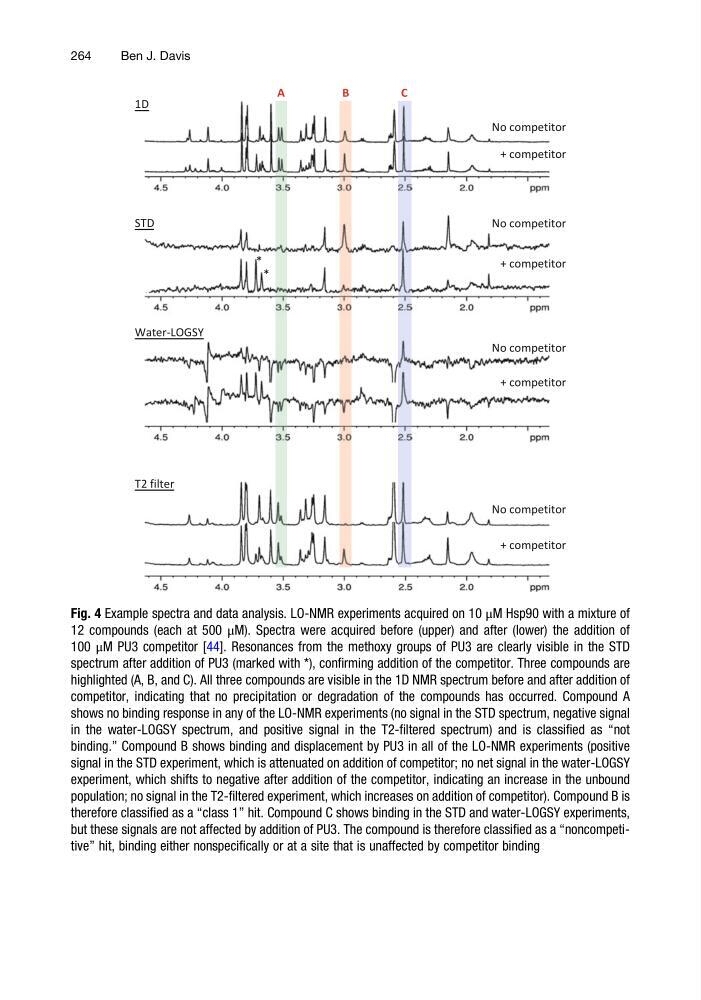
Fig. 4 Example spectra and data analysis. LO-NMR experiments acquired on 10 μM Hsp90 with a mixture of
12 compounds (each at 500 μM). Spectra were acquired before (upper) and after (lower) the addition of
100 μM PU3 competitor [44]. Resonances from the methoxy groups of PU3 are clearly visible in the STD
spectrum after addition of PU3 (marked with *), confirming addition of the competitor. Three compounds are
highlighted (A, B, and C). All three compounds are visible in the 1D NMR spectrum before and after addition of
competitor, indicating that no precipitation or degradation of the compounds has occurred. Compound A
shows no binding response in any of the LO-NMR experiments (no signal in the STD spectrum, negative signal
in the water-LOGSY spectrum, and positive signal in the T2-filtered spectrum) and is classified as “not
binding.” Compound B shows binding and displacement by PU3 in all of the LO-NMR experiments (positive
signal in the STD experiment, which is attenuated on addition of competitor; no net signal in the water-LOGSY
experiment, which shifts to negative after addition of the competitor, indicating an increase in the unbound
population; no signal in the T2-filtered experiment, which increases on addition of competitor). Compound B is
therefore classified as a “class 1” hit. Compound C shows binding in the STD and water-LOGSY experiments,
but these signals are not affected by addition of PU3. The compound is therefore classified as a “noncompetitive” hit, binding either nonspecifically or at a site that is unaffected by competitor binding
264
Ben J. Davis
C
A
1D
STD
Water-LOGSY
T2 filter
No competitor
+ competitor
No competitor
+ competitor
No competitor
+ competitor
No competitor
+ competitor
*
*
Fig. 4 Example spectra and data analysis. LO-NMR experiments acquired on 10 μM Hsp90 with a mixture of
12 compounds (each at 500 μM). Spectra were acquired before (upper) and after (lower) the addition of
100 μM PU3 competitor [44]. Resonances from the methoxy groups of PU3 are clearly visible in the STD
spectrum after addition of PU3 (marked with *), confirming addition of the competitor. Three compounds are
highlighted (A, B, and C). All three compounds are visible in the 1D NMR spectrum before and after addition of
competitor, indicating that no precipitation or degradation of the compounds has occurred. Compound A
shows no binding response in any of the LO-NMR experiments (no signal in the STD spectrum, negative signal
in the water-LOGSY spectrum, and positive signal in the T2-filtered spectrum) and is classified as “not
binding.” Compound B shows binding and displacement by PU3 in all of the LO-NMR experiments (positive
signal in the STD experiment, which is attenuated on addition of competitor; no net signal in the water-LOGSY
experiment, which shifts to negative after addition of the competitor, indicating an increase in the unbound
population; no signal in the T2-filtered experiment, which increases on addition of competitor). Compound B is
therefore classified as a “class 1” hit. Compound C shows binding in the STD and water-LOGSY experiments,
but these signals are not affected by addition of PU3. The compound is therefore classified as a “noncompetitive” hit, binding either nonspecifically or at a site that is unaffected by competitor binding
264
Ben J. Davis