

3 Methods
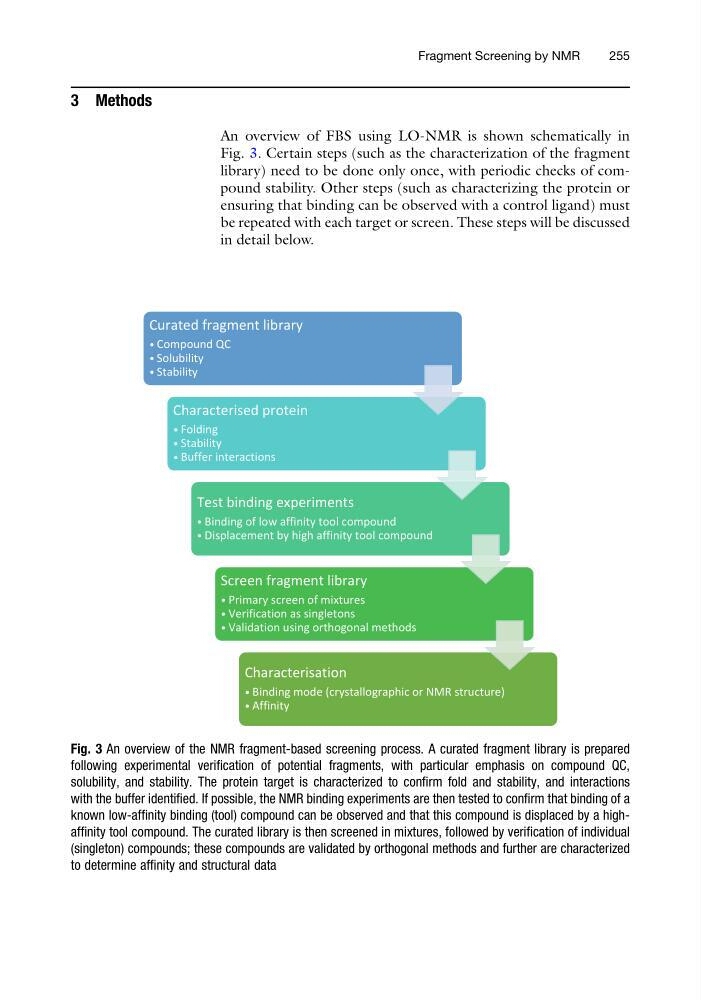
An overview of FBS using LO-NMR is shown schematically in
Fig. 3. Certain steps (such as the characterization of the fragment
library) need to be done only once, with periodic checks of compound stability. Other steps (such as characterizing the protein or
ensuring that binding can be observed with a control ligand) must
be repeated with each target or screen. These steps will be discussed
in detail below.
Curated fragment library
• Compound QC
• Solubility
• Stability
Characterised protein
• Folding
• Stability
• Buffer interactions
Test binding experiments
• Binding of low affinity tool compound
• Displacement by high affinity tool compound
Screen fragment library
• Primary screen of mixtures
• Verification as singletons
• Validation using orthogonal methods
Characterisation
• Binding mode (crystallographic or NMR structure)
• Affinity
Fig. 3 An overview of the NMR fragment-based screening process. A curated fragment library is prepared
following experimental verification of potential fragments, with particular emphasis on compound QC,
solubility, and stability. The protein target is characterized to confirm fold and stability, and interactions
with the buffer identified. If possible, the NMR binding experiments are then tested to confirm that binding of a
known low-affinity binding (tool) compound can be observed and that this compound is displaced by a highaffinity tool compound. The curated library is then screened in mixtures, followed by verification of individual
(singleton) compounds; these compounds are validated by orthogonal methods and further are characterized
to determine affinity and structural data
Fragment Screening by NMR
255
An overview of FBS using LO-NMR is shown schematically in
Fig. 3. Certain steps (such as the characterization of the fragment
library) need to be done only once, with periodic checks of compound stability. Other steps (such as characterizing the protein or
ensuring that binding can be observed with a control ligand) must
be repeated with each target or screen. These steps will be discussed
in detail below.
Curated fragment library
• Compound QC
• Solubility
• Stability
Characterised protein
• Folding
• Stability
• Buffer interactions
Test binding experiments
• Binding of low affinity tool compound
• Displacement by high affinity tool compound
Screen fragment library
• Primary screen of mixtures
• Verification as singletons
• Validation using orthogonal methods
Characterisation
• Binding mode (crystallographic or NMR structure)
• Affinity
Fig. 3 An overview of the NMR fragment-based screening process. A curated fragment library is prepared
following experimental verification of potential fragments, with particular emphasis on compound QC,
solubility, and stability. The protein target is characterized to confirm fold and stability, and interactions
with the buffer identified. If possible, the NMR binding experiments are then tested to confirm that binding of a
known low-affinity binding (tool) compound can be observed and that this compound is displaced by a highaffinity tool compound. The curated library is then screened in mixtures, followed by verification of individual
(singleton) compounds; these compounds are validated by orthogonal methods and further are characterized
to determine affinity and structural data
Fragment Screening by NMR
255