

and the ligand-binding site (either by using an existing assignment
of protein resonances or via comparison with the perturbations
induced by a known ligand).
15 N–
1
H correlation spectra are, however, sometimes prone to widespread perturbations caused by even
small alterations of secondary or tertiary structure making precise
localization of the binding site difficult. In such cases,
13
C–
1
H
correlation spectra can be more useful as they typically respond
only to more localized effects [24]. Generally, PO-NMR requires
large amounts of protein labeled with stable isotopes (
13
C or
15
N),
and in practice, this limits the widespread application to relatively
small proteins expressed to high levels in bacterial systems.
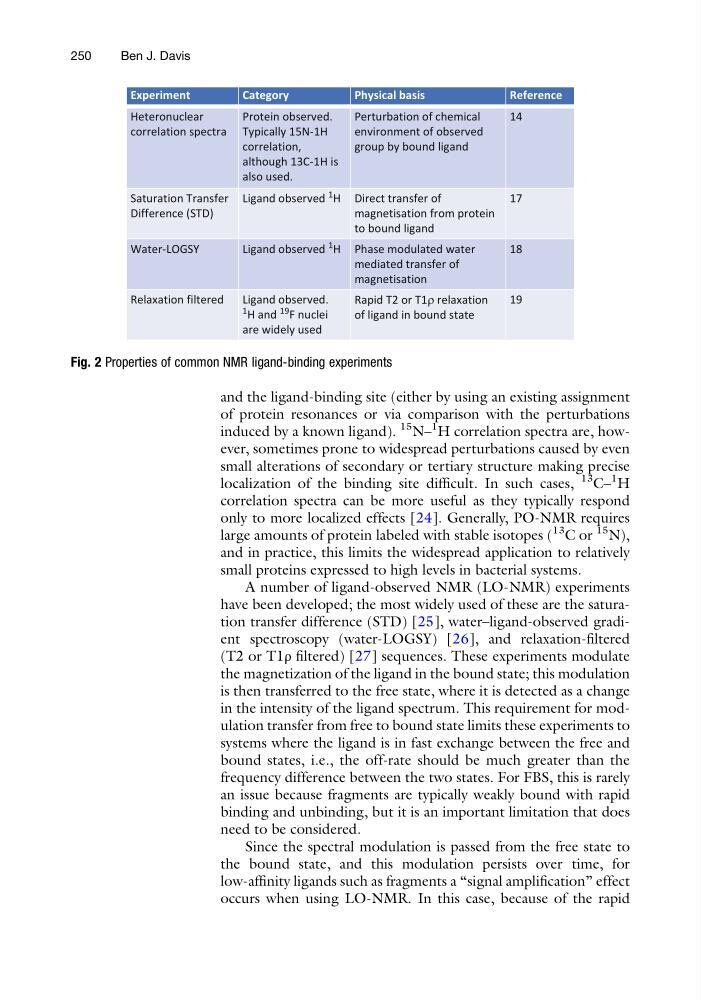
A number of ligand-observed NMR (LO-NMR) experiments
have been developed; the most widely used of these are the saturation transfer difference (STD) [25], water–ligand-observed gradient spectroscopy (water-LOGSY) [26], and relaxation-filtered
(T2 or T1ρ filtered) [27] sequences. These experiments modulate
the magnetization of the ligand in the bound state; this modulation
is then transferred to the free state, where it is detected as a change
in the intensity of the ligand spectrum. This requirement for modulation transfer from free to bound state limits these experiments to
systems where the ligand is in fast exchange between the free and
bound states, i.e., the off-rate should be much greater than the
frequency difference between the two states. For FBS, this is rarely
an issue because fragments are typically weakly bound with rapid
binding and unbinding, but it is an important limitation that does
need to be considered.
Since the spectral modulation is passed from the free state to
the bound state, and this modulation persists over time, for
low-affinity ligands such as fragments a “signal amplification” effect
occurs when using LO-NMR. In this case, because of the rapid
Experiment
Category
Physical basis
Reference
Heteronuclear
correlation spectra
Protein observed.
Typically 15N-1H
correlation,
although 13C-1H is
also used.
Perturbation of chemical
environment of observed
group by bound ligand
14
Saturation Transfer
Difference (STD)
Ligand observed
1
H Direct transfer of
magnetisation from protein
to bound ligand
17
Water-LOGSY
Ligand observed
1
H Phase modulated water
mediated transfer of
magnetisation
18
Relaxation filtered Ligand observed.
1 H and
19 F nuclei
are widely used
Rapid T2 or T1ρ relaxation
of ligand in bound state
19
Fig. 2 Properties of common NMR ligand-binding experiments
250
Ben J. Davis
of protein resonances or via comparison with the perturbations
induced by a known ligand).
15 N–
1
H correlation spectra are, however, sometimes prone to widespread perturbations caused by even
small alterations of secondary or tertiary structure making precise
localization of the binding site difficult. In such cases,
13
C–
1
H
correlation spectra can be more useful as they typically respond
only to more localized effects [24]. Generally, PO-NMR requires
large amounts of protein labeled with stable isotopes (
13
C or
15
N),
and in practice, this limits the widespread application to relatively
small proteins expressed to high levels in bacterial systems.
A number of ligand-observed NMR (LO-NMR) experiments
have been developed; the most widely used of these are the saturation transfer difference (STD) [25], water–ligand-observed gradient spectroscopy (water-LOGSY) [26], and relaxation-filtered
(T2 or T1ρ filtered) [27] sequences. These experiments modulate
the magnetization of the ligand in the bound state; this modulation
is then transferred to the free state, where it is detected as a change
in the intensity of the ligand spectrum. This requirement for modulation transfer from free to bound state limits these experiments to
systems where the ligand is in fast exchange between the free and
bound states, i.e., the off-rate should be much greater than the
frequency difference between the two states. For FBS, this is rarely
an issue because fragments are typically weakly bound with rapid
binding and unbinding, but it is an important limitation that does
need to be considered.
Since the spectral modulation is passed from the free state to
the bound state, and this modulation persists over time, for
low-affinity ligands such as fragments a “signal amplification” effect
occurs when using LO-NMR. In this case, because of the rapid
Experiment
Category
Physical basis
Reference
Heteronuclear
correlation spectra
Protein observed.
Typically 15N-1H
correlation,
although 13C-1H is
also used.
Perturbation of chemical
environment of observed
group by bound ligand
14
Saturation Transfer
Difference (STD)
Ligand observed
1
H Direct transfer of
magnetisation from protein
to bound ligand
17
Water-LOGSY
Ligand observed
1
H Phase modulated water
mediated transfer of
magnetisation
18
Relaxation filtered Ligand observed.
1 H and
19 F nuclei
are widely used
Rapid T2 or T1ρ relaxation
of ligand in bound state
19
Fig. 2 Properties of common NMR ligand-binding experiments
250
Ben J. Davis