

protein–ligand interactions which has led to biocalorimetry, and
ITC in particular, being described as the “gold standard” label-free
technique for their characterization. Furthermore, under constant
pressure (atmospheric), the measured heat of a protein–ligand
interaction equates to the enthalpy change (ΔH) of the process
that gives ITC an additional unique and direct insight into the
fundamental underlying thermodynamics.
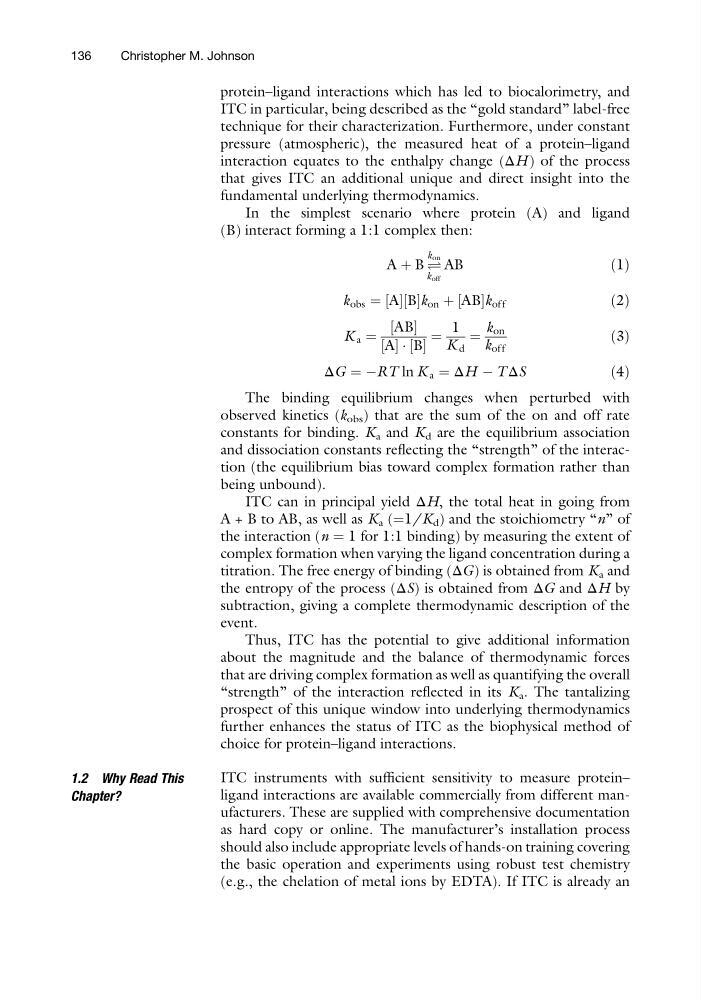
In the simplest scenario where protein (A) and ligand
(B) interact forming a 1:1 complex then:
A þ B Ð
k on
k off
AB
ð1Þ
k obs ¼ ½A½Bk on þ ½ABk of f
ð2Þ
K a ¼
½AB
½A Á ½B
¼
1
K d
¼
k on
k of f
ð3Þ
ΔG ¼ ÀRT ln K a ¼ ΔH À T ΔS
ð4Þ
The binding equilibrium changes when perturbed with
observed kinetics (k obs ) that are the sum of the on and off rate
constants for binding. K a and K d are the equilibrium association
and dissociation constants reflecting the “strength” of the interaction (the equilibrium bias toward complex formation rather than
being unbound).
ITC can in principal yield ΔH, the total heat in going from
A + B to AB, as well as K a (¼1/K d ) and the stoichiometry “n” of
the interaction (n ¼ 1 for 1:1 binding) by measuring the extent of
complex formation when varying the ligand concentration during a
titration. The free energy of binding (ΔG) is obtained from K a and
the entropy of the process (ΔS) is obtained from ΔG and ΔH by
subtraction, giving a complete thermodynamic description of the
event.
Thus, ITC has the potential to give additional information
about the magnitude and the balance of thermodynamic forces
that are driving complex formation as well as quantifying the overall
“strength” of the interaction reflected in its K a . The tantalizing
prospect of this unique window into underlying thermodynamics
further enhances the status of ITC as the biophysical method of
choice for protein–ligand interactions.
1.2 Why Read This
Chapter?
ITC instruments with sufficient sensitivity to measure protein–
ligand interactions are available commercially from different manufacturers. These are supplied with comprehensive documentation
as hard copy or online. The manufacturer’s installation process
should also include appropriate levels of hands-on training covering
the basic operation and experiments using robust test chemistry
(e.g., the chelation of metal ions by EDTA). If ITC is already an
136
Christopher M. Johnson
ITC in particular, being described as the “gold standard” label-free
technique for their characterization. Furthermore, under constant
pressure (atmospheric), the measured heat of a protein–ligand
interaction equates to the enthalpy change (ΔH) of the process
that gives ITC an additional unique and direct insight into the
fundamental underlying thermodynamics.
In the simplest scenario where protein (A) and ligand
(B) interact forming a 1:1 complex then:
A þ B Ð
k on
k off
AB
ð1Þ
k obs ¼ ½A½Bk on þ ½ABk of f
ð2Þ
K a ¼
½AB
½A Á ½B
¼
1
K d
¼
k on
k of f
ð3Þ
ΔG ¼ ÀRT ln K a ¼ ΔH À T ΔS
ð4Þ
The binding equilibrium changes when perturbed with
observed kinetics (k obs ) that are the sum of the on and off rate
constants for binding. K a and K d are the equilibrium association
and dissociation constants reflecting the “strength” of the interaction (the equilibrium bias toward complex formation rather than
being unbound).
ITC can in principal yield ΔH, the total heat in going from
A + B to AB, as well as K a (¼1/K d ) and the stoichiometry “n” of
the interaction (n ¼ 1 for 1:1 binding) by measuring the extent of
complex formation when varying the ligand concentration during a
titration. The free energy of binding (ΔG) is obtained from K a and
the entropy of the process (ΔS) is obtained from ΔG and ΔH by
subtraction, giving a complete thermodynamic description of the
event.
Thus, ITC has the potential to give additional information
about the magnitude and the balance of thermodynamic forces
that are driving complex formation as well as quantifying the overall
“strength” of the interaction reflected in its K a . The tantalizing
prospect of this unique window into underlying thermodynamics
further enhances the status of ITC as the biophysical method of
choice for protein–ligand interactions.
1.2 Why Read This
Chapter?
ITC instruments with sufficient sensitivity to measure protein–
ligand interactions are available commercially from different manufacturers. These are supplied with comprehensive documentation
as hard copy or online. The manufacturer’s installation process
should also include appropriate levels of hands-on training covering
the basic operation and experiments using robust test chemistry
(e.g., the chelation of metal ions by EDTA). If ITC is already an
136
Christopher M. Johnson