

3.6.5 Case Study 5:
Using Linear Free Energy
Relationships to Access
the Overall Properties
of the Transition State
for Binding and Folding
So far examples have considered how populated intermediates
along the coupled binding and folding pathway result in detectable
kinetic phases. But the transition states of the binding reactions are
also accessible via kinetic measurements [24–26]. It has been seen
in Subheadings 3.6.2 and 3.6.4 how systematic changes in buffer
conditions can be used to probe the binding reaction. Another
method of systematically perturbing protein–protein interactions
is by using site-directed mutagenesis. Mutations will potentially
affect low-energy populated ground states (free proteins, intermediates, bound complex) as well as high-energy transition states
along the binding pathway. One strategy is to measure kinetics and
plot logarithms of rate constants (which reflect the free energy
barrier of the transition state) versus an equilibrium parameter
that reflects changes in overall free energy of the system, for
example, logarithms of equilibrium constants or concentration of
a perturbing agent such as denaturant concentration. As an
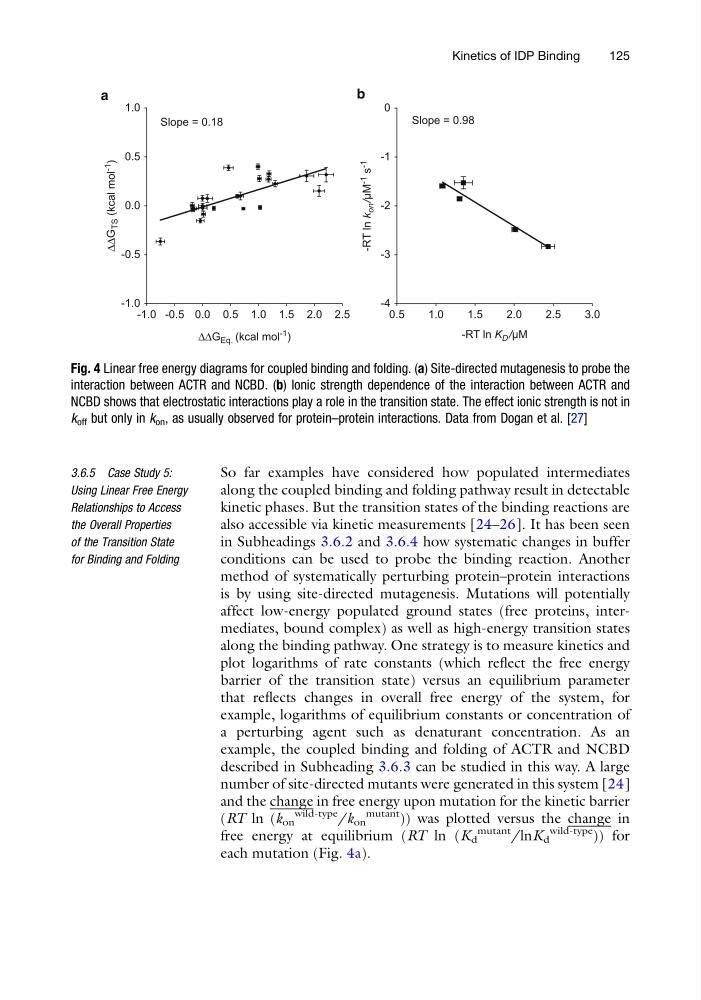
example, the coupled binding and folding of ACTR and NCBD
described in Subheading 3.6.3 can be studied in this way. A large
number of site-directed mutants were generated in this system [24]
and the change in free energy upon mutation for the kinetic barrier
(RT ln (k on
wild-type
/k on
mutant )) was plotted versus the change in
free energy at equilibrium (RT ln (K d
mutant /lnK d
wild-type
)) for
each mutation (Fig. 4a).
-1.0 -0.5 0.0 0.5 1.0 1.5 2.0 2.5
-1.0
-0.5
0.0
0.5
1.0
0.5
1.0
1.5
2.0
2.5
3.0
-4
-3
-2
-1
0
ΔΔG Eq. (kcal mol
-1 )
-RT ln K D /μM
-RT ln k
on /μM
-1
s
-1
a
b
ΔΔG
TS (kcal mol
-1
)
Slope = 0.18
Slope = 0.98
Fig. 4 Linear free energy diagrams for coupled binding and folding. (a) Site-directed mutagenesis to probe the
interaction between ACTR and NCBD. (b) Ionic strength dependence of the interaction between ACTR and
NCBD shows that electrostatic interactions play a role in the transition state. The effect ionic strength is not in
k off but only in k on , as usually observed for protein–protein interactions. Data from Dogan et al. [27]
Kinetics of IDP Binding
125
Using Linear Free Energy
Relationships to Access
the Overall Properties
of the Transition State
for Binding and Folding
So far examples have considered how populated intermediates
along the coupled binding and folding pathway result in detectable
kinetic phases. But the transition states of the binding reactions are
also accessible via kinetic measurements [24–26]. It has been seen
in Subheadings 3.6.2 and 3.6.4 how systematic changes in buffer
conditions can be used to probe the binding reaction. Another
method of systematically perturbing protein–protein interactions
is by using site-directed mutagenesis. Mutations will potentially
affect low-energy populated ground states (free proteins, intermediates, bound complex) as well as high-energy transition states
along the binding pathway. One strategy is to measure kinetics and
plot logarithms of rate constants (which reflect the free energy
barrier of the transition state) versus an equilibrium parameter
that reflects changes in overall free energy of the system, for
example, logarithms of equilibrium constants or concentration of
a perturbing agent such as denaturant concentration. As an
example, the coupled binding and folding of ACTR and NCBD
described in Subheading 3.6.3 can be studied in this way. A large
number of site-directed mutants were generated in this system [24]
and the change in free energy upon mutation for the kinetic barrier
(RT ln (k on
wild-type
/k on
mutant )) was plotted versus the change in
free energy at equilibrium (RT ln (K d
mutant /lnK d
wild-type
)) for
each mutation (Fig. 4a).
-1.0 -0.5 0.0 0.5 1.0 1.5 2.0 2.5
-1.0
-0.5
0.0
0.5
1.0
0.5
1.0
1.5
2.0
2.5
3.0
-4
-3
-2
-1
0
ΔΔG Eq. (kcal mol
-1 )
-RT ln K D /μM
-RT ln k
on /μM
-1
s
-1
a
b
ΔΔG
TS (kcal mol
-1
)
Slope = 0.18
Slope = 0.98
Fig. 4 Linear free energy diagrams for coupled binding and folding. (a) Site-directed mutagenesis to probe the
interaction between ACTR and NCBD. (b) Ionic strength dependence of the interaction between ACTR and
NCBD shows that electrostatic interactions play a role in the transition state. The effect ionic strength is not in
k off but only in k on , as usually observed for protein–protein interactions. Data from Dogan et al. [27]
Kinetics of IDP Binding
125