

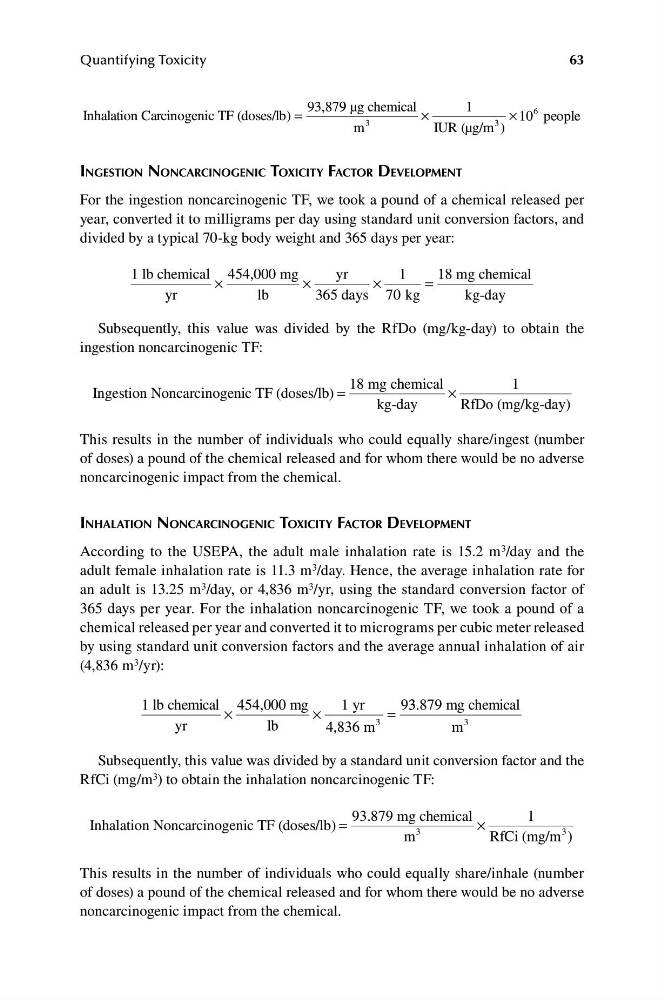
93,879 9 μg chemical
1
Inhalation Carcinogenic TF (doses/lb) =
×
× 10
6 people
m
3
IUR (μg/m
3 )
INGESTION NONCARCINOGENIC TOXICITY FACTOR DEVELOPMENT
For the ingestion noncarcinogenic TF, we took a pound of a chemical released per
year, converted it to milligrams per day using standard unit conversion factors, and
divided by a typical 70-kg body weight and 365 days per year:
1 lb chemical 454,000 mg
yr
1
1 18 mg chemical
×
×
×
=
yr
lb
365 days 70 kg
kg-day
Subsequently, this value was divided by the RfDo (mg/kg-day) to obtain the
ingestion noncarcinogenic TF:
18 mg ch hemical
1
Ingestion Noncarcinogenic TF (doses/lb) =
×
kg-day
RfDo (mg/kg-day)
This results in the number of individuals who could equally share/ingest (number
of doses) a pound of the chemical released and for whom there would be no adverse
noncarcinogenic impact from the chemical.
INHALATION NONCARCINOGENIC TOXICITY FACTOR DEVELOPMENT
According to the USEPA, the adult male inhalation rate is 15.2 m 3 /day and the
adult female inhalation rate is 11.3 m 3 /day. Hence, the average inhalation rate for
an adult is 13.25 m 3 /day, or 4,836 m 3 /yr, using the standard conversion factor of
365 days per year. For the inhalation noncarcinogenic TF, we took a pound of a
chemical released per year and converted it to micrograms per cubic meter released
by using standard unit conversion factors and the average annual inhalation of air
(4,836 m 3 /yr):
1 lb chemical 454,000 mg
1 yr
93 3.879 mg chemical
×
×
=
yr
lb
4,836 m
3
m
3
Subsequently, this value was divided by a standard unit conversion factor and the
RfCi (mg/m 3 ) to obtain the inhalation noncarcinogenic TF:
93.879 mg chemical
1
Inhalation Noncarcinogenic TF (doses/lb) =
3
×
m
RfCi (mg/m
3 )
This results in the number of individuals who could equally share/inhale (number
of doses) a pound of the chemical released and for whom there would be no adverse
noncarcinogenic impact from the chemical.
Quantifying Toxicity
63
1
Inhalation Carcinogenic TF (doses/lb) =
×
× 10
6 people
m
3
IUR (μg/m
3 )
INGESTION NONCARCINOGENIC TOXICITY FACTOR DEVELOPMENT
For the ingestion noncarcinogenic TF, we took a pound of a chemical released per
year, converted it to milligrams per day using standard unit conversion factors, and
divided by a typical 70-kg body weight and 365 days per year:
1 lb chemical 454,000 mg
yr
1
1 18 mg chemical
×
×
×
=
yr
lb
365 days 70 kg
kg-day
Subsequently, this value was divided by the RfDo (mg/kg-day) to obtain the
ingestion noncarcinogenic TF:
18 mg ch hemical
1
Ingestion Noncarcinogenic TF (doses/lb) =
×
kg-day
RfDo (mg/kg-day)
This results in the number of individuals who could equally share/ingest (number
of doses) a pound of the chemical released and for whom there would be no adverse
noncarcinogenic impact from the chemical.
INHALATION NONCARCINOGENIC TOXICITY FACTOR DEVELOPMENT
According to the USEPA, the adult male inhalation rate is 15.2 m 3 /day and the
adult female inhalation rate is 11.3 m 3 /day. Hence, the average inhalation rate for
an adult is 13.25 m 3 /day, or 4,836 m 3 /yr, using the standard conversion factor of
365 days per year. For the inhalation noncarcinogenic TF, we took a pound of a
chemical released per year and converted it to micrograms per cubic meter released
by using standard unit conversion factors and the average annual inhalation of air
(4,836 m 3 /yr):
1 lb chemical 454,000 mg
1 yr
93 3.879 mg chemical
×
×
=
yr
lb
4,836 m
3
m
3
Subsequently, this value was divided by a standard unit conversion factor and the
RfCi (mg/m 3 ) to obtain the inhalation noncarcinogenic TF:
93.879 mg chemical
1
Inhalation Noncarcinogenic TF (doses/lb) =
3
×
m
RfCi (mg/m
3 )
This results in the number of individuals who could equally share/inhale (number
of doses) a pound of the chemical released and for whom there would be no adverse
noncarcinogenic impact from the chemical.
Quantifying Toxicity
63