

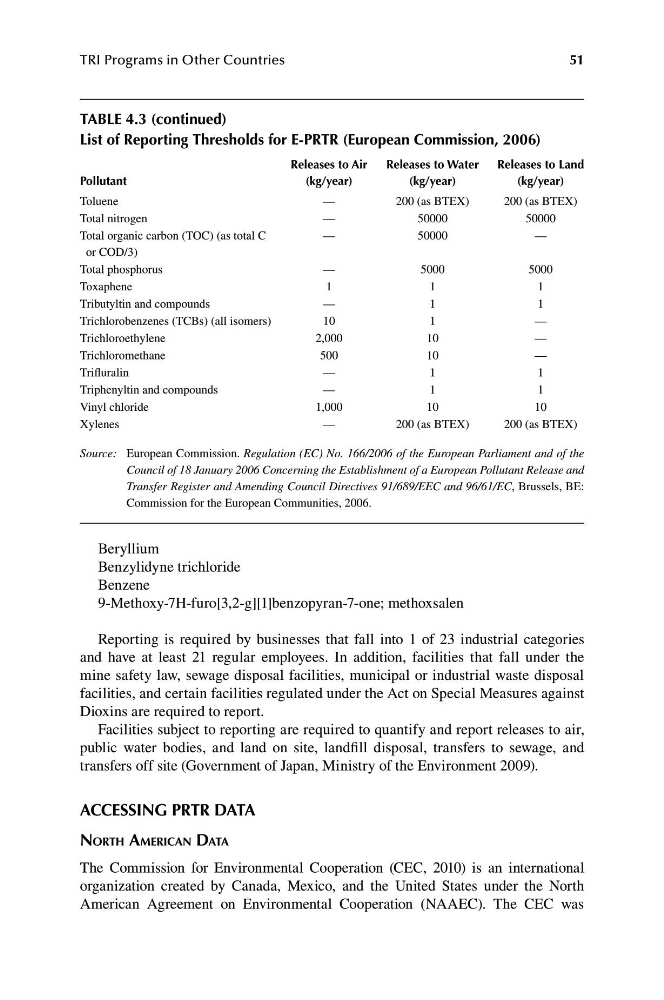
TABLE 4.3 (continued)
List of Reporting Thresholds for E-PRTR (European Commission, 2006)
Releases to Air
Releases to Water
Releases to Land
Pollutant
(kg/year)
(kg/year)
(kg/year)
Toluene
—
200 (as BTEX)
200 (as BTEX)
Total nitrogen
—
50000
50000
Total organic carbon (TOC) (as total C
—
50000
—
or COD/3)
Total phosphorus
—
5000
5000
Toxaphene
1
1
Tributyltin and compounds
—
1
1
Trichlorobenzenes (TCBs) (all isomers)
10
1
—
Trichloroethylene
10
—
Trichloromethane
10
—
Trifluralin
1
1
Triphenyltin and compounds
—
1
1
Vinyl chloride
1,000
10
10
Xylenes
—
200 (as BTEX)
200 (as BTEX)
1
2,000
500
—
Source: European Commission. Regulation (EC) No. 166/2006 of the European Parliament and of the
Council of 18 January 2006 Concerning the Establishment of a European Pollutant Release and
Transfer Register and Amending Council Directives 91/689/EEC and 96/61/EC, Brussels, BE:
Commission for the European Communities, 2006.
51
TRI Programs in Other Countries
Beryllium
Benzylidyne trichloride
Benzene
9-Methoxy-7H-furo[3,2-g][1]benzopyran-7-one; methoxsalen
Reporting is required by businesses that fall into 1 of 23 industrial categories
and have at least 21 regular employees. In addition, facilities that fall under the
mine safety law, sewage disposal facilities, municipal or industrial waste disposal
facilities, and certain facilities regulated under the Act on Special Measures against
Dioxins are required to report.
Facilities subject to reporting are required to quantify and report releases to air,
public water bodies, and land on site, landfill disposal, transfers to sewage, and
transfers off site (Government of Japan, Ministry of the Environment 2009).
ACCESSING PRTR DATA
NORTH AMERICAN DATA
The Commission for Environmental Cooperation (CEC, 2010) is an international
organization created by Canada, Mexico, and the United States under the North
American Agreement on Environmental Cooperation (NAAEC). The CEC was
List of Reporting Thresholds for E-PRTR (European Commission, 2006)
Releases to Air
Releases to Water
Releases to Land
Pollutant
(kg/year)
(kg/year)
(kg/year)
Toluene
—
200 (as BTEX)
200 (as BTEX)
Total nitrogen
—
50000
50000
Total organic carbon (TOC) (as total C
—
50000
—
or COD/3)
Total phosphorus
—
5000
5000
Toxaphene
1
1
Tributyltin and compounds
—
1
1
Trichlorobenzenes (TCBs) (all isomers)
10
1
—
Trichloroethylene
10
—
Trichloromethane
10
—
Trifluralin
1
1
Triphenyltin and compounds
—
1
1
Vinyl chloride
1,000
10
10
Xylenes
—
200 (as BTEX)
200 (as BTEX)
1
2,000
500
—
Source: European Commission. Regulation (EC) No. 166/2006 of the European Parliament and of the
Council of 18 January 2006 Concerning the Establishment of a European Pollutant Release and
Transfer Register and Amending Council Directives 91/689/EEC and 96/61/EC, Brussels, BE:
Commission for the European Communities, 2006.
51
TRI Programs in Other Countries
Beryllium
Benzylidyne trichloride
Benzene
9-Methoxy-7H-furo[3,2-g][1]benzopyran-7-one; methoxsalen
Reporting is required by businesses that fall into 1 of 23 industrial categories
and have at least 21 regular employees. In addition, facilities that fall under the
mine safety law, sewage disposal facilities, municipal or industrial waste disposal
facilities, and certain facilities regulated under the Act on Special Measures against
Dioxins are required to report.
Facilities subject to reporting are required to quantify and report releases to air,
public water bodies, and land on site, landfill disposal, transfers to sewage, and
transfers off site (Government of Japan, Ministry of the Environment 2009).
ACCESSING PRTR DATA
NORTH AMERICAN DATA
The Commission for Environmental Cooperation (CEC, 2010) is an international
organization created by Canada, Mexico, and the United States under the North
American Agreement on Environmental Cooperation (NAAEC). The CEC was