

44
Toxic Chemicals
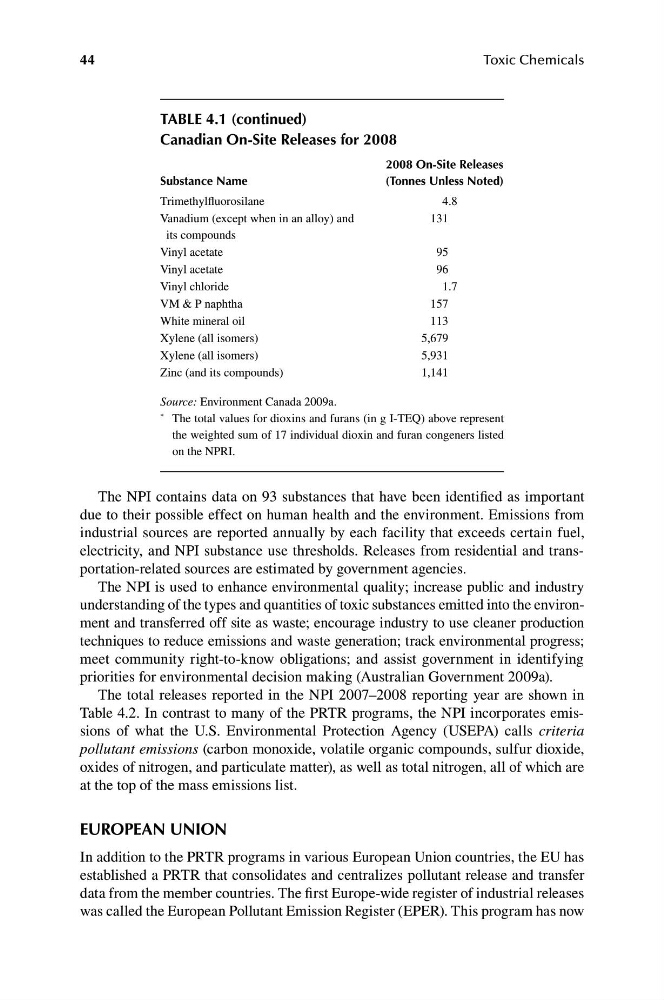
TABLE 4.1 (continued)
Canadian On-Site Releases for 2008
2008 On-Site Releases
Substance Name
(Tonnes Unless Noted)
Trimethylfluorosilane
4.8
Vanadium (except when in an alloy) and
131
its compounds
Vinyl acetate
95
Vinyl acetate
96
Vinyl chloride
1.7
VM & P naphtha
157
White mineral oil
113
Xylene (all isomers)
5,679
Xylene (all isomers)
5,931
Zinc (and its compounds)
1,141
Source: Environment Canada 2009a.
* The total values for dioxins and furans (in g I-TEQ) above represent
the weighted sum of 17 individual dioxin and furan congeners listed
on the NPRI.
The NPI contains data on 93 substances that have been identified as important
due to their possible effect on human health and the environment. Emissions from
industrial sources are reported annually by each facility that exceeds certain fuel,
electricity, and NPI substance use thresholds. Releases from residential and transportation-related sources are estimated by government agencies.
The NPI is used to enhance environmental quality; increase public and industry
understanding of the types and quantities of toxic substances emitted into the environment and transferred off site as waste; encourage industry to use cleaner production
techniques to reduce emissions and waste generation; track environmental progress;
meet community right-to-know obligations; and assist government in identifying
priorities for environmental decision making (Australian Government 2009a).
The total releases reported in the NPI 2007–2008 reporting year are shown in
Table 4.2. In contrast to many of the PRTR programs, the NPI incorporates emissions of what the U.S. Environmental Protection Agency (USEPA) calls criteria
pollutant emissions (carbon monoxide, volatile organic compounds, sulfur dioxide,
oxides of nitrogen, and particulate matter), as well as total nitrogen, all of which are
at the top of the mass emissions list.
EUROPEAN UNION
In addition to the PRTR programs in various European Union countries, the EU has
established a PRTR that consolidates and centralizes pollutant release and transfer
data from the member countries. The first Europe-wide register of industrial releases
was called the European Pollutant Emission Register (EPER). This program has now
Toxic Chemicals
TABLE 4.1 (continued)
Canadian On-Site Releases for 2008
2008 On-Site Releases
Substance Name
(Tonnes Unless Noted)
Trimethylfluorosilane
4.8
Vanadium (except when in an alloy) and
131
its compounds
Vinyl acetate
95
Vinyl acetate
96
Vinyl chloride
1.7
VM & P naphtha
157
White mineral oil
113
Xylene (all isomers)
5,679
Xylene (all isomers)
5,931
Zinc (and its compounds)
1,141
Source: Environment Canada 2009a.
* The total values for dioxins and furans (in g I-TEQ) above represent
the weighted sum of 17 individual dioxin and furan congeners listed
on the NPRI.
The NPI contains data on 93 substances that have been identified as important
due to their possible effect on human health and the environment. Emissions from
industrial sources are reported annually by each facility that exceeds certain fuel,
electricity, and NPI substance use thresholds. Releases from residential and transportation-related sources are estimated by government agencies.
The NPI is used to enhance environmental quality; increase public and industry
understanding of the types and quantities of toxic substances emitted into the environment and transferred off site as waste; encourage industry to use cleaner production
techniques to reduce emissions and waste generation; track environmental progress;
meet community right-to-know obligations; and assist government in identifying
priorities for environmental decision making (Australian Government 2009a).
The total releases reported in the NPI 2007–2008 reporting year are shown in
Table 4.2. In contrast to many of the PRTR programs, the NPI incorporates emissions of what the U.S. Environmental Protection Agency (USEPA) calls criteria
pollutant emissions (carbon monoxide, volatile organic compounds, sulfur dioxide,
oxides of nitrogen, and particulate matter), as well as total nitrogen, all of which are
at the top of the mass emissions list.
EUROPEAN UNION
In addition to the PRTR programs in various European Union countries, the EU has
established a PRTR that consolidates and centralizes pollutant release and transfer
data from the member countries. The first Europe-wide register of industrial releases
was called the European Pollutant Emission Register (EPER). This program has now