

4
TRI Programs in
Other Countries
INTRODUCTION
Since the first Toxics Release Inventory (TRI) program was established in the United
States, pollutant release and transfer register (PRTR) programs have been established
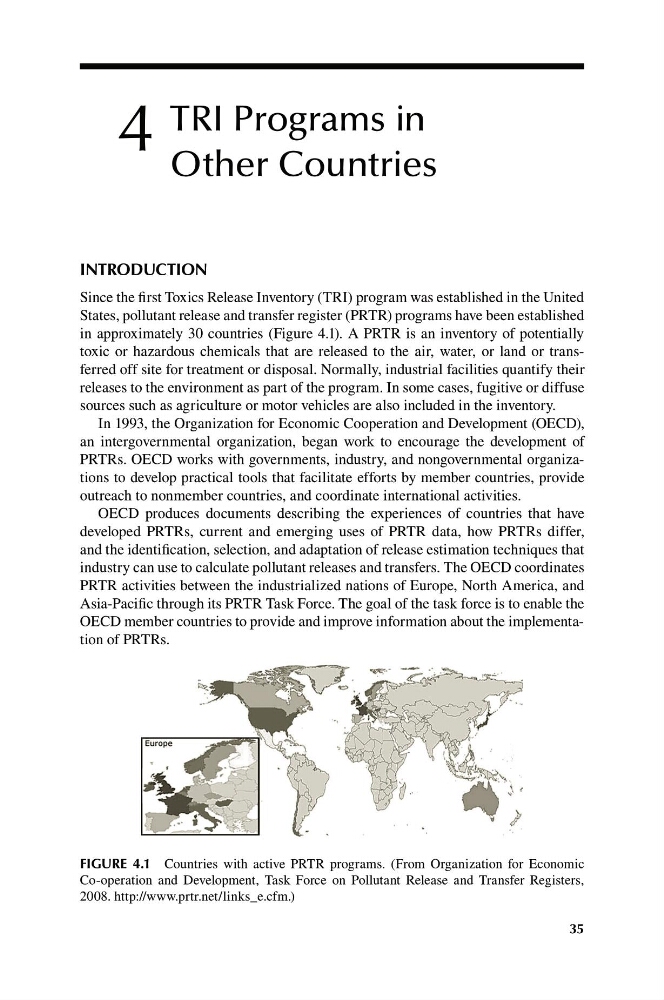
in approximately 30 countries (Figure 4.1). A PRTR is an inventory of potentially
toxic or hazardous chemicals that are released to the air, water, or land or transferred off site for treatment or disposal. Normally, industrial facilities quantify their
releases to the environment as part of the program. In some cases, fugitive or diffuse
sources such as agriculture or motor vehicles are also included in the inventory.
In 1993, the Organization for Economic Cooperation and Development (OECD),
an intergovernmental organization, began work to encourage the development of
PRTRs. OECD works with governments, industry, and nongovernmental organizations to develop practical tools that facilitate efforts by member countries, provide
outreach to nonmember countries, and coordinate international activities.
OECD produces documents describing the experiences of countries that have
developed PRTRs, current and emerging uses of PRTR data, how PRTRs differ,
and the identification, selection, and adaptation of release estimation techniques that
industry can use to calculate pollutant releases and transfers. The OECD coordinates
PRTR activities between the industrialized nations of Europe, North America, and
Asia-Pacific through its PRTR Task Force. The goal of the task force is to enable the
OECD member countries to provide and improve information about the implementation of PRTRs.
FIGURE 4.1 Countries with active PRTR programs. (From Organization for Economic
Co-operation and Development, Task Force on Pollutant Release and Transfer Registers,
2008. http://www.prtr.net/links_e.cfm.)
35
TRI Programs in
Other Countries
INTRODUCTION
Since the first Toxics Release Inventory (TRI) program was established in the United
States, pollutant release and transfer register (PRTR) programs have been established
in approximately 30 countries (Figure 4.1). A PRTR is an inventory of potentially
toxic or hazardous chemicals that are released to the air, water, or land or transferred off site for treatment or disposal. Normally, industrial facilities quantify their
releases to the environment as part of the program. In some cases, fugitive or diffuse
sources such as agriculture or motor vehicles are also included in the inventory.
In 1993, the Organization for Economic Cooperation and Development (OECD),
an intergovernmental organization, began work to encourage the development of
PRTRs. OECD works with governments, industry, and nongovernmental organizations to develop practical tools that facilitate efforts by member countries, provide
outreach to nonmember countries, and coordinate international activities.
OECD produces documents describing the experiences of countries that have
developed PRTRs, current and emerging uses of PRTR data, how PRTRs differ,
and the identification, selection, and adaptation of release estimation techniques that
industry can use to calculate pollutant releases and transfers. The OECD coordinates
PRTR activities between the industrialized nations of Europe, North America, and
Asia-Pacific through its PRTR Task Force. The goal of the task force is to enable the
OECD member countries to provide and improve information about the implementation of PRTRs.
FIGURE 4.1 Countries with active PRTR programs. (From Organization for Economic
Co-operation and Development, Task Force on Pollutant Release and Transfer Registers,
2008. http://www.prtr.net/links_e.cfm.)
35