

281
Costs and Benefits
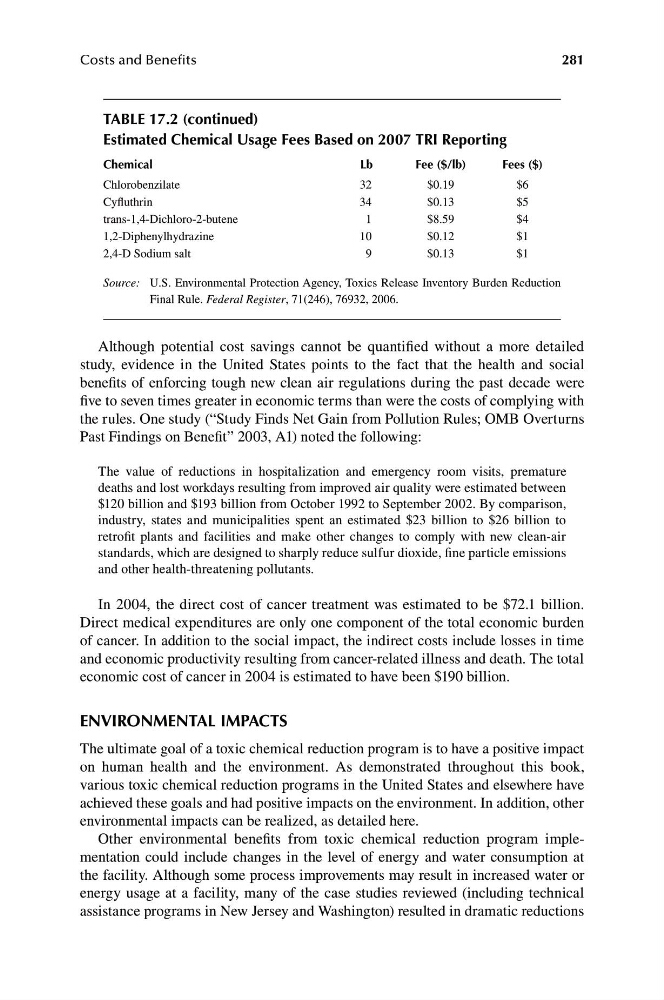
TABLE 17.2 (continued)
Estimated Chemical Usage Fees Based on 2007 TRI Reporting
Chemical
Lb
Fee ($/lb)
Fees ($)
Chlorobenzilate
32
$0.19
$6
Cyfluthrin
34
$0.13
$5
trans-1,4-Dichloro-2-butene
1
$8.59
$4
1,2-Diphenylhydrazine
10
$0.12
$1
2,4-D Sodium salt
9
$0.13
$1
Source: U.S. Environmental Protection Agency, Toxics Release Inventory Burden Reduction
Final Rule. Federal Register, 71(246), 76932, 2006.
Although potential cost savings cannot be quantified without a more detailed
study, evidence in the United States points to the fact that the health and social
benefits of enforcing tough new clean air regulations during the past decade were
five to seven times greater in economic terms than were the costs of complying with
the rules. One study (“Study Finds Net Gain from Pollution Rules; OMB Overturns
Past Findings on Benefit” 2003, A1) noted the following:
The value of reductions in hospitalization and emergency room visits, premature
deaths and lost workdays resulting from improved air quality were estimated between
$120 billion and $193 billion from October 1992 to September 2002. By comparison,
industry, states and municipalities spent an estimated $23 billion to $26 billion to
retrofit plants and facilities and make other changes to comply with new clean-air
standards, which are designed to sharply reduce sulfur dioxide, fine particle emissions
and other health-threatening pollutants.
In 2004, the direct cost of cancer treatment was estimated to be $72.1 billion.
Direct medical expenditures are only one component of the total economic burden
of cancer. In addition to the social impact, the indirect costs include losses in time
and economic productivity resulting from cancer-related illness and death. The total
economic cost of cancer in 2004 is estimated to have been $190 billion.
ENVIRONMENTAL IMPACTS
The ultimate goal of a toxic chemical reduction program is to have a positive impact
on human health and the environment. As demonstrated throughout this book,
various toxic chemical reduction programs in the United States and elsewhere have
achieved these goals and had positive impacts on the environment. In addition, other
environmental impacts can be realized, as detailed here.
Other environmental benefits from toxic chemical reduction program implementation could include changes in the level of energy and water consumption at
the facility. Although some process improvements may result in increased water or
energy usage at a facility, many of the case studies reviewed (including technical
assistance programs in New Jersey and Washington) resulted in dramatic reductions
Costs and Benefits
TABLE 17.2 (continued)
Estimated Chemical Usage Fees Based on 2007 TRI Reporting
Chemical
Lb
Fee ($/lb)
Fees ($)
Chlorobenzilate
32
$0.19
$6
Cyfluthrin
34
$0.13
$5
trans-1,4-Dichloro-2-butene
1
$8.59
$4
1,2-Diphenylhydrazine
10
$0.12
$1
2,4-D Sodium salt
9
$0.13
$1
Source: U.S. Environmental Protection Agency, Toxics Release Inventory Burden Reduction
Final Rule. Federal Register, 71(246), 76932, 2006.
Although potential cost savings cannot be quantified without a more detailed
study, evidence in the United States points to the fact that the health and social
benefits of enforcing tough new clean air regulations during the past decade were
five to seven times greater in economic terms than were the costs of complying with
the rules. One study (“Study Finds Net Gain from Pollution Rules; OMB Overturns
Past Findings on Benefit” 2003, A1) noted the following:
The value of reductions in hospitalization and emergency room visits, premature
deaths and lost workdays resulting from improved air quality were estimated between
$120 billion and $193 billion from October 1992 to September 2002. By comparison,
industry, states and municipalities spent an estimated $23 billion to $26 billion to
retrofit plants and facilities and make other changes to comply with new clean-air
standards, which are designed to sharply reduce sulfur dioxide, fine particle emissions
and other health-threatening pollutants.
In 2004, the direct cost of cancer treatment was estimated to be $72.1 billion.
Direct medical expenditures are only one component of the total economic burden
of cancer. In addition to the social impact, the indirect costs include losses in time
and economic productivity resulting from cancer-related illness and death. The total
economic cost of cancer in 2004 is estimated to have been $190 billion.
ENVIRONMENTAL IMPACTS
The ultimate goal of a toxic chemical reduction program is to have a positive impact
on human health and the environment. As demonstrated throughout this book,
various toxic chemical reduction programs in the United States and elsewhere have
achieved these goals and had positive impacts on the environment. In addition, other
environmental impacts can be realized, as detailed here.
Other environmental benefits from toxic chemical reduction program implementation could include changes in the level of energy and water consumption at
the facility. Although some process improvements may result in increased water or
energy usage at a facility, many of the case studies reviewed (including technical
assistance programs in New Jersey and Washington) resulted in dramatic reductions