

276
Toxic Chemicals
TABLE 17.1
Estimated Costs for REACH Registration and Testing
Costs
Cost Items
(Million Euros)
Registration
€500
Testing
€1,250
Safety data sheets
€250
Authorization procedures
€100
Reduced costs for new substances below 1 ton and so on
(€100)
Total testing and registration
€2,000
Agency fees (paid by chemicals sector)
€300
Total (including agency fees)
€2,300
Source: European Commission, Environment Fact Sheet: REACH—A New
Chemicals Policy for the EU, 2006.http://ec.europa.eu/environment/
pubs/pdf/factsheets/reach.pdf.
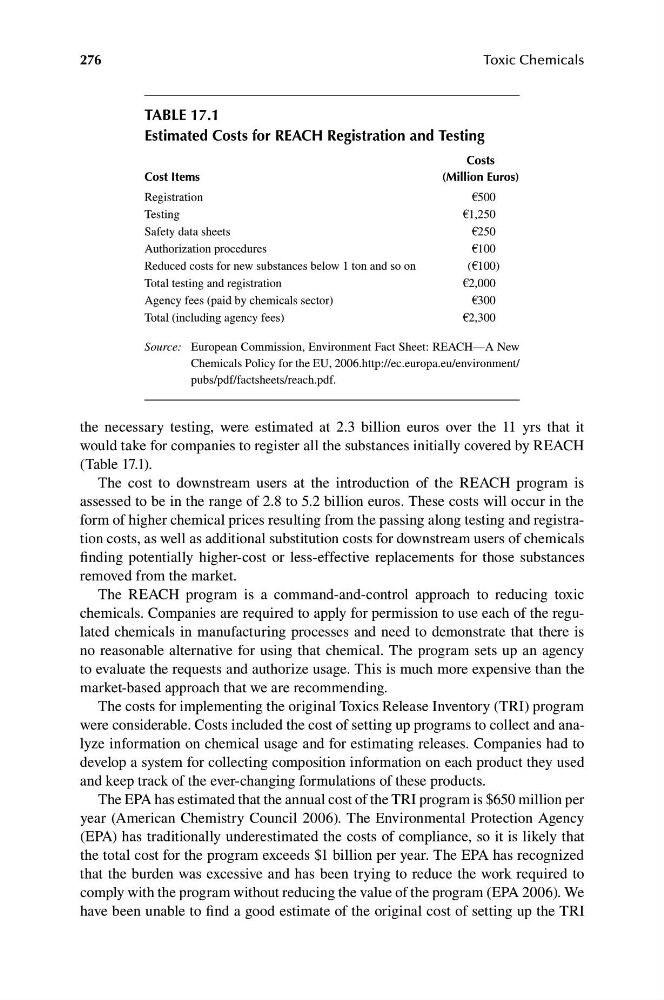
the necessary testing, were estimated at 2.3 billion euros over the 11 yrs that it
would take for companies to register all the substances initially covered by REACH
(Table 17.1).
The cost to downstream users at the introduction of the REACH program is
assessed to be in the range of 2.8 to 5.2 billion euros. These costs will occur in the
form of higher chemical prices resulting from the passing along testing and registration costs, as well as additional substitution costs for downstream users of chemicals
finding potentially higher-cost or less-effective replacements for those substances
removed from the market.
The REACH program is a command-and-control approach to reducing toxic
chemicals. Companies are required to apply for permission to use each of the regulated chemicals in manufacturing processes and need to demonstrate that there is
no reasonable alternative for using that chemical. The program sets up an agency
to evaluate the requests and authorize usage. This is much more expensive than the
market-based approach that we are recommending.
The costs for implementing the original Toxics Release Inventory (TRI) program
were considerable. Costs included the cost of setting up programs to collect and analyze information on chemical usage and for estimating releases. Companies had to
develop a system for collecting composition information on each product they used
and keep track of the ever-changing formulations of these products.
The EPA has estimated that the annual cost of the TRI program is $650 million per
year (American Chemistry Council 2006). The Environmental Protection Agency
(EPA) has traditionally underestimated the costs of compliance, so it is likely that
the total cost for the program exceeds $1 billion per year. The EPA has recognized
that the burden was excessive and has been trying to reduce the work required to
comply with the program without reducing the value of the program (EPA 2006). We
have been unable to find a good estimate of the original cost of setting up the TRI
Toxic Chemicals
TABLE 17.1
Estimated Costs for REACH Registration and Testing
Costs
Cost Items
(Million Euros)
Registration
€500
Testing
€1,250
Safety data sheets
€250
Authorization procedures
€100
Reduced costs for new substances below 1 ton and so on
(€100)
Total testing and registration
€2,000
Agency fees (paid by chemicals sector)
€300
Total (including agency fees)
€2,300
Source: European Commission, Environment Fact Sheet: REACH—A New
Chemicals Policy for the EU, 2006.http://ec.europa.eu/environment/
pubs/pdf/factsheets/reach.pdf.
the necessary testing, were estimated at 2.3 billion euros over the 11 yrs that it
would take for companies to register all the substances initially covered by REACH
(Table 17.1).
The cost to downstream users at the introduction of the REACH program is
assessed to be in the range of 2.8 to 5.2 billion euros. These costs will occur in the
form of higher chemical prices resulting from the passing along testing and registration costs, as well as additional substitution costs for downstream users of chemicals
finding potentially higher-cost or less-effective replacements for those substances
removed from the market.
The REACH program is a command-and-control approach to reducing toxic
chemicals. Companies are required to apply for permission to use each of the regulated chemicals in manufacturing processes and need to demonstrate that there is
no reasonable alternative for using that chemical. The program sets up an agency
to evaluate the requests and authorize usage. This is much more expensive than the
market-based approach that we are recommending.
The costs for implementing the original Toxics Release Inventory (TRI) program
were considerable. Costs included the cost of setting up programs to collect and analyze information on chemical usage and for estimating releases. Companies had to
develop a system for collecting composition information on each product they used
and keep track of the ever-changing formulations of these products.
The EPA has estimated that the annual cost of the TRI program is $650 million per
year (American Chemistry Council 2006). The Environmental Protection Agency
(EPA) has traditionally underestimated the costs of compliance, so it is likely that
the total cost for the program exceeds $1 billion per year. The EPA has recognized
that the burden was excessive and has been trying to reduce the work required to
comply with the program without reducing the value of the program (EPA 2006). We
have been unable to find a good estimate of the original cost of setting up the TRI