

257
A Program to Reduce Toxic Chemical Use
Typically, when toxic chemicals need to be replaced, not only does the chemical
need to be replaced but also the processes employing the chemicals require upgrading to accommodate the process change. By ensuring that the toxic chemical use
fee collection program is revenue neutral by reinvesting even a part of the revenue
collected into the more proactive companies, those companies can implement the
necessary upgrades in a way that minimizes the impacts of U.S. competitiveness in
the world market (i.e., allows for the necessary upgrades with the least impact on
additional costs having to be passed on to the end consumer).
Table 16.2 is a list of one possible set of toxic chemical use fees based on setting fees proportional to the ETFs (i.e., higher fee per pound of chemical for those
chemicals with relatively higher toxic impacts). We made the following assumptions,
solely for the purpose of proposing one way of how a toxic chemical use fee system
could be established, but before such a policy is adopted, a more formal and rigorous
analysis would be required:
• We assumed that there is 1/10 of 1 percent (0.1 percent) of actual human
inhalation or ingestion exposure of a toxic chemical (with the remainder of
the chemical released into the environment or remaining in a product and
not inhaled or ingested).
• We assumed that 50 percent of the inhalation or ingestion exposure that does
occur causes carcinogenic effects (vs. noncarcinogenic effects), with carcinogenic effects posing more potential adverse effects on the quality of human life
(therefore, we based the toxic chemical use fee on carcinogenic effects).
• While no cancer is desirable, there is a threshold of cancer risk that is generally acceptable, and according to the USEPA, this is usually from 1 excess
cancer case per 100,000 people to 1 excess cancer case per 1 million people
over a 70-yr lifetime. For this analysis, we factored in 1 excess cancer risk
per million people.
• We assumed that the strict monetary impact of cancer is $1 million per
individual affected.
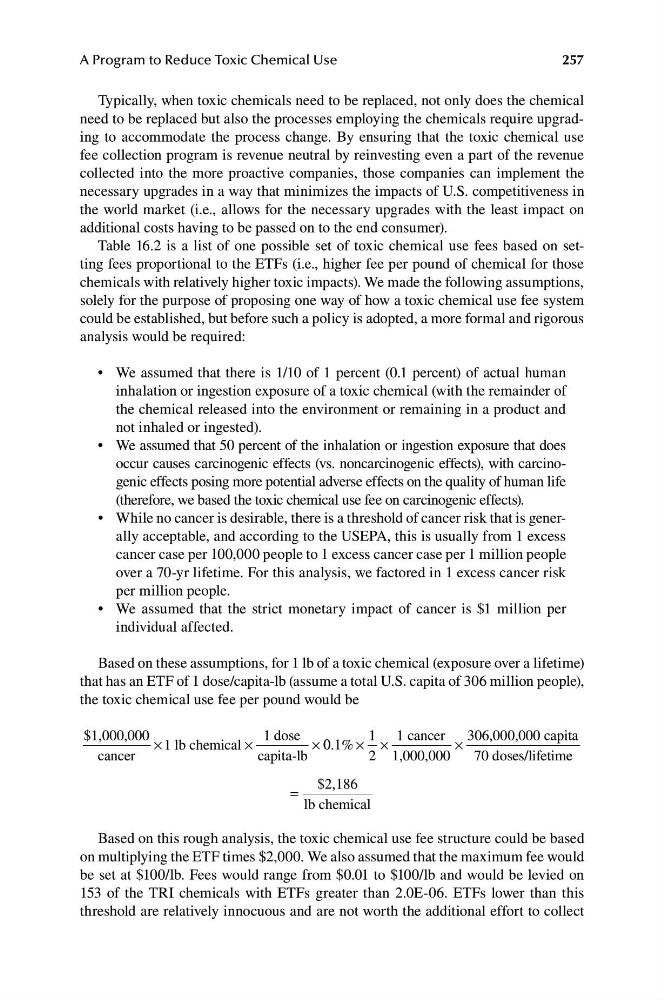
Based on these assumptions, for 1 lb of a toxic chemical (exposure over a lifetime)
that has an ETF of 1 dose/capita-lb (assume a total U.S. capita of 306 million people),
the toxic chemical use fee per pound would be
$1,000,000
1 dose
1 1 cancer
306,000,000 capita
× 1 lb chemical ×
× 0 0 1
. % × ×
×
cancer
capita-lb
2 1,000,000
70 doses/lifetime
$2,186
=
lb chemical
Based on this rough analysis, the toxic chemical use fee structure could be based
on multiplying the ETF times $2,000. We also assumed that the maximum fee would
be set at $100/lb. Fees would range from $0.01 to $100/lb and would be levied on
153 of the TRI chemicals with ETFs greater than 2.0E-06. ETFs lower than this
threshold are relatively innocuous and are not worth the additional effort to collect