

254
Toxic Chemicals
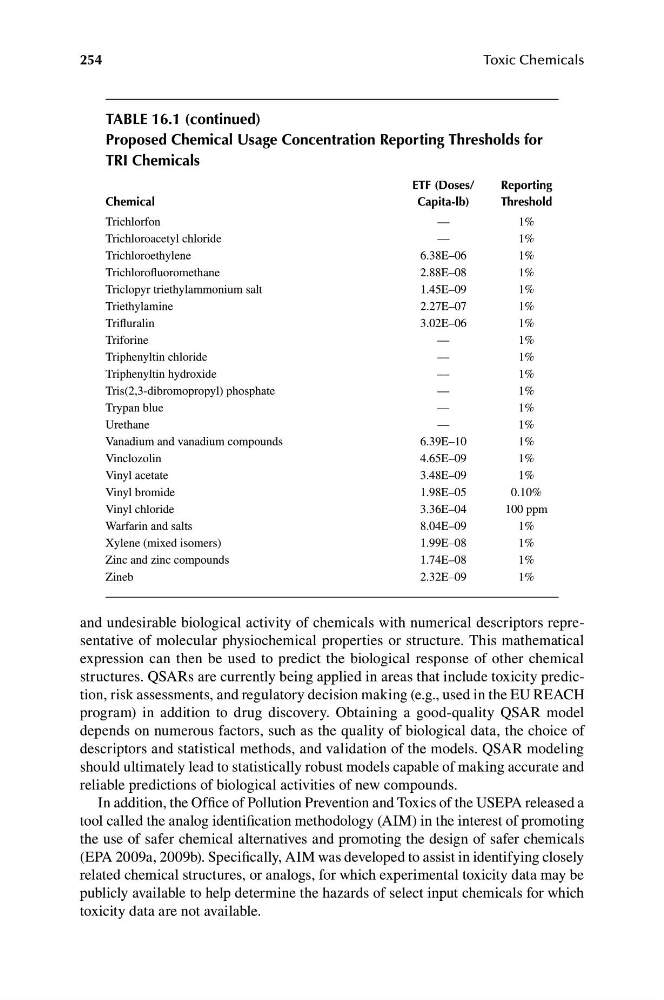
TABLE 16.1 (continued)
Proposed Chemical Usage Concentration Reporting Thresholds for
TRI Chemicals
Chemical
ETF (Doses/
Capita-lb)
Reporting
Threshold
Trichlorfon
—
1%
Trichloroacetyl chloride
—
1%
Trichloroethylene
6.38E–06
1%
Trichlorofluoromethane
2.88E–08
1%
Triclopyr triethylammonium salt
1.45E–09
1%
Triethylamine
2.27E–07
1%
Trifluralin
3.02E–06
1%
Triforine
—
1%
Triphenyltin chloride
—
1%
Triphenyltin hydroxide
—
1%
Tris(2,3-dibromopropyl) phosphate
—
1%
Trypan blue
—
1%
Urethane
—
1%
Vanadium and vanadium compounds
6.39E–10
1%
Vinclozolin
4.65E–09
1%
Vinyl acetate
3.48E–09
1%
Vinyl bromide
1.98E–05
0.10%
Vinyl chloride
3.36E–04
100 ppm
Warfarin and salts
8.04E–09
1%
Xylene (mixed isomers)
1.99E–08
1%
Zinc and zinc compounds
1.74E–08
1%
Zineb
2.32E–09
1%
and undesirable biological activity of chemicals with numerical descriptors representative of molecular physiochemical properties or structure. This mathematical
expression can then be used to predict the biological response of other chemical
structures. QSARs are currently being applied in areas that include toxicity prediction, risk assessments, and regulatory decision making (e.g., used in the EU REACH
program) in addition to drug discovery. Obtaining a good-quality QSAR model
depends on numerous factors, such as the quality of biological data, the choice of
descriptors and statistical methods, and validation of the models. QSAR modeling
should ultimately lead to statistically robust models capable of making accurate and
reliable predictions of biological activities of new compounds.
In addition, the Office of Pollution Prevention and Toxics of the USEPA released a
tool called the analog identification methodology (AIM) in the interest of promoting
the use of safer chemical alternatives and promoting the design of safer chemicals
(EPA 2009a, 2009b). Specifically, AIM was developed to assist in identifying closely
related chemical structures, or analogs, for which experimental toxicity data may be
publicly available to help determine the hazards of select input chemicals for which
toxicity data are not available.
Toxic Chemicals
TABLE 16.1 (continued)
Proposed Chemical Usage Concentration Reporting Thresholds for
TRI Chemicals
Chemical
ETF (Doses/
Capita-lb)
Reporting
Threshold
Trichlorfon
—
1%
Trichloroacetyl chloride
—
1%
Trichloroethylene
6.38E–06
1%
Trichlorofluoromethane
2.88E–08
1%
Triclopyr triethylammonium salt
1.45E–09
1%
Triethylamine
2.27E–07
1%
Trifluralin
3.02E–06
1%
Triforine
—
1%
Triphenyltin chloride
—
1%
Triphenyltin hydroxide
—
1%
Tris(2,3-dibromopropyl) phosphate
—
1%
Trypan blue
—
1%
Urethane
—
1%
Vanadium and vanadium compounds
6.39E–10
1%
Vinclozolin
4.65E–09
1%
Vinyl acetate
3.48E–09
1%
Vinyl bromide
1.98E–05
0.10%
Vinyl chloride
3.36E–04
100 ppm
Warfarin and salts
8.04E–09
1%
Xylene (mixed isomers)
1.99E–08
1%
Zinc and zinc compounds
1.74E–08
1%
Zineb
2.32E–09
1%
and undesirable biological activity of chemicals with numerical descriptors representative of molecular physiochemical properties or structure. This mathematical
expression can then be used to predict the biological response of other chemical
structures. QSARs are currently being applied in areas that include toxicity prediction, risk assessments, and regulatory decision making (e.g., used in the EU REACH
program) in addition to drug discovery. Obtaining a good-quality QSAR model
depends on numerous factors, such as the quality of biological data, the choice of
descriptors and statistical methods, and validation of the models. QSAR modeling
should ultimately lead to statistically robust models capable of making accurate and
reliable predictions of biological activities of new compounds.
In addition, the Office of Pollution Prevention and Toxics of the USEPA released a
tool called the analog identification methodology (AIM) in the interest of promoting
the use of safer chemical alternatives and promoting the design of safer chemicals
(EPA 2009a, 2009b). Specifically, AIM was developed to assist in identifying closely
related chemical structures, or analogs, for which experimental toxicity data may be
publicly available to help determine the hazards of select input chemicals for which
toxicity data are not available.