

195
Use versus Release Reporting
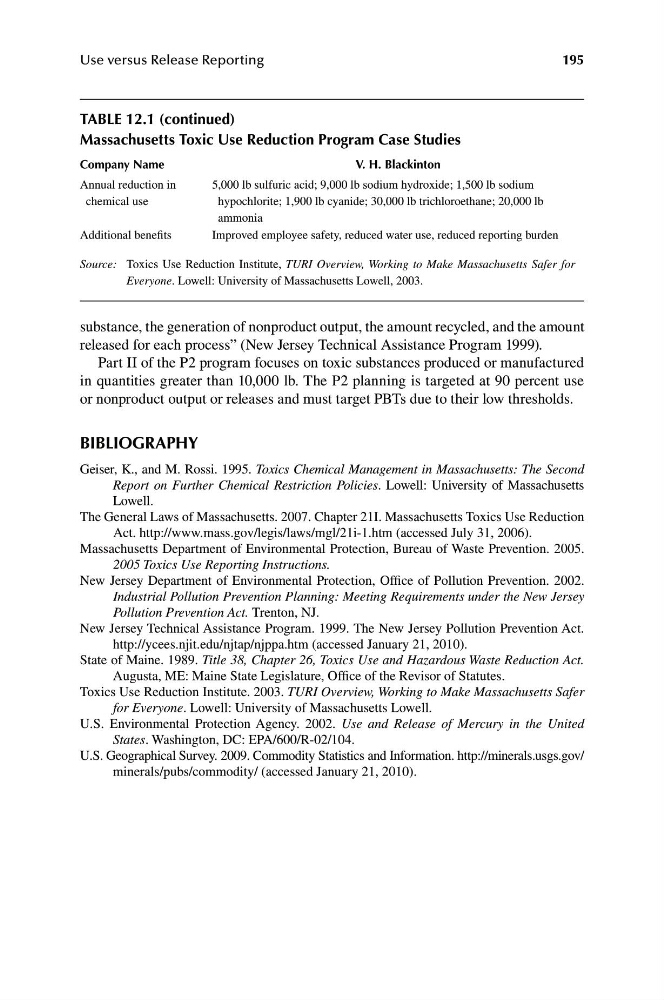
TABLE 12.1 (continued)
Massachusetts Toxic Use Reduction Program Case Studies
Company Name
V. H. Blackinton
Annual reduction in
5,000 lb sulfuric acid; 9,000 lb sodium hydroxide; 1,500 lb sodium
chemical use
hypochlorite; 1,900 lb cyanide; 30,000 lb trichloroethane; 20,000 lb
ammonia
Additional benefits
Improved employee safety, reduced water use, reduced reporting burden
Source: Toxics Use Reduction Institute, TURI Overview, Working to Make Massachusetts Safer for
Everyone. Lowell: University of Massachusetts Lowell, 2003.
substance, the generation of nonproduct output, the amount recycled, and the amount
released for each process” (New Jersey Technical Assistance Program 1999).
Part II of the P2 program focuses on toxic substances produced or manufactured
in quantities greater than 10,000 lb. The P2 planning is targeted at 90 percent use
or nonproduct output or releases and must target PBTs due to their low thresholds.
BIBLIOGRAPHY
Geiser, K., and M. Rossi. 1995. Toxics Chemical Management in Massachusetts: The Second
Report on Further Chemical Restriction Policies. Lowell: University of Massachusetts
Lowell.
The General Laws of Massachusetts. 2007. Chapter 21I. Massachusetts Toxics Use Reduction
Act. http://www.mass.gov/legis/laws/mgl/21i-1.htm (accessed July 31, 2006).
Massachusetts Department of Environmental Protection, Bureau of Waste Prevention. 2005.
2005 Toxics Use Reporting Instructions.
New Jersey Department of Environmental Protection, Office of Pollution Prevention. 2002.
Industrial Pollution Prevention Planning: Meeting Requirements under the New Jersey
Pollution Prevention Act. Trenton, NJ.
New Jersey Technical Assistance Program. 1999. The New Jersey Pollution Prevention Act.
http://ycees.njit.edu/njtap/njppa.htm (accessed January 21, 2010).
State of Maine. 1989. Title 38, Chapter 26, Toxics Use and Hazardous Waste Reduction Act.
Augusta, ME: Maine State Legislature, Office of the Revisor of Statutes.
Toxics Use Reduction Institute. 2003. TURI Overview, Working to Make Massachusetts Safer
for Everyone. Lowell: University of Massachusetts Lowell.
U.S. Environmental Protection Agency. 2002. Use and Release of Mercury in the United
States. Washington, DC: EPA/600/R-02/104.
U.S. Geographical Survey. 2009. Commodity Statistics and Information. http://minerals.usgs.gov/
minerals/pubs/commodity/ (accessed January 21, 2010).
Use versus Release Reporting
TABLE 12.1 (continued)
Massachusetts Toxic Use Reduction Program Case Studies
Company Name
V. H. Blackinton
Annual reduction in
5,000 lb sulfuric acid; 9,000 lb sodium hydroxide; 1,500 lb sodium
chemical use
hypochlorite; 1,900 lb cyanide; 30,000 lb trichloroethane; 20,000 lb
ammonia
Additional benefits
Improved employee safety, reduced water use, reduced reporting burden
Source: Toxics Use Reduction Institute, TURI Overview, Working to Make Massachusetts Safer for
Everyone. Lowell: University of Massachusetts Lowell, 2003.
substance, the generation of nonproduct output, the amount recycled, and the amount
released for each process” (New Jersey Technical Assistance Program 1999).
Part II of the P2 program focuses on toxic substances produced or manufactured
in quantities greater than 10,000 lb. The P2 planning is targeted at 90 percent use
or nonproduct output or releases and must target PBTs due to their low thresholds.
BIBLIOGRAPHY
Geiser, K., and M. Rossi. 1995. Toxics Chemical Management in Massachusetts: The Second
Report on Further Chemical Restriction Policies. Lowell: University of Massachusetts
Lowell.
The General Laws of Massachusetts. 2007. Chapter 21I. Massachusetts Toxics Use Reduction
Act. http://www.mass.gov/legis/laws/mgl/21i-1.htm (accessed July 31, 2006).
Massachusetts Department of Environmental Protection, Bureau of Waste Prevention. 2005.
2005 Toxics Use Reporting Instructions.
New Jersey Department of Environmental Protection, Office of Pollution Prevention. 2002.
Industrial Pollution Prevention Planning: Meeting Requirements under the New Jersey
Pollution Prevention Act. Trenton, NJ.
New Jersey Technical Assistance Program. 1999. The New Jersey Pollution Prevention Act.
http://ycees.njit.edu/njtap/njppa.htm (accessed January 21, 2010).
State of Maine. 1989. Title 38, Chapter 26, Toxics Use and Hazardous Waste Reduction Act.
Augusta, ME: Maine State Legislature, Office of the Revisor of Statutes.
Toxics Use Reduction Institute. 2003. TURI Overview, Working to Make Massachusetts Safer
for Everyone. Lowell: University of Massachusetts Lowell.
U.S. Environmental Protection Agency. 2002. Use and Release of Mercury in the United
States. Washington, DC: EPA/600/R-02/104.
U.S. Geographical Survey. 2009. Commodity Statistics and Information. http://minerals.usgs.gov/
minerals/pubs/commodity/ (accessed January 21, 2010).