

182
Toxic Chemicals
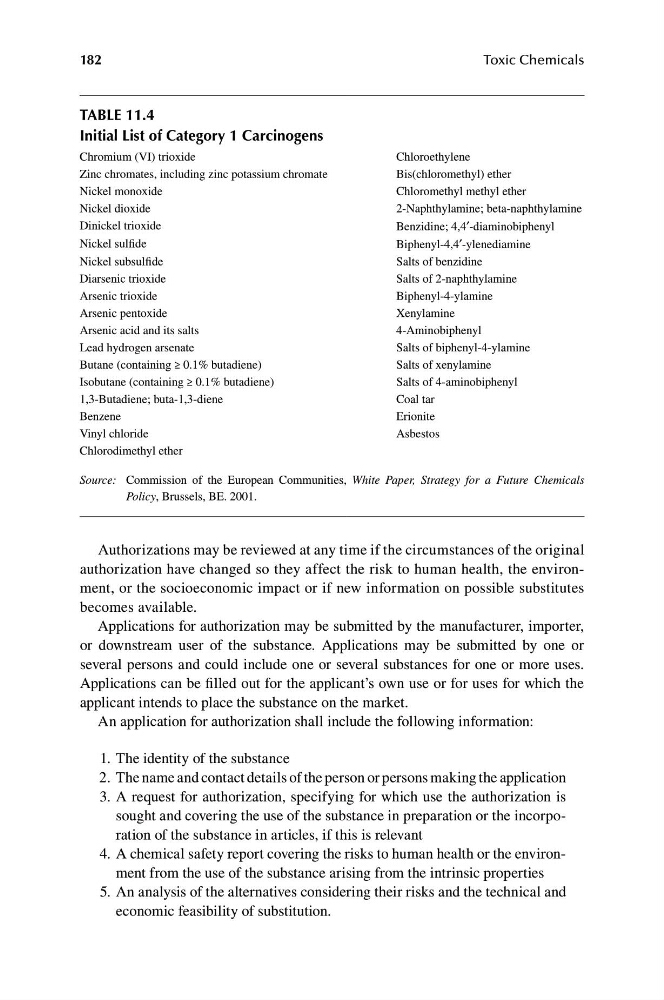
TABLE 11.4
Initial List of Category 1 Carcinogens
Chromium (VI) trioxide
Chloroethylene
Zinc chromates, including zinc potassium chromate
Bis(chloromethyl) ether
Nickel monoxide
Chloromethyl methyl ether
Nickel dioxide
2-Naphthylamine; beta-naphthylamine
Dinickel trioxide
Benzidine; 4,4′-diaminobiphenyl
Nickel sulfide
Biphenyl-4,4′-ylenediamine
Nickel subsulfide
Salts of benzidine
Diarsenic trioxide
Salts of 2-naphthylamine
Arsenic trioxide
Biphenyl-4-ylamine
Arsenic pentoxide
Xenylamine
Arsenic acid and its salts
4-Aminobiphenyl
Lead hydrogen arsenate
Salts of biphenyl-4-ylamine
Butane (containing ≥ 0.1% butadiene)
Salts of xenylamine
Isobutane (containing ≥ 0.1% butadiene)
Salts of 4-aminobiphenyl
1,3-Butadiene; buta-1,3-diene
Coal tar
Benzene
Erionite
Vinyl chloride
Asbestos
Chlorodimethyl ether
Source: Commission of the European Communities, White Paper, Strategy for a Future Chemicals
Policy, Brussels, BE. 2001.
Authorizations may be reviewed at any time if the circumstances of the original
authorization have changed so they affect the risk to human health, the environment, or the socioeconomic impact or if new information on possible substitutes
becomes available.
Applications for authorization may be submitted by the manufacturer, importer,
or downstream user of the substance. Applications may be submitted by one or
several persons and could include one or several substances for one or more uses.
Applications can be filled out for the applicant’s own use or for uses for which the
applicant intends to place the substance on the market.
An application for authorization shall include the following information:
1. The identity of the substance
2. The name and contact details of the person or persons making the application
3. A request for authorization, specifying for which use the authorization is
sought and covering the use of the substance in preparation or the incorporation of the substance in articles, if this is relevant
4. A chemical safety report covering the risks to human health or the environment from the use of the substance arising from the intrinsic properties
5. An analysis of the alternatives considering their risks and the technical and
economic feasibility of substitution.
Toxic Chemicals
TABLE 11.4
Initial List of Category 1 Carcinogens
Chromium (VI) trioxide
Chloroethylene
Zinc chromates, including zinc potassium chromate
Bis(chloromethyl) ether
Nickel monoxide
Chloromethyl methyl ether
Nickel dioxide
2-Naphthylamine; beta-naphthylamine
Dinickel trioxide
Benzidine; 4,4′-diaminobiphenyl
Nickel sulfide
Biphenyl-4,4′-ylenediamine
Nickel subsulfide
Salts of benzidine
Diarsenic trioxide
Salts of 2-naphthylamine
Arsenic trioxide
Biphenyl-4-ylamine
Arsenic pentoxide
Xenylamine
Arsenic acid and its salts
4-Aminobiphenyl
Lead hydrogen arsenate
Salts of biphenyl-4-ylamine
Butane (containing ≥ 0.1% butadiene)
Salts of xenylamine
Isobutane (containing ≥ 0.1% butadiene)
Salts of 4-aminobiphenyl
1,3-Butadiene; buta-1,3-diene
Coal tar
Benzene
Erionite
Vinyl chloride
Asbestos
Chlorodimethyl ether
Source: Commission of the European Communities, White Paper, Strategy for a Future Chemicals
Policy, Brussels, BE. 2001.
Authorizations may be reviewed at any time if the circumstances of the original
authorization have changed so they affect the risk to human health, the environment, or the socioeconomic impact or if new information on possible substitutes
becomes available.
Applications for authorization may be submitted by the manufacturer, importer,
or downstream user of the substance. Applications may be submitted by one or
several persons and could include one or several substances for one or more uses.
Applications can be filled out for the applicant’s own use or for uses for which the
applicant intends to place the substance on the market.
An application for authorization shall include the following information:
1. The identity of the substance
2. The name and contact details of the person or persons making the application
3. A request for authorization, specifying for which use the authorization is
sought and covering the use of the substance in preparation or the incorporation of the substance in articles, if this is relevant
4. A chemical safety report covering the risks to human health or the environment from the use of the substance arising from the intrinsic properties
5. An analysis of the alternatives considering their risks and the technical and
economic feasibility of substitution.