

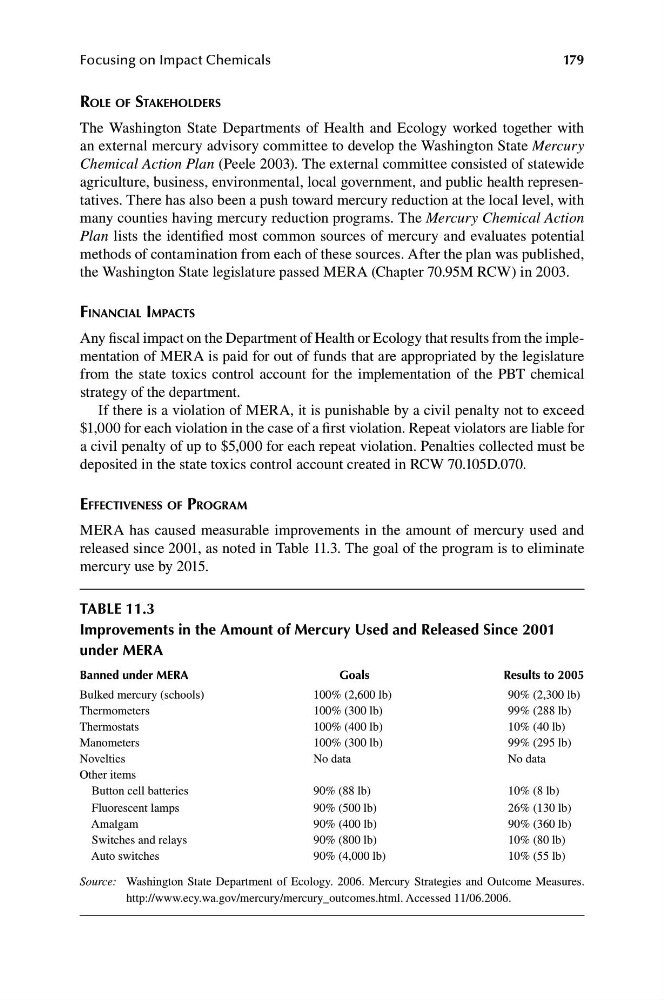
TABLE 11.3
Improvements in the Amount of Mercury Used and Released Since 2001
179
Focusing on Impact Chemicals
ROLE OF STAKEHOLDERS
The Washington State Departments of Health and Ecology worked together with
an external mercury advisory committee to develop the Washington State Mercury
Chemical Action Plan (Peele 2003). The external committee consisted of statewide
agriculture, business, environmental, local government, and public health representatives. There has also been a push toward mercury reduction at the local level, with
many counties having mercury reduction programs. The Mercury Chemical Action
Plan lists the identified most common sources of mercury and evaluates potential
methods of contamination from each of these sources. After the plan was published,
the Washington State legislature passed MERA (Chapter 70.95M RCW) in 2003.
FINANCIAL IMPACTS
Any fiscal impact on the Department of Health or Ecology that results from the implementation of MERA is paid for out of funds that are appropriated by the legislature
from the state toxics control account for the implementation of the PBT chemical
strategy of the department.
If there is a violation of MERA, it is punishable by a civil penalty not to exceed
$1,000 for each violation in the case of a first violation. Repeat violators are liable for
a civil penalty of up to $5,000 for each repeat violation. Penalties collected must be
deposited in the state toxics control account created in RCW 70.105D.070.
EFFECTIVENESS OF PROGRAM
MERA has caused measurable improvements in the amount of mercury used and
released since 2001, as noted in Table 11.3. The goal of the program is to eliminate
mercury use by 2015.
under MERA
Banned under MERA
Goals
Results to 2005
Bulked mercury (schools)
100% (2,600 lb)
90% (2,300 lb)
Thermometers
100% (300 lb)
99% (288 lb)
Thermostats
100% (400 lb)
10% (40 lb)
Manometers
100% (300 lb)
99% (295 lb)
Novelties
No data
No data
Other items
Button cell batteries
90% (88 lb)
10% (8 lb)
Fluorescent lamps
90% (500 lb)
26% (130 lb)
Amalgam
90% (400 lb)
90% (360 lb)
Switches and relays
90% (800 lb)
10% (80 lb)
Auto switches
90% (4,000 lb)
10% (55 lb)
Source: Washington State Department of Ecology. 2006. Mercury Strategies and Outcome Measures.
http://www.ecy.wa.gov/mercury/mercury_outcomes.html. Accessed 11/06.2006.
Improvements in the Amount of Mercury Used and Released Since 2001
179
Focusing on Impact Chemicals
ROLE OF STAKEHOLDERS
The Washington State Departments of Health and Ecology worked together with
an external mercury advisory committee to develop the Washington State Mercury
Chemical Action Plan (Peele 2003). The external committee consisted of statewide
agriculture, business, environmental, local government, and public health representatives. There has also been a push toward mercury reduction at the local level, with
many counties having mercury reduction programs. The Mercury Chemical Action
Plan lists the identified most common sources of mercury and evaluates potential
methods of contamination from each of these sources. After the plan was published,
the Washington State legislature passed MERA (Chapter 70.95M RCW) in 2003.
FINANCIAL IMPACTS
Any fiscal impact on the Department of Health or Ecology that results from the implementation of MERA is paid for out of funds that are appropriated by the legislature
from the state toxics control account for the implementation of the PBT chemical
strategy of the department.
If there is a violation of MERA, it is punishable by a civil penalty not to exceed
$1,000 for each violation in the case of a first violation. Repeat violators are liable for
a civil penalty of up to $5,000 for each repeat violation. Penalties collected must be
deposited in the state toxics control account created in RCW 70.105D.070.
EFFECTIVENESS OF PROGRAM
MERA has caused measurable improvements in the amount of mercury used and
released since 2001, as noted in Table 11.3. The goal of the program is to eliminate
mercury use by 2015.
under MERA
Banned under MERA
Goals
Results to 2005
Bulked mercury (schools)
100% (2,600 lb)
90% (2,300 lb)
Thermometers
100% (300 lb)
99% (288 lb)
Thermostats
100% (400 lb)
10% (40 lb)
Manometers
100% (300 lb)
99% (295 lb)
Novelties
No data
No data
Other items
Button cell batteries
90% (88 lb)
10% (8 lb)
Fluorescent lamps
90% (500 lb)
26% (130 lb)
Amalgam
90% (400 lb)
90% (360 lb)
Switches and relays
90% (800 lb)
10% (80 lb)
Auto switches
90% (4,000 lb)
10% (55 lb)
Source: Washington State Department of Ecology. 2006. Mercury Strategies and Outcome Measures.
http://www.ecy.wa.gov/mercury/mercury_outcomes.html. Accessed 11/06.2006.