

11
Focusing on Impact
Chemicals
INTRODUCTION
Successful toxic chemical use reduction programs target those chemicals that have
the greatest potential toxic impact. Basing programs on total poundage of chemicals,
versus a basis on toxicity, could result in reduction efforts focused on high-volume,
low-toxicity releases. Under this scenario, one could conceivably reduce the total
volume of a chemical by replacing the chemical, which may have a low toxicity, with
a smaller volume of a much more toxic compound.
This chapter presents existing toxic chemical use reduction programs that have
focused on impact chemicals, including the basis for the program, program requirements, the role of stakeholders, financial impacts, and the effectiveness of the program.
U.S. ENVIRONMENTAL PROTECTION AGENCY 33/50 PROGRAM
The U.S. Environmental Protection Agency (USEPA) 33/50 Program (USEPA 1999)
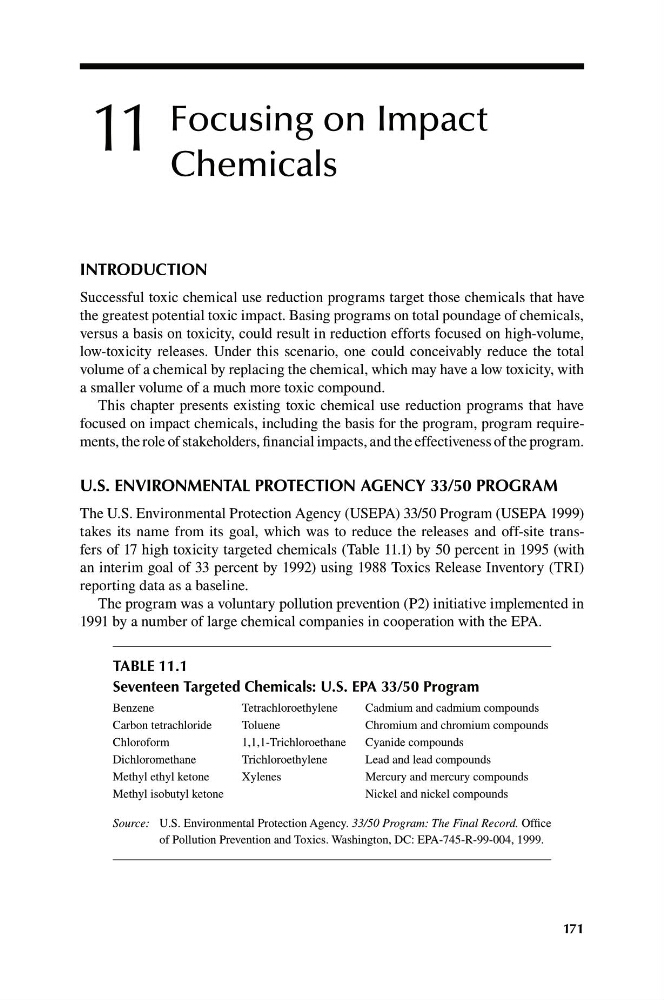
takes its name from its goal, which was to reduce the releases and off-site transfers of 17 high toxicity targeted chemicals (Table 11.1) by 50 percent in 1995 (with
an interim goal of 33 percent by 1992) using 1988 Toxics Release Inventory (TRI)
reporting data as a baseline.
The program was a voluntary pollution prevention (P2) initiative implemented in
1991 by a number of large chemical companies in cooperation with the EPA.
TABLE 11.1
Seventeen Targeted Chemicals: U.S. EPA 33/50 Program
Benzene
Tetrachloroethylene
Cadmium and cadmium compounds
Carbon tetrachloride
Toluene
Chromium and chromium compounds
Chloroform
1,1,1-Trichloroethane
Cyanide compounds
Dichloromethane
Trichloroethylene
Lead and lead compounds
Methyl ethyl ketone
Xylenes
Mercury and mercury compounds
Methyl isobutyl ketone
Nickel and nickel compounds
Source: U.S. Environmental Protection Agency. 33/50 Program: The Final Record. Office
of Pollution Prevention and Toxics. Washington, DC: EPA-745-R-99-004, 1999.
171
Focusing on Impact
Chemicals
INTRODUCTION
Successful toxic chemical use reduction programs target those chemicals that have
the greatest potential toxic impact. Basing programs on total poundage of chemicals,
versus a basis on toxicity, could result in reduction efforts focused on high-volume,
low-toxicity releases. Under this scenario, one could conceivably reduce the total
volume of a chemical by replacing the chemical, which may have a low toxicity, with
a smaller volume of a much more toxic compound.
This chapter presents existing toxic chemical use reduction programs that have
focused on impact chemicals, including the basis for the program, program requirements, the role of stakeholders, financial impacts, and the effectiveness of the program.
U.S. ENVIRONMENTAL PROTECTION AGENCY 33/50 PROGRAM
The U.S. Environmental Protection Agency (USEPA) 33/50 Program (USEPA 1999)
takes its name from its goal, which was to reduce the releases and off-site transfers of 17 high toxicity targeted chemicals (Table 11.1) by 50 percent in 1995 (with
an interim goal of 33 percent by 1992) using 1988 Toxics Release Inventory (TRI)
reporting data as a baseline.
The program was a voluntary pollution prevention (P2) initiative implemented in
1991 by a number of large chemical companies in cooperation with the EPA.
TABLE 11.1
Seventeen Targeted Chemicals: U.S. EPA 33/50 Program
Benzene
Tetrachloroethylene
Cadmium and cadmium compounds
Carbon tetrachloride
Toluene
Chromium and chromium compounds
Chloroform
1,1,1-Trichloroethane
Cyanide compounds
Dichloromethane
Trichloroethylene
Lead and lead compounds
Methyl ethyl ketone
Xylenes
Mercury and mercury compounds
Methyl isobutyl ketone
Nickel and nickel compounds
Source: U.S. Environmental Protection Agency. 33/50 Program: The Final Record. Office
of Pollution Prevention and Toxics. Washington, DC: EPA-745-R-99-004, 1999.
171